Introduction
Picture this: July 1916 during the Battle of the Somme. A British infantryman—often called a “Tommy”—climbs out of a trench just before dawn. His rifle is heavy, the ground is wet, and his khaki wool uniform is already soaked from days of rain.
Letters preserved in the Imperial War Museum archives describe soldiers marching through thick mud with uniforms that grew heavier every hour. British troops had entered the First World War with clothing designed for earlier military campaigns, not the harsh trench systems of France and Belgium.
Here's what happened. The war forced the British Army to rethink its uniform design. Early clothing struggled in mud, rain, and artillery bombardments. Over time, the army improved materials, helmets, and equipment. Those improvements later influenced the WW2 British Battle Dress, a uniform built for mobility and protection.
Let's dive into how British uniforms changed from the early WW1 khaki service dress to the more efficient combat clothing used later.
The Problem: British Uniforms That Couldn't Handle the Trenches
Khaki Woes in Mud and Rain
When the war began in 1914, British soldiers wore the Service Dress (SD) uniform, first introduced in 1902. According to historian R. J. Marrion in "British Army Uniforms of World War One", the uniform included:
-
Khaki wool serge tunic
-
Wool trousers
-
Puttees wrapped around the lower legs
-
Leather boots
-
Webbing equipment
The khaki color helped camouflage soldiers better than the bright red uniforms used in earlier wars. But trench warfare exposed several weaknesses.
The wool fabric absorbed water easily. During heavy rain, uniforms became heavier and uncomfortable. A typical Service Dress tunic weighed about 4–5 pounds when dry, according to records cited by the UK National Army Museum. When soaked with rain and mud, it could feel much heavier.
Puttees also trapped moisture and mud. Soldiers often spent hours trying to clean them.
Trench warfare created another issue: artillery fragments. Early uniforms offered little protection against flying shrapnel, which caused many battlefield injuries.
Agitating the Pain: Real Costs to British Troops
Uniform problems did not just cause discomfort. They affected soldier health and effectiveness.
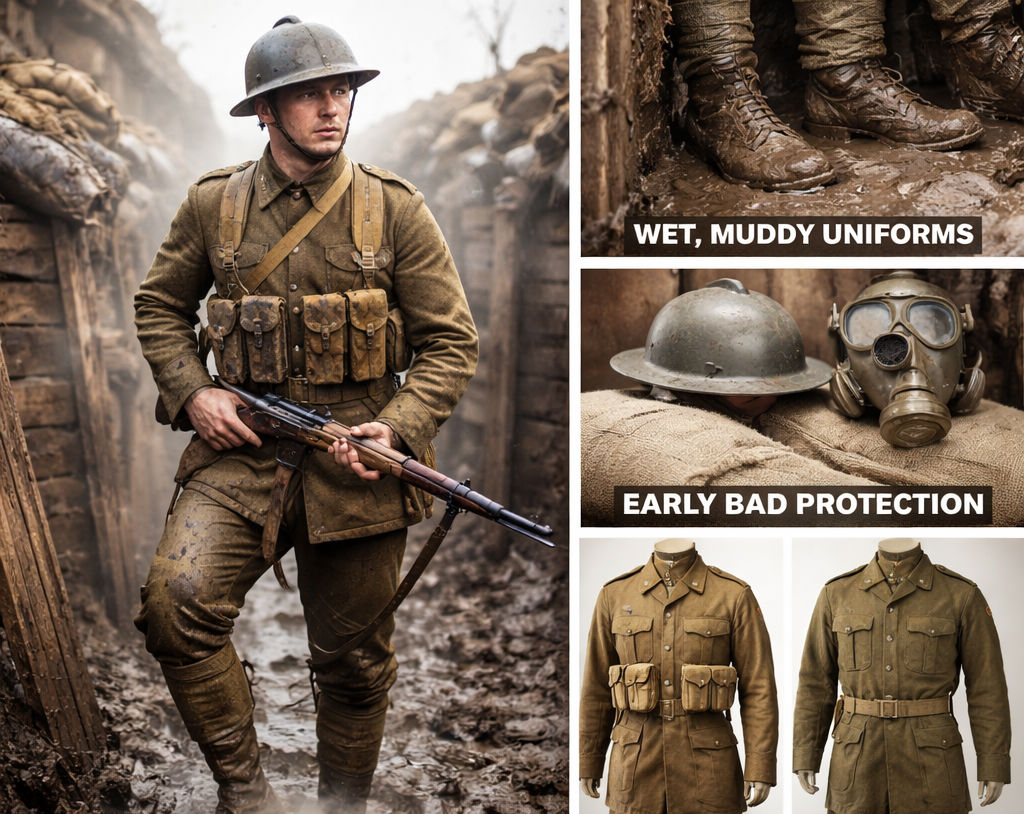
Medical reports from the British Army during the war recorded high cases of trench foot, caused by wet socks and boots. Thousands of soldiers had to be treated for this painful condition.
Heavy clothing also slowed soldiers during attacks or long marches. British infantry already carried equipment loads ranging between 55 and 65 pounds, including rifles, ammunition, rations, and tools.
Add soaked wool uniforms and thick mud, and movement became even harder.
By 1918, the British Army had produced around 12 million uniform sets to supply troops across different fronts. These massive production numbers show how quickly the army had to adapt clothing for millions of soldiers.
Case Study: Passchendaele 1917 Uniform Failures
One of the clearest examples of uniform problems came during the Battle of Passchendaele (Third Battle of Ypres) in 1917.
The battlefield turned into deep mud after constant artillery fire and rain. Soldiers reported sinking knee-deep while moving across the battlefield.
Reports preserved by the Imperial War Museum describe uniforms becoming so heavy with mud that soldiers struggled to move. Boots and puttees often had to be cut off because they were stuck in thick mud.
The experience forced British commanders to rethink equipment and clothing durability for long trench campaigns.
The Solution: Core Features of WW1 British Uniforms
Fabric, Cuts, and Gear Breakdown
Despite early problems, the British Service Dress uniform had several strengths.
The khaki wool serge fabric was durable and warm. Wool kept heat even when slightly wet, which helped soldiers survive cold nights in the trenches.
The tunic design included:
-
Four front pockets for carrying items
-
Brass buttons with regimental insignia
-
Shoulder straps for rank badges
-
A belt system that helped distribute equipment weight
The trousers were loose enough to allow movement, while puttees helped support the lower legs during long marches.
This combination made the uniform practical for large-scale production and field use.
Brodie Helmet and Webb Equipment
One of the most important improvements during the war was the Brodie steel helmet, introduced in 1916.
Before helmets were used widely, soldiers relied on cloth caps for headwear. These offered no protection against shell fragments.
The Brodie helmet changed that.
According to British Army records:
-
Over 7.5 million Brodie helmets were produced during the war.
-
The helmet’s steel shell protected soldiers from falling shrapnel.
-
Its wide brim shielded the head from debris coming from above.
Another major innovation was the 1908 Pattern Web Equipment, commonly called Webb equipment.
This webbing system allowed soldiers to carry:
-
Ammunition pouches
-
Water bottles
-
Entrenching tools
-
Bayonet scabbards
It distributed weight more evenly across the body.
Evolution to WW2: Pros & Cons Comparison
By the late 1930s, the British Army replaced the old Service Dress with the WW2 Battle Dress uniform.
WW1 Service Dress
Pros
-
Durable wool fabric
-
Simple design for mass production
-
Functional pockets
Cons
-
Heavy when wet
-
Limited mobility
-
No early protection from shrapnel
WW2 Battle Dress
Pros
-
Shorter jacket improved movement
-
Stronger fabric blends
-
Better helmet designs
Cons
-
Less pocket space
-
Still heavy compared to modern uniforms
The Battle Dress uniform showed how lessons from WW1 influenced later military clothing.
Real-World Examples: Collectors' Treasures and Auction Wins
Collectors today still search for original British WW1 uniforms.
Example 1: Officer Tunic Auction
A British officer’s 1914 Service Dress tunic sold on eBay for around $1,500, depending on condition and regimental markings.
Example 2: Brodie Helmet Auction
Auction house Spink & Son has sold WW1 Brodie helmets between £250 and £900, depending on markings and paint condition.
Example 3: Imperial War Museum Collection
The Imperial War Museum in London preserves several original uniforms from the Somme and Passchendaele campaigns. Many show repairs and patching done by soldiers in the field.
These artifacts help historians understand how soldiers used their uniforms in real combat situations.
FAQs
1. What fabric was used in British WW1 uniforms?
Most uniforms used khaki wool serge fabric.
2. What helmet did British soldiers wear in WW1?
They wore the Brodie steel helmet, introduced in 1916.
3. How heavy was a British WW1 tunic?
A Service Dress tunic typically weighed 4–5 pounds when dry.
4. How many uniforms were produced during WW1?
Around 12 million British uniform sets were produced during the war.
5. What were puttees?
Puttees were long strips of cloth wrapped around the lower legs.
6. Did WW1 uniforms influence WW2 clothing?
Yes. Lessons from trench warfare helped shape the WW2 Battle Dress uniform.
7. Are WW1 uniforms valuable today?
Yes. Original pieces often sell for hundreds or thousands of dollars depending on condition.
Conclusion
British WW1 uniforms show how quickly armies had to adapt to modern warfare. Early Service Dress clothing worked well for traditional campaigns but struggled in the muddy trenches of France and Belgium.
Over time, improvements like the Brodie helmet, stronger webbing equipment, and better gear design helped protect soldiers and improve mobility. These lessons directly influenced the WW2 Battle Dress uniform, which focused on practicality and movement.
For collectors and eBay sellers today, authenticity matters. Look for original buttons, regimental badges, and period stitching. Museums and auction records remain useful references when identifying genuine WW1 British uniforms.
