Introduction: What If Your Uniform Failed in Battle?
Imagine standing in freezing rain. Your coat is soaked. Mud pulls at your boots. Your gear feels heavier every hour.
That was reality for many British soldiers in World War I.
Uniforms were not just clothing. They were survival tools. If the fabric held water, you froze. If boots cracked, your feet suffered. If gear straps cut into your shoulders, you slowed down.
British WW2 uniforms did not appear out of nowhere. They came from years of trial, error, and real losses. From bright red coats in the 1800s to muddy khaki in WWI, the British Army learned hard lessons.
So what changed by World War II? And did those changes really protect soldiers better?
Let’s walk through it.
Roots in 1800s British Military Uniforms
In the early 1800s, British soldiers wore red wool tunics. These were practical for line battles where units stood in formation. Red dye was cheap and easy to produce at scale.
But red coats had problems:
-
Easy target for rifles
-
Heavy wool in warm climates
-
Limited camouflage
During colonial wars in India and Africa, soldiers began wearing khaki drill uniforms. Khaki means “dust colored.” It blended better with dry landscapes.
By the late 1800s, khaki replaced red for active service.
Lesson learned: visibility could cost lives.
WWI Changes and Lessons
When World War I began in 1914, British soldiers wore khaki wool service dress.
Features:
-
Wool tunic and trousers
-
Puttees (cloth leg wraps)
-
Leather boots
-
Webbing gear for ammunition
Wool worked in cold weather but caused issues in trenches:
-
Heavy when wet
-
Slow to dry
-
Limited flexibility
Trench foot became a serious issue. British medical records from 1914–1915 report over 20,000 cases during the first winter alone.
That number shocked leadership.
Puttees also took time to wrap. Mud reduced their effectiveness. Soldiers reported discomfort during long marches.
WWI proved something simple: a uniform had to work in mud, cold, and constant movement.
WW2 Battle Dress Features
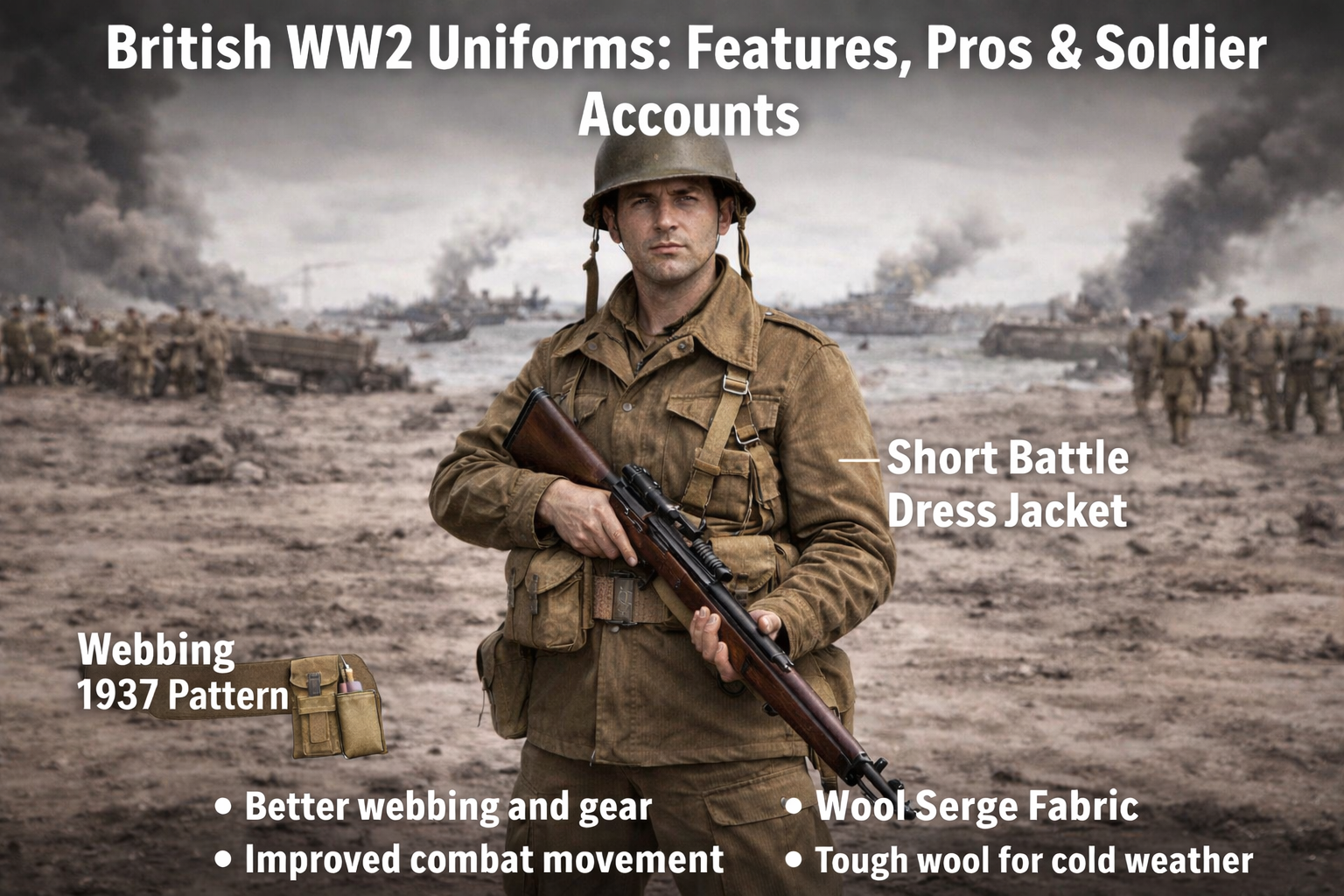
By 1939, Britain introduced the 1937 Pattern webbing and soon after the 1940 Pattern Battle Dress (BD).
Battle Dress (BD) 1940 Pattern
Specifications:
-
Made from wool serge
-
Short blouse-style jacket
-
High waist trousers
-
Large map pocket on left leg
-
Blouse pockets with flaps
The shorter jacket improved movement inside vehicles and tanks. It also reduced fabric use, which mattered during rationing.
British records show millions of BD sets produced between 1940 and 1945. Textile factories across the UK worked under wartime production control.
1937 Pattern Webbing
This webbing replaced older leather gear.
Features:
-
Cotton web straps
-
Ammunition pouches
-
Water bottle carrier
-
Pack system
Cotton webbing was lighter than leather and easier to produce in large numbers.
By 1940, standardization allowed faster issue to new recruits.
Features: Design and Materials
Let’s break it down clearly.
Fabric
-
Wool serge for temperate climates
-
Khaki drill (KD) cotton for hot climates like North Africa
-
RAF uniforms made from blue-grey wool
Wool still had limits. It was warm but could absorb rain. But improved weaving made it slightly lighter than WWI versions.
Fit and Structure
-
Shorter jackets improved mobility
-
Trousers reinforced at stress points
-
Strong stitching for field repairs
Boots
British soldiers wore ankle boots with web gaiters instead of puttees. This improved speed when dressing and reduced mud issues.
Helmets
The Mk II steel helmet replaced earlier designs. It offered better coverage and mass production efficiency.
Production numbers during the war reached millions to equip British forces and Commonwealth troops.
Pros and Cons of British WW2 Uniforms
Pros
-
Short jacket improved movement
-
Webbing lighter than leather
-
Khaki drill better for desert heat
-
Standardized production across Britain
-
Easier mass supply during 1940–1945
Cons
-
Wool still heavy in rain
-
Desert uniforms faded quickly
-
Early shortages during 1940 evacuation
-
Not fully waterproof
No uniform solved weather completely. But compared to WWI, design improved.
Real Soldier Stories
1. Dunkirk Evacuation (1940)
During the Dunkirk evacuation, over 338,000 Allied troops were rescued.
Many British soldiers wore early war Battle Dress and 1937 webbing. Reports mention equipment loss in water during evacuation.
Wool uniforms became soaked crossing beaches. However, the short BD jacket allowed easier movement while boarding ships compared to older long coats.
Dunkirk exposed supply gaps. Afterward, production increased sharply across British factories.
2. North Africa Campaign
Heat in North Africa forced uniform change.
British troops wore khaki drill cotton uniforms. Cotton handled heat better than wool.
However:
-
Sun faded fabric
-
Sand wore down stitching
-
Boots suffered from dry cracking
Still, cotton KD reduced heat stress compared to wool serge.
Units like the Eighth Army relied heavily on KD uniforms during 1942 battles such as El Alamein.
3. Battle of Britain Pilots
RAF pilots wore blue-grey wool uniforms with flight gear layered on top.
Fighter pilots also wore:
-
Mae West life jacket
-
Parachute harness
-
Sheepskin flying jacket in colder months
Pilots needed freedom of arm movement. Wool uniforms under flight jackets allowed layering.
During 1940, RAF uniform production scaled quickly as aircrew numbers increased.
Comparison Snapshot: 1800s to WW2
-
1800s: Red wool tunics, line warfare
-
WWI: Khaki wool, trench focus
-
WW2: Short battle dress, web gear, climate-based options
The shift moved from appearance to function.
FAQs
1. What was the main British WW2 uniform?
The 1940 Pattern Battle Dress with 1937 Pattern webbing.
2. Why did Britain stop using red coats?
They were easy targets in modern warfare.
3. Was WW2 uniform better than WWI?
Yes. It improved movement and standardized gear.
4. What fabric was used?
Mainly wool serge and cotton khaki drill.
5. Did desert troops wear wool?
Mostly cotton khaki drill in hot climates.
6. What helmet did British soldiers wear?
The Mk II steel helmet.
7. Were uniforms waterproof?
No. Wool absorbed rain, and cotton had limits.
Conclusion: The Solution Came From Hard Lessons
British uniforms changed because they had to.
Red coats failed against rifles. WWI wool failed in wet trenches. Soldiers paid the price in cold, mud, and illness.
By World War II, Britain responded with practical design. Short battle dress jackets. Cotton webbing. Climate-based uniforms. Standardized mass production.
Were they perfect? No.
But they worked better. Soldiers moved faster. Gear was lighter. Factories kept up with demand.
If you study military history or collect British WW2 gear, look at the stitching, fabric weight, and pocket design. Each detail tells a story of lessons learned in earlier wars.
Uniforms are not just cloth. They are answers to problems written in battle reports.
What do you think—did WW2 British uniforms finally get it right? Share your thoughts!
