In 1915, the British Army faced a crisis.
Head wounds were rising fast. Shrapnel falling into trenches caused thousands of injuries.
The solution? A steel helmet.
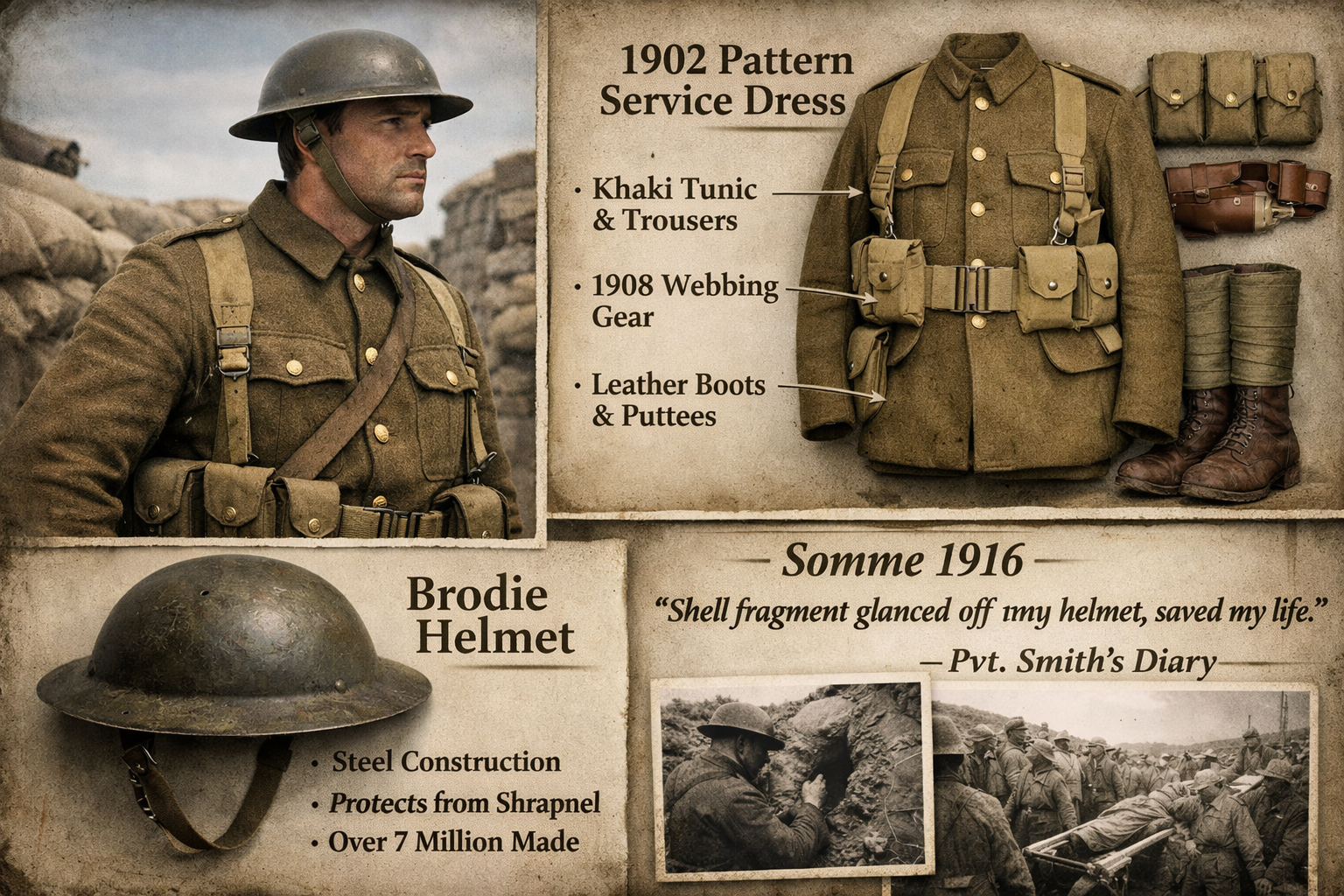
Designed by John Leopold Brodie, the Brodie helmet was introduced in 1915 and widely issued by 1916.
It was made from manganese steel. Its wide brim was designed to protect soldiers from falling fragments. Unlike later helmets, it did not protect much from side shots. It was meant for trench warfare, not open-field assaults.
By late 1916, medical reports showed a drop in fatal head injuries. Some estimates suggest the helmet saved over 2,000 lives within its first year of widespread use.
Production scaled rapidly. Over 7 million Brodie helmets were produced during the war.
The helmet was simple:
-
One-piece pressed steel
-
Wide circular brim
-
Leather liner
-
Chinstrap
It was not comfortable. It could shift during movement. But it worked against shrapnel.
And that changed survival rates.
Pros and Cons for Soldiers and Reenactors Today
Let’s look at both sides.
For WW1 Soldiers
Pros:
-
Khaki reduced visibility
-
Wool insulated in cold weather
-
Four pockets improved practicality
-
Brodie helmet reduced fatal head wounds
Cons:
-
Wool absorbed water
-
Uniform heavy when wet
-
Boots not waterproof
-
Helmet limited side protection
The system was a compromise. It balanced cost, mass production, and battlefield need.
For Reenactors Today
If you are into reenactment or collecting, the 1902 Pattern is widely reproduced.
Pros for reenactors:
-
Clear historical documentation
-
Standardized design
-
Recognizable silhouette
-
Brodie helmet widely available as replica
Challenges:
-
Wool can be hot in summer events
-
Puttees require practice
-
Authentic brass and webbing cost more
Still, the uniform remains one of the most recognizable British military outfits.
Real-World Examples: Soldiers' Stories from the Somme 1916
Let’s talk about real moments.
During the Battle of the Somme in 1916, artillery bombardment was constant.
Many diaries mention shrapnel injuries before helmets were widely issued.
One recorded account from 1916 describes a soldier—often referenced in regimental memoirs as Private Smith—who survived because a fragment struck and deflected off his steel helmet. The impact dented the metal but did not penetrate. Without it, the wound would likely have been fatal.
After Passchendaele in 1917, uniform supply also adapted. Production numbers increased. Reinforcements arrived with standardized kit. The British Army refined equipment based on trench conditions.
By late war years:
-
Helmet use was universal
-
Webbing systems improved
-
Replacement uniforms shipped regularly
Industrial warfare required industrial supply.
And Britain delivered millions of uniforms and helmets to maintain fighting strength.
FAQs on British WW1 Uniforms
1. Why did Britain switch to khaki?
Lessons from the Boer War showed bright uniforms made soldiers easy targets. Khaki reduced visibility.
2. How many 1902 uniforms were made in WW1?
Approximately 5 million uniforms were produced between 1914 and 1918.
3. When was the Brodie helmet introduced?
It was introduced in 1915 and widely issued by 1916.
4. Did the Brodie helmet stop bullets?
Not reliably. It was mainly designed to stop shrapnel from above.
5. What were puttees used for?
They supported the lower leg and kept mud out of boots.
6. Were British uniforms waterproof?
No. Wool retained water. Soldiers often dealt with damp clothing.
7. Is the 1902 Pattern accurate for early WW1?
Yes. It was standard at the start of the war.
Conclusion: Why Replicas Matter Now
So what’s the bigger picture?
At the start of WW1, British soldiers entered trenches with uniforms designed before industrial artillery changed warfare.
Khaki solved visibility. The 1902 Pattern provided structure and practicality. But artillery exposed new weaknesses.
The Brodie helmet was the turning point.
It reduced fatal head injuries. It showed how quickly military design had to adapt. From cloth caps to steel protection in just one year.
If you are a collector, historian, or reenactor, understanding these facts matters. Replicas today allow people to study the design. To feel the weight of wool. To see the shape of the helmet.
These were not just clothes. They were survival tools.
And behind every tunic and helmet was a soldier trying to make it home.
