GENERAL WWI BRITISH UNIFORMS COMPARED TO WW2 SAS EQUIPMENT
Introduction: The Collector’s Problem
Let’s be honest. The British Army uniform story is not simple.
You might see a khaki wool tunic and think, “WWI.” Then you see a rough desert jacket and think, “SAS.” But over time, items were reused, altered, or copied. After both wars, surplus gear flooded markets. Reproductions followed.
The problem? Many collectors and even reenactors struggle to understand how general WWI British soldier kits evolved into later WW2 special forces gear. The cloth changed. The webbing changed. The markings changed. Even the purpose changed.
If you misread those details, you can end up paying WWI prices for a post-war copy. Or you might label a WW2 item as WWI in your display. That damages value and history.
So let’s fix it. We’ll break down what a general WWI British soldier wore. Then we’ll look at WW2 SAS gear. Then we’ll compare them using real cases from 1914 to 1944. Simple. Clear. Practical.
WWI British Soldier Kits: What Was Standard?
When Britain entered the war in August 1914, the standard field uniform was simple.
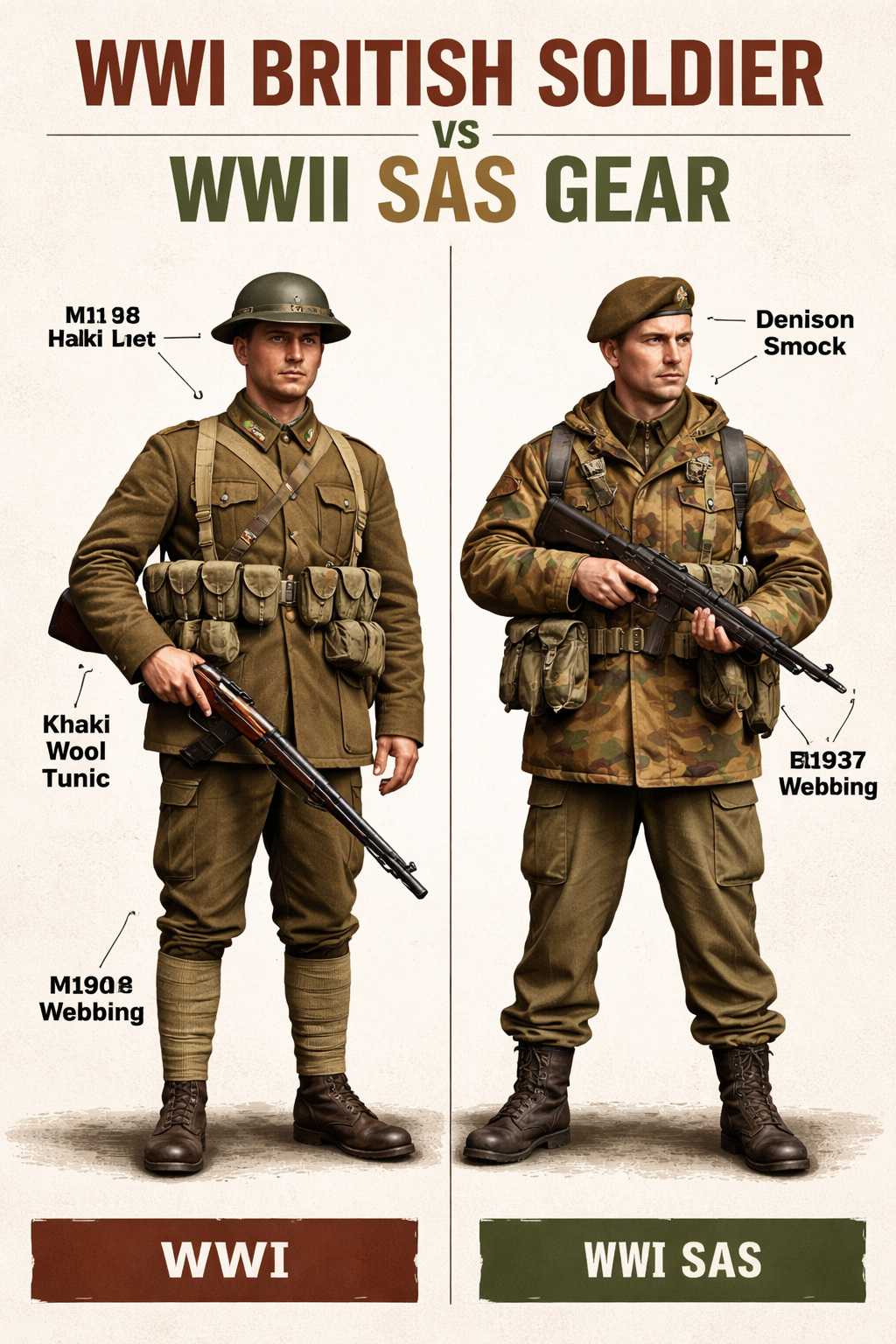
The core item was the khaki wool service dress tunic. It was made of wool serge, usually around 18–20 ounces per yard. The color was plain khaki. Early war tunics had stand-and-fall collars and brass general service buttons.
Trousers matched the tunic. Puttees wrapped around the lower legs. Boots were ankle boots with hobnails.
Webbing was key. The 1908 Pattern webbing system carried ammunition, water bottle, entrenching tool, and bayonet. It was made of woven cotton webbing in a khaki tone. Buckles were brass.
Case Study 1: Horrocks’ Patrol, 1914
In October 1914, a unit later known as Horrocks’ Patrol operated near Ypres. Photographs and surviving pieces in the Imperial War Museum collection show early war service dress. The tunics still had bright brass buttons. Some men wore soft service dress caps instead of steel helmets.
Markings from this period often include a date stamp such as “1914” or “1915” inside the tunic, along with a broad arrow mark indicating government property.
For you as a collector, that date stamp matters. A tunic without internal stamps but claimed as 1914 should raise questions.
Case Study 2: Battle of the Somme, 1916
By 1916, changes appeared. Steel helmets, known as the Brodie helmet, became standard after heavy head injuries in trench warfare. Surviving Somme-era uniforms in museum collections show wear from mud and repairs.
Labels inside often include contractor names and size numbers. The cloth remained wool, but production scaled up. Quality sometimes varied.
If you’re checking a WWI tunic, look for period stitching. Machine stitching from 1916 differs from modern reproduction thread and patterns.
The Risk: Misreading WWI Uniforms
Here’s where things get risky.
Post-war surplus uniforms were altered for civilian use. Buttons were replaced. Badges were removed. Some WWI tunics were later reissued during WW2 for training units.
If you ignore small details, you might buy a reissued or modified piece as untouched WWI.
Another issue is reproduction gear. Many reenactment suppliers produce service dress tunics. These often use modern wool blends and lack proper internal markings.
So what should you check?
-
Broad arrow property mark
-
Clear wartime date stamp
-
Correct brass buttons with period back marks
-
Original stitching around pockets and collar
Miss these, and you risk a bad buy.
WW2 SAS Gear: Built for Raids, Not Trenches
Now let’s jump forward to WW2.
The Special Air Service (SAS) formed in 1941. Their role was different from trench infantry. They carried out raids in North Africa and later in France.
So their clothing reflected that role.
Instead of standard wool service dress, SAS men often wore lighter desert kit. This included khaki drill shorts, shirts, and sometimes Arab headscarves. Later in Europe, they wore battledress and items like the Denison smock.
The Denison smock was made from heavy cotton cloth with a printed pattern. It had a half-zip front and knitted cuffs.
Webbing also evolved. The 1937 Pattern webbing replaced the 1908 set. It used brass fittings and cotton webbing but had a different layout.
Case Study 3: North Africa SAS Raids, 1942
Photos from SAS raids on Axis airfields in 1942 show men wearing mixed gear. Some wore standard British battledress. Others wore desert shirts and shorts. The heat shaped the kit.
Imperial War Museum images show 1937 Pattern webbing with simple rank insignia. You will not see WWI-style puttees. Instead, you often see short boots or desert boots.
If someone offers you “WWI SAS desert gear,” that’s a red flag. SAS did not exist in WWI.
Case Study 4: Operation Loyton, 1944
Operation Loyton took place in the Vosges region of France in 1944. SAS troops wore battledress blouses and sometimes Denison smocks. Surviving pieces linked to this operation show printed pattern cloth and parachute wings insignia.
These smocks often have 1943 or 1944 dated labels. The cloth is not wool serge. It is printed cotton.
That material difference alone separates WW2 SAS gear from WWI service dress.
The Agitation: Why Confusion Costs You
Let’s talk money.
Original WWI tunics can sell for high prices, especially early war dated examples. SAS gear linked to named operations can sell for even more.
If you misidentify a standard 1940s battledress as SAS raid gear, you could overpay. If you mistake a reproduction Denison smock for a wartime one, you might lose hundreds or more.
There’s also the history side. If you display a WWI mannequin wearing 1937 Pattern webbing, you distort the story.
Small differences matter:
-
WWI webbing: 1908 Pattern
-
WW2 webbing: 1937 Pattern
-
WWI tunic: wool serge
-
WW2 SAS smock: printed cotton
Ignore that, and your collection loses accuracy.
Collectors have reported cases where buttons were swapped to fake earlier dates. Others found that internal labels were removed to hide post-war origin.
It’s frustrating. But you can avoid it with clear checks.
The Solution: Clear Comparison and Practical Tips
Let’s make it simple.
Fabric
WWI general soldier kit:
-
Khaki wool serge tunic
-
Wool trousers
-
Heavy cloth built for cold trenches
WW2 SAS gear:
-
Cotton drill for desert
-
Printed cotton for Denison smock
-
Standard battledress wool in Europe
Touch the cloth. Wool feels dense and warm. Cotton drill feels lighter.
Webbing
WWI: 1908 Pattern webbing. Wide pouches for .303 ammunition. Brass fittings.
WW2 SAS: 1937 Pattern webbing. Different pouch shape. Updated layout.
Lay them side by side if possible. The difference is clear once you know it.
Markings
WWI pieces often show:
-
Broad arrow mark
-
Early date stamps 1914–1918
WW2 SAS gear often shows:
-
1940s date stamps
-
Parachute or SAS insignia
Check inside seams. Check under collars. Don’t rely on external badges alone. Badges are easy to add later.
Case Study 5: Museum-Verified Comparison
In collections where both a 1916 service dress tunic and a 1944 Denison smock are stored, the contrast is clear. The 1916 tunic is structured, buttoned, and formal in cut. The 1944 smock is loose, pull-over style, built for mobility.
Seeing both together teaches you fast. If possible, visit a museum or study high-resolution archive photos.
Buying Tips for You
-
Ask for clear photos of internal labels.
-
Compare webbing pattern numbers.
-
Verify insignia placement with period photos.
-
Be cautious of items with no markings at all.
-
Cross-check dates with known operations.
If a seller claims “Somme 1916” but the webbing is 1937 Pattern, walk away.
If a Denison smock has a modern zip instead of period hardware, question it.
Stay calm. Stay methodical.
Conclusion: Know the Story, Protect Your Collection
At first glance, khaki cloth from two wars can look similar. But when you slow down and compare details, the story becomes clear.
WWI British soldier kits were built for trench warfare. Wool serge tunics. 1908 webbing. Brodie helmets.
WW2 SAS gear was built for raids and movement. Cotton drill. 1937 webbing. Denison smocks.
Real cases like Horrocks’ Patrol in 1914 and Operation Loyton in 1944 show how gear evolved with the mission.
The problem is confusion. The risk is costly mistakes and lost history. The solution is knowledge and careful checking.
Next time you hold a tunic or smock, don’t rush. Check fabric. Check markings. Compare webbing. Match dates to known events.
Do that, and you won’t just own an item. You’ll understand it. And that’s what serious collecting is really about.
