Introduction: The Real Problem Collectors Face
You find a WW1 olive drab coat online. The seller says it is original. The price is high. The photos look fine. But how do you know?
Or maybe you see a dark blue 19th-century frock coat with brass buttons. The tag says “Civil War era.” But is it really from the 1860s? Or made 100 years later?
This is the main problem. Many collectors struggle with identification. Small differences matter. Fabric type. Stitch style. Branch color. Issue year. Button backmarks. If you miss one detail, you can overpay.
The issue gets worse because both WW1 and 19th-century uniforms changed over time. The US Army updated regulations many times in the 1800s. In 1917 and 1918, wartime production created variations in wool shade and stitching.
Let’s break it down clearly. First, we compare WW1 Army uniforms by branch. Then we step back to 19th-century blue uniforms. After that, we look at real unit examples and practical tips.
WW1 Uniform Branches
When the US entered World War I in 1917, the Army shifted fully to olive drab field service clothing.
Infantry Features
The standard WW1 service coat was the Model 1917 wool service coat. It was made from olive drab wool serge. It had four front pockets and bronze US buttons.
Infantry branch color was light blue. You see this on collar discs and sometimes on piping. Enlisted men wore round bronze collar discs with “U.S.” on one side and crossed rifles for Infantry on the other.
The 77th Infantry Division, formed in 1917 from draftees in New York, wore standard olive drab service coats. Surviving coats in museum collections show division shoulder patches added later in 1918. The 77th used a Statue of Liberty patch design.
Trousers were olive drab wool breeches. Soldiers wore puttees (cloth leg wraps) in early stages of the war.
Pros of Wool Design
-
Durable in field use
-
Neutral color for camouflage
-
Standardized production under wartime contracts
Cons of Wool Design
-
Heavy when wet
-
Shrinks if poorly stored
-
Moth damage over time
Artillery and Cavalry Differences
Artillery branch color was red. Crossed cannons appeared on collar discs. Cavalry branch color was yellow, with crossed sabers.
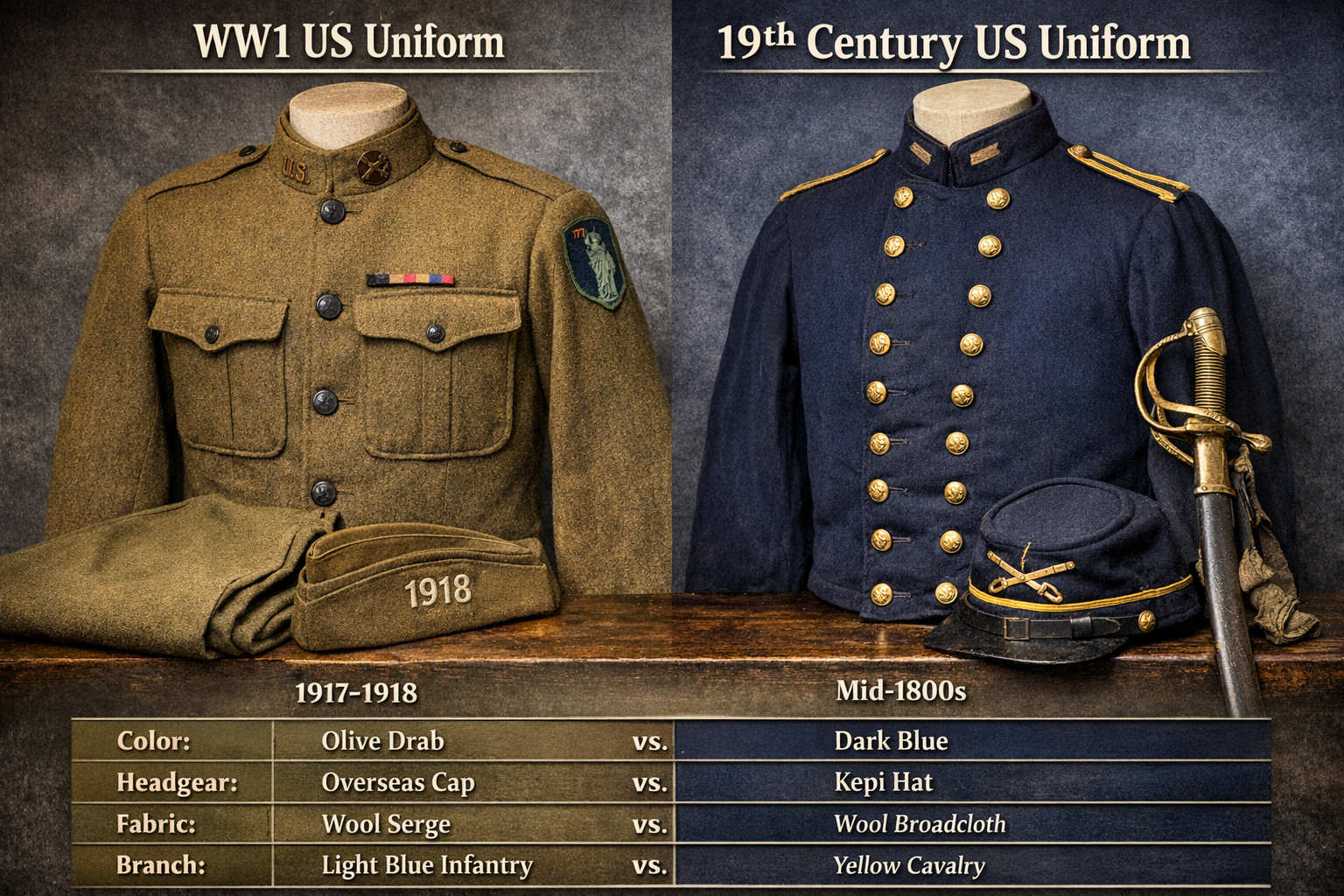
Mounted units often wore breeches designed for riding. The 1st Cavalry Regiment had earlier blue uniforms in the 1800s but by WW1 period cavalry elements used olive drab like the rest of the Army.
Officers’ coats were similar but made from finer wool. Officers purchased uniforms privately but followed Army regulations.
Headgear included:
-
Campaign hat (broad brim, Montana peak style)
-
Overseas cap (side cap, introduced during the war in France)
Original overseas caps often show contract stamps inside the lining dated 1917 or 1918.
19th-Century US Army Uniforms
Before olive drab, the Army wore dark blue wool as standard field and dress color.
Blue Frock Coats
In the mid-1800s, Infantry soldiers wore dark blue wool frock coats. These coats extended below the waist and had nine brass buttons down the front for enlisted men under 1858 regulations.
Buttons often had an eagle with shield design. Originals usually show backmarks from makers such as “Waterbury Button Co.” Collectors check button backs closely.
Fabric was heavy wool broadcloth. It is thicker than WW1 wool serge. Stitching is hand-finished in many examples before industrial mass production increased.
Kepi and Headgear
The kepi, a short cap with a flat top and visor, became common during the Civil War. Infantry kepis had light blue trim. Artillery had red trim. Cavalry used yellow.
Later in the 1870s and 1880s, uniform styles changed again. Sack coats replaced frock coats for fatigue wear.
Comparing WW1 and 19th-Century Designs
Here is a simple comparison:
| Feature | WW1 Uniform | 19th Century Uniform |
|---|---|---|
| Main Color | Olive drab | Dark blue |
| Fabric | Wool serge | Wool broadcloth |
| Headgear | Campaign hat, overseas cap | Kepi, forage cap |
| Branch ID | Collar discs | Hat cords, piping |
| Coat Length | Waist length | Long frock style |
You can see a clear shift. The Army moved from bright branch colors and long coats to simpler field-ready clothing.
Real-World Case Studies
Case Study 1: 77th Division Service Coat
A verified WW1 service coat linked to the 77th Infantry Division is held in US museum collections. The coat includes:
-
Olive drab wool serge
-
1918 dated contract label
-
Division shoulder patch
-
Bronze US and crossed rifles discs
The patch was sewn by hand, showing wartime modification.
Collectors check for correct wool weave and period stitching when evaluating similar coats.
Case Study 2: 1st Cavalry 19th-Century Dress
The 1st Cavalry Regiment, formed in 1855, originally wore dark blue coats with yellow trim. Surviving examples show:
-
Yellow piping on trousers
-
Brass eagle buttons
-
Heavy wool broadcloth
Original pieces often show age wear consistent with mid-1800s fabric aging patterns. Reproductions usually use modern machine stitching and lighter cloth.
Case Study 3: Smithsonian Civil War Infantry Coat
The Smithsonian National Museum of American History preserves Civil War infantry coats made of dark blue wool. These examples confirm:
-
Nine-button front for enlisted
-
Hand-sewn buttonholes
-
Light blue trim for Infantry
When you compare to reproductions, buttonhole stitching and wool thickness are key signs.
Pros & Cons for Collectors
WW1 Uniforms
Pros
-
More surviving examples
-
Easier to match with photos from 1917–1918
-
Division patches add research value
Cons
-
Many post-war surplus items
-
Reproductions for reenactors
-
Moth damage common
19th-Century Uniforms
Pros
-
Strong historical interest
-
Clear branch color system
-
Museum-documented regulations
Cons
-
High prices
-
Fakes with artificial aging
-
Harder to find full original sets
FAQs
1. How can you tell WW1 wool from later wool?
Check weave pattern and contract labels. WW1 serge has a diagonal twill weave.
2. Are all blue coats from the 1800s Civil War era?
No. Blue was used before and after the Civil War. Always check regulation year and button style.
3. Did all WW1 soldiers wear overseas caps?
No. Many wore campaign hats early in the war.
4. What branch color was Infantry in both eras?
Light blue.
5. Did Cavalry always use yellow trim?
Yes, yellow identified Cavalry in the 19th century and continued in branch systems later.
6. Are division patches common on WW1 coats?
They appear mostly in late 1918 and post-war occupation uniforms.
7. Is condition more important than completeness?
For value, both matter. Heavy moth damage reduces price.
Conclusion: Know the Details Before You Buy
You now see the clear difference. WW1 uniforms used olive drab wool serge and simple field designs. 19th-century uniforms used dark blue wool broadcloth and bright branch trim.
If you collect, focus on fabric weight, stitching type, button backmarks, and documented unit history. Use museum examples and Army regulations as your guide. Small details protect your money.
Research first. Compare carefully. Ask questions.
And when you find a good piece, share your uniform finds in the comments!
