Introduction: The Real Problem Soldiers Faced
Ever wonder what it felt like to fight a war in heavy wool clothing that stayed wet for days?
In World War I, US soldiers wore olive drab wool tunics and breeches. The 1917 service coat was made from wool serge, usually around 18–20 ounces per yard. It worked in cool weather, but once soaked in rain or mud, it dried slowly. In France during 1918, soldiers reported trench foot and skin infections partly due to wet clothing and boots, according to US Army medical records.
That was the problem.
Clothing was not just about looks. It affected survival. If a jacket trapped water, a soldier froze. If boots cracked, feet rotted. If fabric tore, it meant exposure.
By the time the United States entered World War II in December 1941, the Army knew it needed change. Over 16 million Americans would serve during WWII. The uniform had to work in deserts, jungles, snow, and city streets.
So what did they fix? And did it actually help?
Let’s break it down.
Evolution from World War I to World War II
In World War I, the standard US Army uniform included:
-
Olive drab wool service coat (Model 1917)
-
Wool breeches
-
Puttees (cloth leg wraps)
-
Hobnailed leather boots
-
Campaign hat or steel helmet (M1917)
This system was based heavily on European designs. It worked in trenches but had limits.
Problems reported in WWI:
-
Wool shrank or stiffened when wet
-
Puttees took time to wrap
-
Boots lacked strong water resistance
-
Limited cold-weather layering system
By World War II, the Army moved toward a more flexible system.
Instead of one heavy uniform, WWII introduced:
-
Layered clothing options
-
Field jackets instead of formal coats
-
Cotton-based work uniforms
-
Standardized combat boots
-
Mass production with improved sizing charts
Between 1940 and 1945, the US produced over 8 million M1 steel helmets and millions of field jackets and boots. Industrial output shaped uniform design as much as battlefield need.
Key World War II Features
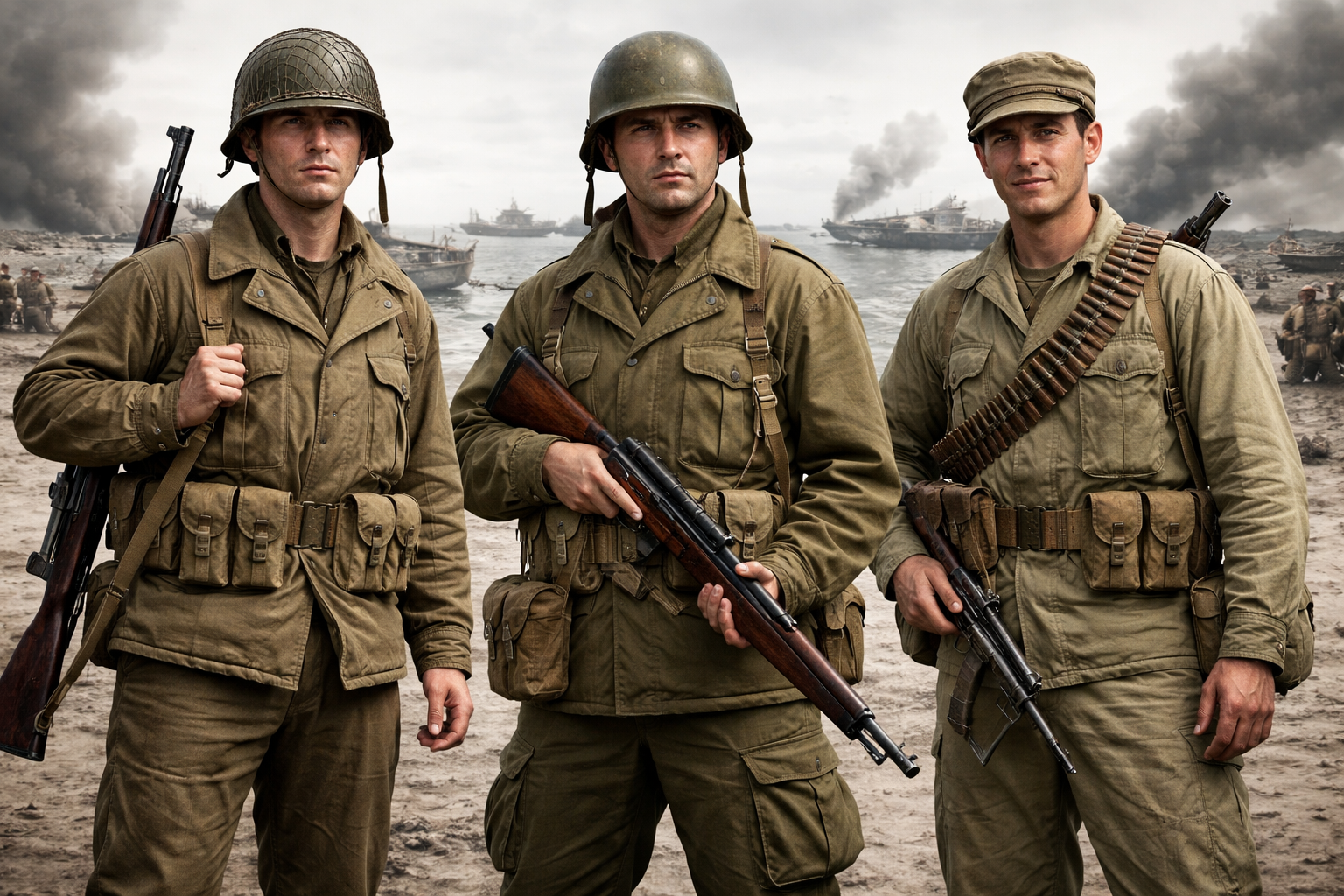
M1941 Field Jacket
The M1941 field jacket became standard early in the war.
Specifications:
-
Cotton poplin outer shell
-
Wool flannel lining
-
Button front with zipper
-
Waist drawstring
It weighed less than WWI wool coats and dried faster. Around 2.5 million were produced before being replaced.
But soldiers complained. It offered limited protection in cold and rain.
That feedback led to improvement.
M1943 Field Uniform System
Introduced in 1943, this was a major upgrade.
The M1943 field jacket included:
-
Wind-resistant cotton sateen shell
-
Button front with storm flap
-
Four large cargo pockets
-
Drawstring waist and hood attachment
It was designed as part of a layered system:
-
Wool shirt
-
Wool sweater
-
Field jacket
-
Pile liner in winter
This system allowed soldiers to adjust clothing based on climate. The jacket was longer than the M1941, offering better coverage.
By late 1944, M1943 jackets were widely issued in Europe.
HBT (Herringbone Twill) Uniform
For work and warm climates, the Army used HBT uniforms.
Features:
-
Cotton herringbone twill fabric
-
Lightweight
-
Two large chest pockets
-
Button front
HBT uniforms were widely used in the Pacific Theater. Cotton dried faster than wool and handled heat better.
Millions were produced between 1941 and 1945.
Pros of the M1943 Uniform
-
Better wind resistance than M1941
-
Large pockets for gear
-
Adjustable layering system
-
Standardized sizing improved fit
-
Easier to mass produce
Cons Reported by Soldiers
-
Cotton shell not fully waterproof
-
Still heavy when soaked
-
Cold in extreme winter without extra liners
-
Buttons could break under stress
No uniform was perfect. But it was better than before.
Real-World Case Studies
1. D-Day, Normandy – June 6, 1944
On D-Day, many US troops still wore the M1941 jacket. Photographs from Omaha Beach show soldiers in wet cotton jackets within hours of landing.
After-action reports mention:
-
Jackets became heavy when soaked
-
Limited insulation during early morning cold
-
Gear weight averaged 60–80 pounds per soldier
Despite this, cotton dried faster than WWI wool would have. The M1 helmet and improved boots reduced head and foot injuries compared to WWI trench conditions.
Later reinforcements arriving in late 1944 often wore the M1943 uniform. Soldiers reported better coverage and pocket space for ammunition and rations.
2. Pacific Theater – Jungle Conditions
In the Pacific, heat and humidity created different problems.
Wool uniforms from WWI would have been unusable in jungle climates. Instead, soldiers wore HBT cotton uniforms.
Army Quartermaster records show that tropical uniforms were redesigned to reduce heat stress. Lightweight cotton shirts and trousers replaced heavy wool.
However, cotton still rotted in constant moisture. Soldiers in New Guinea and the Philippines reported fabric wear within months due to jungle conditions.
Boots were also upgraded. The WWII “service shoe” with canvas leggings replaced WWI puttees. Later, double-buckle combat boots were introduced in 1943 to reduce mud and water entry.
This change reduced trench foot cases compared to WWI data from 1918, according to Army medical summaries.
3. Battle of the Bulge – Winter 1944
Cold weather in Belgium exposed limits in uniform design.
Many troops still had lighter field jackets when temperatures dropped below freezing in December 1944.
Reports show shortages of winter gear in early days of the battle. Soldiers used:
-
Overcoats
-
Pile liners
-
Wool gloves
-
Improvised insulation
The M1943 layered system performed better than the older M1941 jacket in freezing conditions. Units equipped with full winter sets had fewer cold injuries.
By early 1945, improved winter issue reduced frostbite rates compared to WWI winter campaigns.
## Materials and Production Scale
World War II uniforms were shaped by industry.
Facts:
-
Over 16 million Americans served
-
Millions of uniforms produced between 1941–1945
-
Cotton and wool were primary fabrics
-
Standard color: Olive Drab Shade No. 7 (late war)
Factories across the US converted to wartime production. Clothing contracts were issued through the Army Quartermaster Corps.
Sizing charts improved. WWI uniforms often had limited sizing. WWII used expanded size categories to improve fit, based on Army anthropometric studies.
Better fit meant:
-
Less fabric strain
-
Better movement
-
Fewer tears
Simple changes. Big effect.
## Pros and Cons of WWII American Uniforms
Pros
-
Layered system allowed climate flexibility
-
Cotton fabrics dried faster than WWI wool
-
Improved boots reduced trench foot cases
-
Cargo pockets increased storage
-
Mass production ensured supply
Cons
-
Not fully waterproof
-
Cotton wore down in jungle environments
-
Early war gear lacked winter insulation
-
Color fading in sunlight
No uniform solved every problem. But compared to WWI, it was progress.
## FAQs
1. What was the main WWII US field jacket?
The M1941 early in the war, later replaced by the M1943 field jacket.
2. Were WWII uniforms better than WWI uniforms?
Yes. They introduced layering, better boots, and lighter materials.
3. What fabric was most common?
Cotton and wool. Cotton was widely used for field jackets and HBT uniforms.
4. Did soldiers complain about uniforms?
Yes. Cold weather shortages and water resistance were common complaints.
5. What boots did WWII soldiers wear?
Service shoes with leggings early on, later double-buckle combat boots.
6. How many uniforms were produced?
Millions between 1941 and 1945 to supply over 16 million service members.
7. Why switch from wool to cotton?
Cotton dried faster and worked better in warm climates.
Conclusion: The Solution That Came from Hard Lessons
World War I showed the problem. Heavy wool. Wet trenches. Poor foot protection.
Soldiers suffered from cold, water, and poor fit.
World War II uniforms were not perfect. But they were smarter. The US Army introduced layering systems, field jackets instead of formal coats, better boots, and improved sizing. Feedback from early battles shaped later designs like the M1943 system.
The result? Fewer cold injuries than WWI. Better mobility. More practical field use.
Uniforms are not just cloth. They are survival tools.
If you study military history or collect WWII gear, look closely at the details. Fabric type. Pocket design. Boot structure. Each change tells a story of real soldiers solving real problems under fire.
And that is what makes World War II American uniforms worth understanding.
