Introduction: A Field Lesson in Rank
Last summer at a local reenactment event, I watched two new participants argue over a simple detail. One wore an M43 field tunic with shoulder boards that marked him as an Obergefreiter. The other insisted he was dressed as a Leutnant. The confusion came down to small details—piping color, braid pattern, and collar tabs. From five feet away, they looked similar. Up close, they told two very different stories.
If you collect German WW2 rank insignia or build WW2 German uniform reproductions, you have probably faced the same issue. The German armed forces used structured rank systems across the Wehrmacht Army (Heer), Waffen-SS, and Luftwaffe. Each branch had its own placement rules and insignia patterns. A small mistake can turn a solid impression into an inaccurate one.
This guide breaks it down in simple terms. We will look at how German WW2 rank insignia were structured, why mistakes happen, and how to correctly set up insignia on an M43 field tunic. If you want your uniform to match historical records from 1943–1945, this is for you.
What Problem Do Rank Insignia Cause for Collectors?
The main problem is identification. German WW2 rank insignia were detailed and branch-specific. Heer shoulder boards differ from SS collar tabs. Luftwaffe used different colors and insignia shapes. Without careful study, these differences blend together.
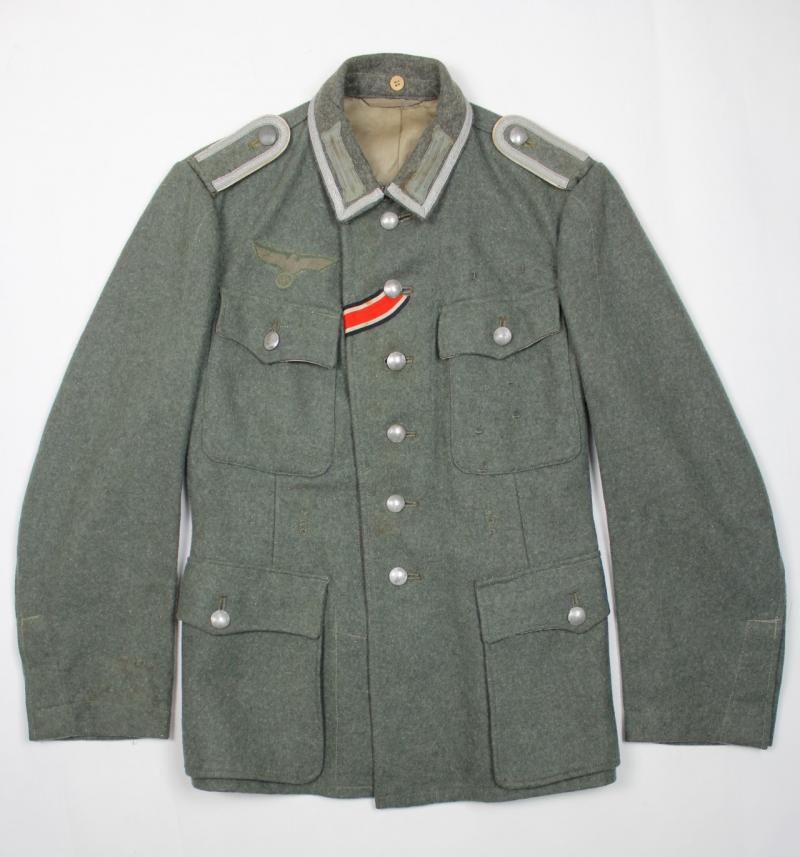
On the M43 field tunic, insignia placement followed regulations. Shoulder boards showed rank and branch color. Collar tabs could indicate rank, branch, or unit. Sleeve eagles also varied between Heer, SS, and Luftwaffe.
For collectors, mixing parts from different branches is common. For reenactors, wearing officer boards on an enlisted tunic is another frequent mistake. Even reproduction sellers sometimes combine elements incorrectly.
Small details matter:
-
NCO tresse (silver braid) around collar edges
-
Waffenfarbe piping color
-
Number of pips or bars on shoulder boards
-
SS runes versus Heer Litzen
If you do not check references, you can easily misidentify a rank.
Agitating the Issue—Fakes and Misidentifications
The risk goes beyond embarrassment. Original German WW2 rank insignia can be expensive. Wartime shoulder boards and SS collar tabs often sell for high prices due to demand.
Common issues include:
-
Post-war copies aged artificially
-
Incorrect thread types
-
Wrong backing materials
-
Machine stitching that does not match 1940s methods
For example, Heer shoulder boards from the M43 period used field-grey wool bases with colored piping. If the piping is neon-bright or synthetic, that is a red flag.
Misidentification also affects historical value. An Oberfeldwebel board is not the same as an Unteroffizier board. One extra pip changes the rank completely. For reenactors, wrong insignia reduces authenticity during events.
Understanding structure is the only way to reduce these risks.
Solving It: Breaking Down M43 Tunic Insignia
The M43 field tunic became standard in 1943. It had a simplified design compared to earlier M36 and M40 tunics. Field-grey wool, four pockets, straight collar, and reduced trim defined the look.
Insignia placement followed clear rules:
-
National eagle above the right breast pocket (Heer and Luftwaffe)
-
Collar tabs on both collar sides
-
Shoulder boards attached by button loops
For Waffen-SS M43 tunics, collar tabs often showed SS runes on one side and rank on the other.
Understanding each branch helps you avoid confusion.
Heer Shoulder Boards Explained
Heer shoulder boards were structured by rank groups:
Enlisted (Mannschaften):
-
Simple straps
-
Branch color piping
-
No silver braid
NCO (Unteroffiziere):
-
Silver tresse around collar
-
Shoulder boards with braid and piping
-
Possible rank pips
Officers:
-
Braided silver cords
-
Colored underlay
-
Metal pips for rank
Waffenfarbe identified branch:
-
White: Infantry
-
Red: Artillery
-
Pink: Panzer
-
Yellow: Cavalry/Recon
On an M43 field tunic, the shoulder board button secured the strap at the collar seam. This system stayed consistent from 1943 onward.
SS Collar Tabs Variations
SS collar tabs are often misunderstood. The Waffen-SS used collar tabs differently from Heer Litzen.
Common patterns:
-
Right collar tab: SS runes (for many units)
-
Left collar tab: Rank insignia
-
Some units used divisional symbols
Ranks were shown with:
-
Silver pips
-
Horizontal bars
-
Oakleaf designs for officers
Unlike Heer, SS did not use branch piping in the same way. That difference alone causes confusion when building WW2 German uniform reproductions.
Always cross-check with unit references from 1943–1945 photos.
Features of Accurate WW2 German Uniform Reproductions
If you are buying modern reproductions, accuracy depends on materials and construction.
Look for:
-
Wool fabric close to wartime field-grey shade
-
Correct weave density
-
Cotton or wool thread, not shiny polyester
-
Proper button placement on M43 field tunic
Accurate German WW2 rank insignia reproductions should match:
-
Correct piping color
-
Correct braid width
-
Proper backing cloth
-
Hand-finished look where appropriate
WW2 German uniform reproductions today are widely available, but quality varies. Some are designed for costume use. Others are made for reenactment and follow wartime measurements.
Check product details before purchase.
Pros & Cons of Modern Reproductions
| Pros | Cons |
|---|---|
| Affordable compared to originals | Not investment-grade |
| Suitable for reenactments | Some lack material accuracy |
| Easy to replace if damaged | Color shades may vary |
| Available in full size range | Stitching may be machine-only |
Modern German WW2 rank insignia reproductions are practical. Originals are rare and expensive. For field events, reproductions are often the smarter choice.
Real-World Case Study: 1943 Eastern Front Impression
A reenactor building a 1943 Eastern Front Heer impression used:
-
M43 field tunic reproduction
-
White-piped infantry shoulder boards
-
Unteroffizier tresse around collar
Historical references from Eastern Front photos show similar setups for infantry NCOs in late 1943. The simplified M43 cut and reduced trim matched period images.
At a public event, experienced collectors reviewed the uniform and confirmed the rank alignment. Small details, like correct piping color and rank pip placement, made the difference.
Real-World Examples
Reenactor Event Example:
At a 1944-themed event, one participant wore SS collar tabs on a Heer tunic. Observers quickly noted the mismatch. After correction with proper Heer Litzen and shoulder boards, the uniform matched regulations.
Collector Purchase Story:
A collector purchased what was advertised as original Heer Hauptmann boards. On inspection, the backing cloth was synthetic. The silver braid was too bright. Research showed it was a reproduction. Proper knowledge of German WW2 rank insignia prevented further loss.
FAQs
1. How to spot real vs fake insignia?
Check thread material, backing cloth, aging pattern, and compare with documented examples.
2. Did all M43 tunics use the same insignia placement?
Yes, placement rules were standardized from 1943 onward.
3. Are SS collar tabs interchangeable with Heer insignia?
No. They follow different systems and should not be mixed.
4. What is Waffenfarbe?
Branch color piping used mainly by Heer and Luftwaffe.
5. Can reenactors use original insignia?
It is possible, but risk of damage makes reproductions safer.
6. Were Luftwaffe ranks different?
Yes, Luftwaffe used unique shoulder boards and yellow piping for many units.
7. Is the M43 field tunic correct for late war impressions?
Yes, especially for 1943–1945 setups.
Conclusion: Getting It Right
German WW2 rank insignia are detailed but structured. Once you understand Heer shoulder boards, SS collar tabs, and branch colors, the confusion fades. The M43 field tunic provides a clear layout for insignia placement, making it easier to build a correct impression.
Avoid mixing branches. Study wartime photos. Check piping colors and rank pips carefully. When in doubt, choose accurate WW2 German uniform reproductions built for reenactment use.
If you are building your next setup, check paddelaters.com for M43 reproductions and properly matched insignia. Small details create a correct historical look. Get those details right, and your impression will stand up to close inspection.
