THE FALL OF THE REDCOAT: BRITISH UNIFORM CHANGES BEFORE WWI
British military uniforms changed a lot between the early 1800s and World War I. At first, bright red coats and heavy wool were standard. They looked sharp on parade but caused real trouble in battle. Over time, hard lessons from wars like Waterloo, the Boer War, and the Somme pushed the army to adopt khaki, lighter fabrics, and steel helmets. This guide walks through those changes using real facts from British Army records and Imperial War Museum archives. You’ll see what worked, what failed, and how uniforms slowly adapted to modern warfare
EDITORIAL DESK
Paddelaters Research Desk
ARTICLE PURPOSE
Historical reference for collectors, reenactors, and costume buyers.
LAST REVIEWED
February 13, 2026
Introduction
Imagine marching miles in thick wool under a hot sun. Or standing in a muddy trench for weeks in the rain. That was daily life for British soldiers in the 1800s and early 1900s. Uniforms were not just about looks. They affected comfort, health, and survival.
Here’s the problem. Early British uniforms were designed for order and discipline. They worked well in neat battle lines. But wars changed. Weapons improved. Battlefields became deadlier. The old uniforms often failed to keep up.
The consequences were serious. Soldiers stood out as easy targets. Heavy cloth soaked up rain. Bright colors drew enemy fire. Over time, painful lessons forced change.
Let’s walk through how British military uniforms evolved from the redcoat era to the trenches of World War I.
Early 1800s Uniforms
Key Features
In the early 1800s, especially during the Napoleonic Wars, British soldiers wore what most people picture: the redcoat.
Typical features included:
-
Red wool tunic (often called a “coatee”)
-
White cross-belts for ammunition and bayonet
-
Shako hat made of felt or leather
-
Wool trousers or breeches
-
Black leather boots
-
Equipment made of thick leather
The red dye came from cochineal and other sources. According to British Army clothing records, wool was the main fabric because it was durable and easy to produce in Britain.
At the Battle of Waterloo in 1815, soldiers of the Duke of Wellington’s army wore red coats with regimental facings in different colors. The cloth was heavy wool. It kept soldiers warm in cold weather but was hot in summer.
Pros and Cons
Pros:
-
Easy to identify units by color and badge
-
Strong wool fabric lasted long
-
Smart appearance boosted discipline
Cons:
-
Bright red made soldiers visible
-
Heavy wool caused heat stress
-
Tight tailoring limited movement
-
Leather gear added weight
Real-World Example: Waterloo 1815
At the Battle of Waterloo, British forces faced French troops in open fields. Line formations were still standard. Bright uniforms were not yet a major disadvantage because smoke from muskets reduced visibility.
However, as rifles became more accurate later in the 19th century, visibility became a bigger issue. Red worked in an age of close-range muskets. It became a problem once long-range fire improved.
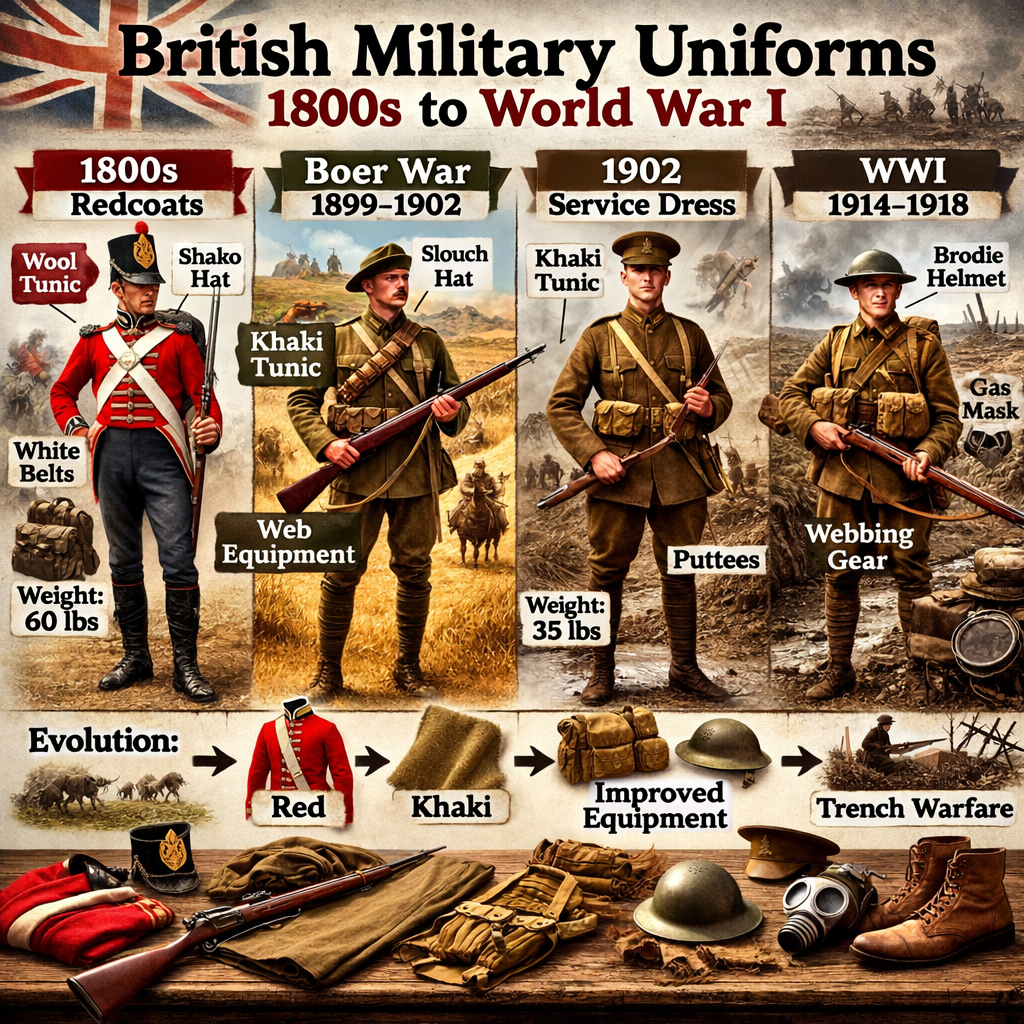
Records from the period show that a full infantry kit could weigh over 60 pounds when including musket, ammunition, and gear. The uniform itself was not light. Imagine carrying that all day across muddy ground.
Late 1800s Changes
The Shift Toward Khaki
By the mid to late 1800s, warfare was changing. The British Army fought in India and Africa. Red coats stood out against dry landscapes.
In India during the 1840s and 1850s, soldiers began dyeing white uniforms with tea or mud to create a dull brown shade. This color became known as “khaki,” from a Hindi word meaning “dust.”
By the time of the Second Boer War (1899–1902), khaki was widely used.
Key features of late 1800s uniforms:
-
Khaki drill or serge tunics
-
Slouch hats or helmets for sun protection
-
Simpler designs with fewer bright details
-
Webbing equipment instead of heavy leather
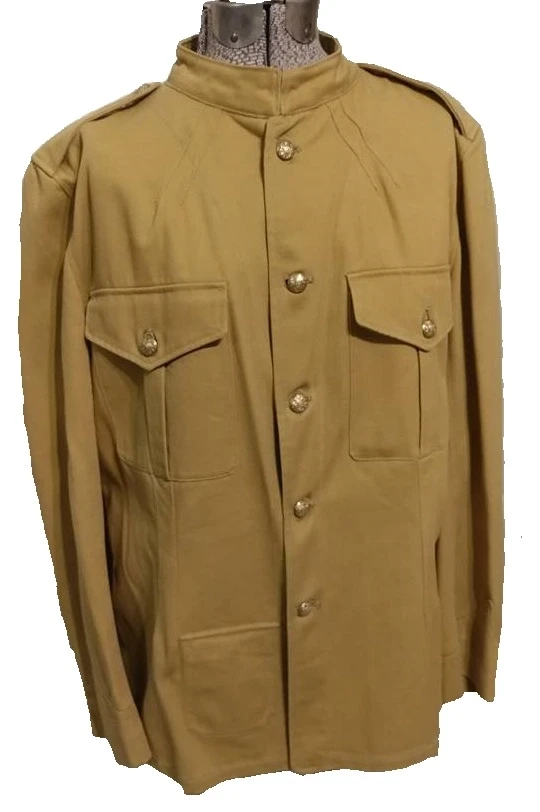
According to British Army records, the 1902 Service Dress became the standard field uniform. It used khaki wool serge. The tunic had four pockets and brass buttons.
Pros and Cons
Pros:
-
Camouflage in dry terrain
-
Lighter color reduced visibility
-
More practical pocket design
-
Better suited for rifle warfare
Cons:
-
Wool still heavy in wet climates
-
Early khaki faded unevenly
-
Limited waterproofing
Real-World Example: Boer War 1899–1902
The Boer War was a turning point. British troops fought Boer marksmen who used modern rifles and took cover effectively. Bright uniforms would have been disastrous.
Khaki reduced visibility, but other problems remained. Reports from the war mention issues with heat, dust, and poor supply systems. Soldiers often marched long distances in hot weather.
The war showed that:
-
Camouflage mattered.
-
Mobility mattered.
-
Modern rifles changed everything.
The redcoat era was effectively over for battlefield use.
World War I Changes
Key Features
When World War I began in 1914, British soldiers wore the 1902 pattern Service Dress. It included:
-
Khaki wool serge tunic
-
Matching trousers
-
Puttees (cloth leg wraps)
-
Leather boots
-
Soft peaked cap (initially)
The wool serge fabric weighed around 18–20 ounces per yard. It was strong but absorbed water. In trench conditions, this became a major issue.
In 1916, the Brodie steel helmet was introduced. Before that, soldiers wore soft caps, which offered no protection from shrapnel.
Other updates included:
-
Webbing equipment (Pattern 1908)
-
Gas masks after 1915
-
Simplified insignia
Pros and Cons
Pros:
-
Neutral khaki color reduced visibility
-
Strong fabric lasted in rough conditions
-
Steel helmet reduced head injuries
-
Webbing lighter than old leather sets
Cons:
-
Wool soaked up rain
-
Puttees trapped mud
-
Limited insulation in extreme cold
-
Early lack of helmet caused heavy casualties
Real-World Example: Battle of the Somme 1916
At the Battle of the Somme, which began in July 1916, British forces suffered over 57,000 casualties on the first day alone. By the end of the campaign, British losses exceeded 400,000.
Uniforms were not the only reason for casualties, but trench conditions exposed their weaknesses.
Mud at the Somme was thick and constant. Wool uniforms became heavy when wet. Soldiers faced:
-
Trench foot due to damp boots
-
Cold exposure
-
Limited protection from shell fragments
The introduction of the Brodie helmet in 1916 reduced fatal head wounds from shrapnel. Imperial War Museum sources note that steel helmets significantly lowered certain types of injuries compared to the earlier cloth caps.
World War I proved that uniforms were now survival equipment, not just clothing.
Features Over Time (Quick Comparison)
Early 1800s:
-
Red wool coats
-
White belts
-
Shako hats
-
Heavy leather gear
Late 1800s:
-
Khaki tunics
-
Lighter equipment
-
Practical pockets
-
Sun protection
World War I:
-
Khaki wool serge
-
Steel helmets
-
Webbing gear
-
Gas masks
You can see the pattern. Visibility decreased. Practicality increased. Protection slowly improved.
FAQs
1. Why did British soldiers wear red coats?
Red dye was affordable in bulk and made unit identification easy. In the 1700s and early 1800s, visibility was less of a concern due to battlefield smoke and close-range fighting.
2. When did the British Army stop using red in battle?
Khaki replaced red for field service in the late 19th century, especially during the Boer War. Red remained for ceremonial use.
3. What was the 1902 Service Dress?
It was a khaki field uniform adopted by the British Army. It featured a four-pocket tunic and wool serge fabric. It became the standard uniform in World War I.
4. How heavy were WWI British uniforms?
The wool serge fabric weighed around 18–20 ounces per yard. When wet, it became much heavier, especially in trench conditions.
5. What was the Brodie helmet?
Introduced in 1916, it was a steel helmet designed to protect soldiers from shrapnel. It replaced the soft cap worn at the start of World War I.
6. Did uniforms affect survival?
Yes. Camouflage reduced visibility. Helmets reduced head injuries. However, wool fabric in wet trenches caused health problems like trench foot.
7. Are redcoats still used today?
Yes, but only for ceremonial roles, such as guards at Buckingham Palace.
Conclusion
British military uniforms from the 1800s to World War I tell a clear story. The problem was simple at first. Uniforms were built for order and tradition, not modern firepower. Bright red coats and heavy wool worked in line battles. They failed in rifle warfare and trench fighting.
The consequences were real. Greater visibility. Heat stress. Mud-soaked clothing. Injury from shrapnel.
The solution came slowly. Khaki replaced red. Practical design replaced decoration. Steel helmets replaced soft caps. Webbing replaced thick leather.
By the end of World War I, the British Army uniform looked very different from the redcoat of Waterloo. It was not perfect. But it reflected hard lessons learned in real battles.
REQUISITION RELATED GEAR
EXPLORE MORE FIELD REPORTS
Browse all published guides and history articles.
