US ARMY UNIFORMS IN WW1: EARLY PROBLEMS AND LATER IMPROVEMENTS
Published on Feb 07, 2026
Introduction
When the United States entered World War 1 in 1917, its soldiers did not step onto European soil with perfect gear. The problem was simple and serious: the US Army had uniforms designed for earlier wars and peacetime duty, not for long months in muddy trenches under shell fire. Wool clothing was heavy, gear was not standardized across all units, and protection against modern weapons was limited. These issues mattered because uniforms were not just clothing. They affected how soldiers moved, stayed warm, and survived.
The struggle quickly became clear once American troops joined the fighting in France. Mud, rain, gas attacks, and constant wear exposed every weakness. This pressure forced change. The solution came through rapid updates to design, materials, and equipment, leading to a set of uniforms that worked better in combat and influenced later US Army clothing. This article looks at World War 1 US uniforms in detail: what problems existed, how designs worked in real battles, and what lessons carried forward into later wars.
Early US Uniform Challenges
Before World War 1, the US Army focused mainly on coastal defense, border patrols, and small overseas actions. Uniforms reflected that reality. Soldiers often wore service dress that looked sharp on parade but struggled in combat conditions. Wool was standard, but cuts and layers were not ideal for long field use.
One major challenge was weight. A full wool uniform absorbed water and mud, becoming heavier over time. Soldiers in France reported that wet clothing stayed damp for days. Another issue was fit. Many uniforms were produced quickly after mobilization, leading to size problems and uneven quality. Footwear and leg wraps also caused trouble. Puttees, long cloth wraps around the lower leg, could loosen or tighten painfully during long marches.
Protection was another weak point. Early in the war, US troops relied on cloth caps similar to those used before 1917. These offered no defense against shell fragments. As artillery became the main cause of wounds, this gap became dangerous and obvious.
Key Features of WW1 US Uniforms
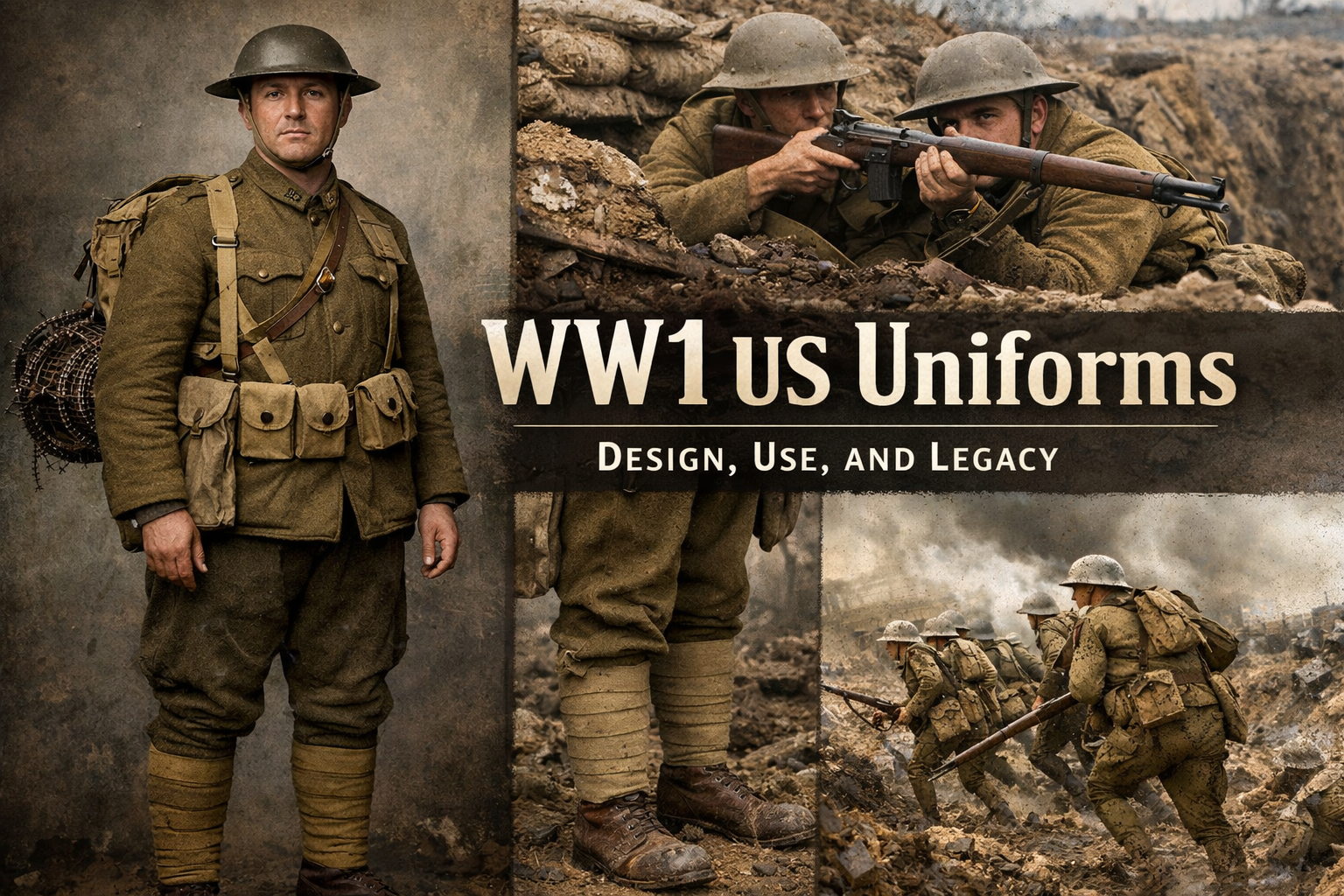
The US Army responded with practical designs that balanced mass production and battlefield needs. Several key items defined the World War 1 American soldier.
-
Olive drab service coat: Made from wool, this coat used a muted green-brown color to reduce visibility. The shade was chosen to blend with European terrain. Four front pockets allowed soldiers to carry maps, rations, and small gear.
-
Breeches: Knee-length wool trousers were worn instead of straight pants. This design reduced fabric drag in mud and worked better with puttees or leggings.
-
Puttees and leggings: Early in the war, puttees were common. Later, canvas leggings with buckles replaced them, offering more consistent support and faster use.
-
Shirts and underlayers: Wool flannel shirts were standard. While warm, they could itch and overheat during movement.
-
M1917 helmet: Introduced after studying British designs, this steel helmet protected against shrapnel. Army reports from 1918 noted a drop in head wounds after its adoption.
-
Footwear: Hobnailed leather boots provided grip but could become stiff and uncomfortable after long exposure to water.
These features were not perfect, but they represented a clear shift toward function over appearance.
Real-World Examples from the Trenches
In the Meuse-Argonne Offensive of 1918, the largest operation involving US forces, uniform performance was tested at scale. Soldiers advanced through forests, mud, and shell-torn ground for weeks. Photos from the campaign show troops wearing olive drab coats darkened by dirt and rain. Letters from soldiers mention leggings holding up better than puttees during long marches.
Another example comes from training camps in France. Recruits initially drilled in older gear, then received updated helmets and coats before entering combat. Officers noted that the steel helmet reduced injuries from falling debris during bombardments, even if it could not stop direct hits.
A third case appears in medical reports. Army doctors recorded fewer head and scalp injuries in late 1918 compared to early engagements. While many factors played a role, the widespread issue of the M1917 helmet clearly helped. These real uses show how uniform changes mattered beyond appearance.
Pros and Cons vs. WW2 Uniforms
Comparing World War 1 and World War 2 uniforms highlights progress and limits.
Pros of WW1 US uniforms
-
Olive drab color reduced visibility compared to bright pre-war uniforms.
-
M1917 helmet offered basic protection from shell fragments.
-
Breeches and leggings improved movement in mud.
-
Standardization improved by 1918 across most units.
Cons of WW1 US uniforms
-
Heavy wool retained water and heat.
-
Limited layering options for changing weather.
-
Boots lacked waterproofing.
-
Gear comfort lagged behind later designs.
Compared to WW2 uniforms
-
WW2 gear used lighter fabrics and better layering systems.
-
Improved helmets and liners increased comfort and protection.
-
Field jackets replaced long wool coats for flexibility.
-
Lessons from WW1 directly shaped WW2 uniform design.
For more context, see our internal guide on WW2 gear and its development.
Common Questions
Why were WW1 US uniforms made of wool?
Wool was durable, warm, and widely available in the US. Synthetic materials were not yet common.
Did all US soldiers wear the M1917 helmet?
By late 1917 and 1918, most frontline troops did, though supplies varied early on.
Were WW1 uniforms comfortable?
They were practical but often uncomfortable, especially when wet or during long marches.
How did US uniforms compare to European allies?
They were similar by 1918, especially after adopting the steel helmet.
Did uniforms protect against gas attacks?
No. Gas masks were separate equipment and essential for protection.
Were officers’ uniforms different?
Officers often had tailored versions but used the same basic designs.
Conclusion
World War 1 forced the United States Army to rethink its uniforms fast. The problem started with clothing meant for older styles of war. Combat in Europe exposed every flaw, from heavy wool to poor protection. The struggle of real soldiers in trenches pushed change. The solution came through practical updates like the olive drab service coat, breeches, leggings, and the M1917 helmet. These items did not make life easy, but they worked better and saved lives.
The legacy of WW1 US uniforms lives on in later designs. Many lessons carried directly into World War 2 and beyond. If you enjoy this topic, explore our related posts on military history and equipment evolution to see how these early choices shaped modern armies.
