Introduction
Picture a young American soldier landing in France in 1917. He steps off the ship wearing a brand-new olive drab wool uniform. Back home, it looked sharp and practical. But now he faces cold rain, thick mud, and enemy gas shells. Within days, he learns something important: uniforms in World War 1 were not about style. They were about survival.
When the United States joined the war in April 1917, it had to quickly equip millions of men. According to U.S. Army Quartermaster records, the Army grew from around 200,000 soldiers in early 1917 to over 4 million by 1918. Supplying uniforms for that force was a massive job. Mistakes happened. Designs changed. New gear appeared in response to real battlefield problems.
Let’s break this down using a simple flow:
-
Problem: Soldiers faced weather, mud, gas, and visibility risks.
-
Agitate: Poor gear meant sickness, frostbite, and casualties.
-
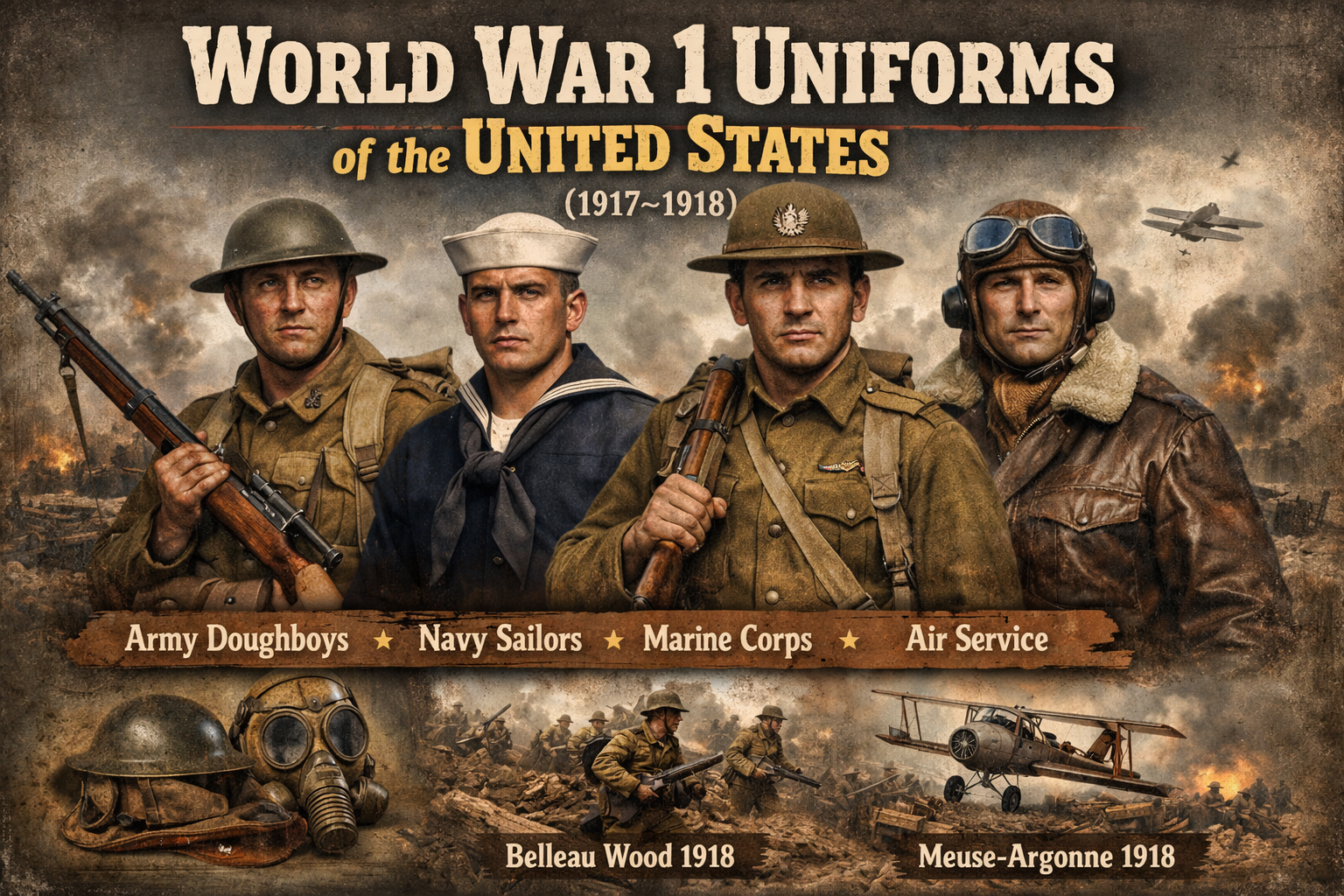
Solution: The U.S. Army, Navy, Marines, and Air Service improved designs quickly between 1917 and 1918.
Now let’s look at each branch.
Early War Uniforms: The U.S. Army Doughboy
Doughboy Olive Drab
The typical American infantry soldier was known as a “doughboy.” His standard uniform in 1917 was based on the M1912 service uniform, later modified during the war.
The key color was olive drab, chosen to reduce visibility. Earlier wars had bright uniforms. By WWI, camouflage mattered.
Key Features Breakdown
According to Quartermaster Corps specifications:
-
Coat: Wool service coat with stand-up collar (later fold-down collar in 1918).
-
Trousers: Wool, matching olive drab.
-
Leggings (puttees): Wrapped around lower legs for ankle support and mud protection.
-
Hat: Campaign hat early on; later replaced by steel helmet.
-
Helmet: M1917 helmet, based on the British Brodie design.
-
Boots: Russet leather marching shoes.
The wool fabric was heavy but durable. Wool also retained warmth when wet, which was important in French winters. However, ventilation was limited.
The M1917 steel helmet was introduced after seeing heavy head wounds in European trenches. U.S. records show over 2 million helmets were produced by war’s end.
The M1917 Helmet and Gas Protection
The Gas Threat
One of the biggest problems in WWI was poison gas. Chlorine and mustard gas caused burns and lung damage. Early in the war, U.S. troops trained with British equipment.
The standard American gas mask became the Small Box Respirator, carried in a canvas bag on the chest. Soldiers had to put it on within seconds during an attack.
Real-World Case Study: Meuse-Argonne Offensive (1918)
During the Meuse-Argonne campaign, over 1 million American troops were involved. Reports from the U.S. Army Medical Department show thousands of gas casualties. Many survived because masks worked—but only if worn correctly.
Problem:
-
Masks were uncomfortable.
-
Vision was limited.
-
Communication was harder.
Agitate:
Some soldiers delayed putting them on. That delay caused injuries.
Solution:
Training improved. Mask drills became constant. By late 1918, American gas discipline was better, and survival rates increased.
Navy and Marines Gear
The Navy and Marine Corps had different needs.
U.S. Navy Uniforms (1917–1918)
The Navy used:
-
Dark blue wool uniforms for cold weather.
-
White cotton uniforms for warm climates.
-
Peacoats for deck duty.
-
Flat “dixie cup” sailor hats.
Life at sea meant strong winds and water exposure. Wool worked well in cold Atlantic conditions. According to Navy supply records, uniforms had to resist saltwater damage and constant wear.
U.S. Marine Corps Uniforms
Marines wore similar olive drab service uniforms in France. Their insignia included the Eagle, Globe, and Anchor.
Real-World Case Study: Battle of Belleau Wood (1918)
At Belleau Wood, Marines fought in forests under machine gun fire. The thick wool uniforms helped against brush and minor shrapnel fragments, but heat was a problem during summer fighting.
After-action reports noted:
-
Wool held up well.
-
Helmets reduced head wounds.
-
Leggings collected mud and were hard to clean.
Still, Marine uniforms performed comparably to Army gear in combat.
U.S. Army Air Service Uniforms
Flying brought new problems.
Early Aviation Challenges
Pilots flew open-cockpit planes at high altitude. Temperatures dropped below freezing.
Standard infantry wool was not enough.
Air Service Gear
The Air Service introduced:
-
Leather flight coats.
-
Fur-lined boots.
-
Heavy gloves.
-
Goggles to protect eyes from wind.
-
Soft flight helmets.
Smithsonian aviation collections show early leather jackets designed for warmth and flexibility. These were practical solutions, not fashion statements.
Problem:
Cold air caused numb hands and frostbite.
Agitate:
Frozen fingers made it hard to control aircraft.
Solution:
Layered clothing and leather outerwear improved survival and performance.
Features Breakdown: Materials, Design, Insignia
Across all branches, here are the key features:
Materials
-
Wool: Main fabric for Army and Marines.
-
Cotton: Used in Navy summer uniforms.
-
Leather: Air Service outerwear and boots.
-
Steel: M1917 helmets.
-
Canvas: Gear bags, belts, and gas mask carriers.
Quartermaster production records show millions of wool coats and trousers produced between 1917 and 1918.
Design
-
Loose fit for mobility.
-
Earth-tone colors for camouflage.
-
Functional pockets.
-
Reinforced stitching in stress areas.
Insignia
-
Rank stripes on sleeves.
-
Branch insignia on collars.
-
Service chevrons for overseas duty (introduced in 1918).
Insignia helped organization in large forces, especially with rapid Army expansion.
Pros & Cons of WWI U.S. Uniforms
Pros
-
Durable wool fabric.
-
Neutral colors reduced visibility.
-
Steel helmets lowered head injury rates.
-
Gas masks saved thousands of lives.
-
Standardized production allowed mass supply.
Cons
-
Poor ventilation in hot weather.
-
Heavy when soaked with rain.
-
Leggings uncomfortable over long marches.
-
Gas masks limited sight and breathing comfort.
-
Early supply shortages in 1917.
Soldier letters often mentioned weight and heat as common complaints.
Real-World Examples
1. Meuse-Argonne (Army)
Heavy rain turned trenches into mud. Wool held warmth even when wet. However, soaked uniforms increased weight and fatigue.
2. Belleau Wood (Marines)
Marine uniforms handled rough forest terrain. Helmets reduced head wounds compared to earlier wars without steel helmets.
3. Atlantic Convoys (Navy)
Sailors in wool peacoats faced freezing spray. Navy clothing resisted cold wind but required constant drying below deck.
FAQs
1. What fabric was used in WWI U.S. Army uniforms?
Mostly olive drab wool for coats and trousers.
2. What helmet did U.S. soldiers wear?
The M1917 steel helmet, based on the British Brodie design.
3. Did U.S. Marines wear different uniforms from the Army?
They wore similar olive drab service uniforms but had Marine insignia.
4. What did Navy sailors wear?
Dark blue wool in cold weather and white cotton in warm climates.
5. What did WWI pilots wear?
Leather coats, fur-lined boots, gloves, and goggles for warmth.
6. Were gas masks effective?
Yes, when worn correctly. They reduced fatal gas injuries.
7. Why was olive drab used?
To reduce visibility on the battlefield.
Conclusion
When America entered World War 1, it faced a huge challenge: equip millions of soldiers for modern industrial warfare.
Problem: Mud, gas, cold, and machine guns made survival harder than ever.
Agitate: Early shortages and uncomfortable gear added stress to already dangerous conditions.
Solution: The U.S. Army, Navy, Marines, and Air Service adapted fast. They improved helmets, issued gas masks, and introduced specialized flight clothing.
These uniforms were not perfect. But they show how quickly a country can adjust under pressure.