WW1 BRITISH UNIFORM AUTHENTICATION: KHAKI, STAMPS & STEEL HELMETS
Introduction: The Problem with Fake British Tommy Uniforms
Ever searched online for a WW1 British Tommy uniform?
You’ll see dozens listed as “original.” Prices range from a few hundred to several thousand. But here’s the problem. Many are reproductions. Some are altered post-war pieces. Some are outright fakes.
Collectors get confused. Reenactors waste money. New buyers trust the wrong seller.
During WW1, millions of uniforms were produced. Today, genuine surviving pieces are limited. Demand is high. That creates room for fraud.
So how do you protect yourself?
Let’s break it down step by step. History first. Then identification. Then real-world cases.
Spot a fake yet? Let’s make sure you don’t buy one.
Quick History of WW1 British Soldier Uniform
The standard British uniform at the start of WW1 was the 1902 Pattern Service Dress.
Khaki had replaced red coats after lessons from the Boer War. The British Army entered WW1 already equipped with khaki wool tunics and trousers.
By 1916, around 2.5 million khaki tunics had been issued, according to production records cited in archival collections such as the Imperial War Museum. As the war expanded, demand grew rapidly.
Wool shortages hit Britain in 1915. Supplies from Australia and New Zealand were critical. Fabric blends began to vary. Later-war uniforms sometimes show differences in weave and thickness because of these shortages.
So if someone tells you every tunic looks identical from 1914 to 1918, that’s not accurate.
Uniform evolution happened during the war.
From 1902 Pattern to Trench Wear Evolution
The 1902 Pattern was not designed for trench warfare. It was adapted as conditions changed.
Early War (1914–1915)
-
High-quality wool serge
-
Brass buttons
-
Tailored fit
-
Cloth service cap (no helmet early on)
Mid War (1916–1917)
-
Increased production numbers
-
Fabric variations due to shortages
-
Introduction of the Brodie steel helmet
-
Simplified finishing in some batches
Late War (1917–1918)
-
Repairs common
-
Replacement buttons
-
Mixed webbing sets
-
Evidence of heavy wear
If you see a “mint condition” tunic claimed to be Somme-worn with no wear marks, ask questions.
Real trench use left evidence.
How to Identify WW1 British Uniforms: Step-by-Step
Let’s get practical.
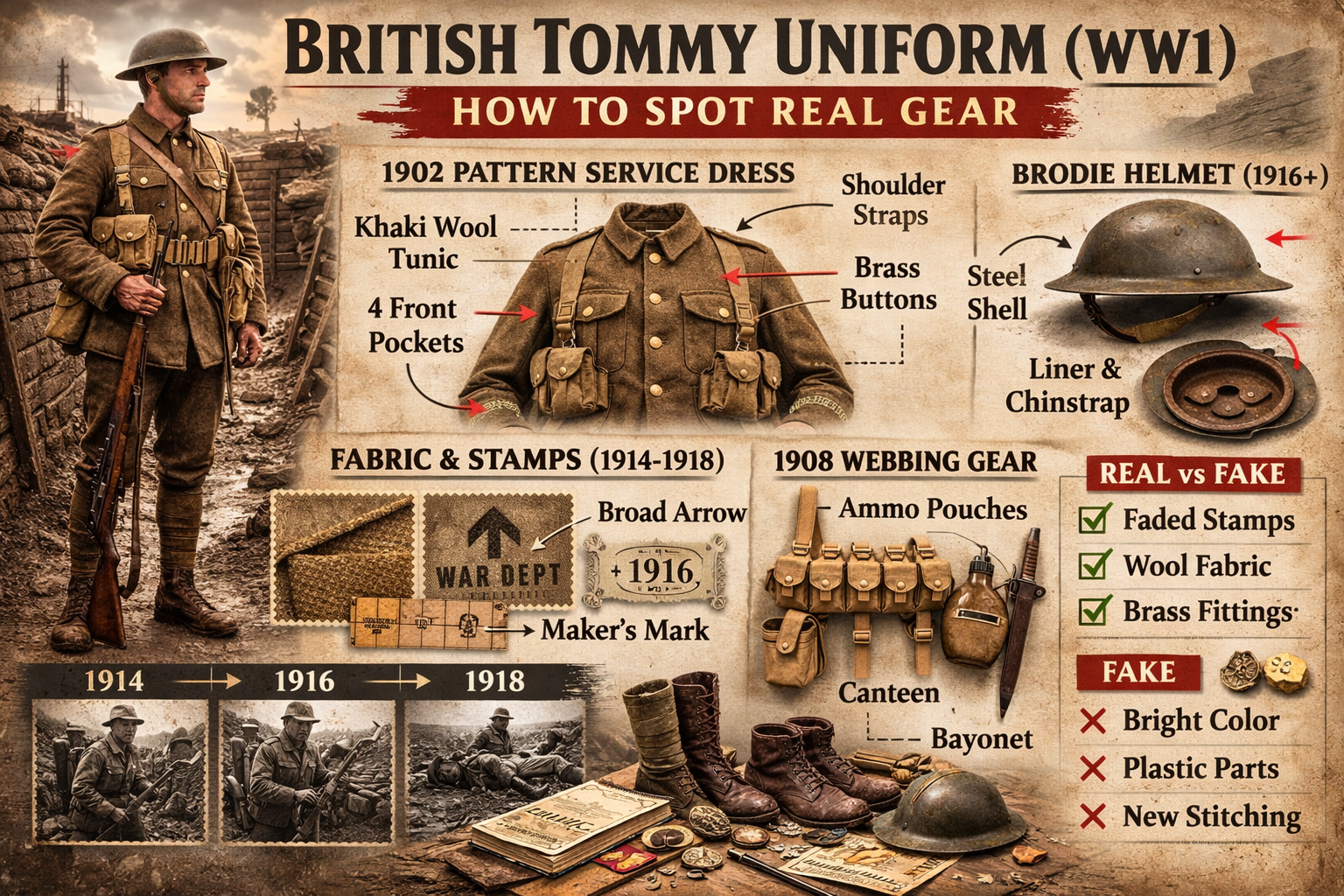
You want to know if that khaki tunic is real.
Here’s your checklist.
1. Examine the Fabric
Original WW1 British tunics were made of wool serge. The weave is tight but slightly coarse. It is not smooth like modern reproduction wool.
Look for:
-
Age-related wear at collar and cuffs
-
Fading unevenly from sun exposure
-
Stitching consistent with early 20th-century machines
Modern repros often use cleaner stitching and uniform thread tension.
2. Inspect the Cut
The 1902 Pattern tunic has:
-
Four front pockets
-
Box pleats
-
Stand-and-fall collar
-
Shoulder straps
Pocket placement and pleat construction matter. Compare with verified museum examples.
If pocket flaps are slightly oversized or shaped differently, it could be a reproduction.
3. Check Inside for Stamps
Original pieces often include:
-
War Department broad arrow mark
-
Manufacturer name
-
Year stamp
-
Size marking
Ink should appear faded. It should soak into wool fibers. Sharp, dark stamps can indicate modern reproduction.
Ever seen a stamp that looks freshly printed? That’s a red flag.
Check Labels, Stamps, and Khaki Fabric Clues
War Department Broad Arrow
This symbol marks British government property. On WW1 uniforms, it is usually small and placed discreetly.
Be cautious of oversized arrows. Some fakes exaggerate this marking.
Date Stamps
Common years range from 1914 to 1918. Post-war reissues may carry later marks.
If you see a 1940s stamp on a “WW1 original,” that’s incorrect unless clearly identified as reused stock.
Fabric Color
Early WW1 khaki tends toward brownish tones. Some later-war pieces appear slightly greener due to dye variation.
Uniform color that looks too bright or too consistent may be modern.
Remember 1915 wool shortages? That led to variations. So inconsistency in fabric across production batches can actually support authenticity.
Brodie Helmet and Webbing Authentication Tips
The Brodie helmet became standard from 1916 onward.
Helmet Shell
Original Brodie helmets were made from manganese steel. They show:
-
Pressed one-piece construction
-
Riveted liner attachment
-
Age patina
Modern replicas often feel lighter. Metal thickness differs.
Look under the rim for manufacturer marks. Some originals carry batch numbers.
Liner and Chinstrap
Original liners were oilcloth-covered with a felt pad. Chinstraps were leather.
Check for:
-
Natural cracking in leather
-
Stitching style consistent with early 20th century
-
Oxidation on metal parts
Brand-new-looking leather on a “1916 helmet” is suspicious.
1908 Pattern Webbing
Authentic webbing:
-
Khaki cotton
-
Brass fittings
-
Maker stamps
Brass should show age. Bright polished brass could mean replacement parts.
Pros and Cons of Original vs Replica Tommy Gear
Let’s be honest.
Originals
Pros:
-
Historical authenticity
-
Investment value
-
Genuine WW1 manufacture
-
Museum-level accuracy
Cons:
-
Expensive
-
Fragile
-
Ethical concerns if heavily worn in reenactment
Replicas
Pros:
-
Affordable
-
Durable for field events
-
Safe for wear and modification
Cons:
-
No investment value
-
May not match exact stitching or fabric
-
Easy to mistake for original if altered
If you’re reenacting, a quality replica may be better. If you’re collecting, documentation matters more than appearance.
Real-World Examples: Soldier Finds and Reenactor Lessons
Let’s talk real cases.
1916 Ypres Diary Entry
A diary entry from a British soldier in Ypres in 1916 mentions uniform wear after months in trenches. He described frayed cuffs and patched knees. This matches physical evidence found in surviving originals.
Uniforms were repaired repeatedly. So pristine pieces with no stitching repairs may not reflect trench use.
Modern Auction Fake Bust
In recent years, auction houses have withdrawn “WW1 British tunics” after closer inspection revealed:
-
Incorrect fabric blend
-
Modern thread
-
Fake broad arrow stamp
Buyers who requested provenance avoided loss.
One reenactor shared how he bought a “Somme-worn tunic” only to discover the lining fabric was synthetic. That fiber did not exist in 1916 military garments.
Simple fabric testing saved future mistakes.
Ask yourself: does the story match the physical evidence?
FAQs on British WW1 Uniforms
1. How many British tunics were issued during WW1?
By 1916, about 2.5 million khaki tunics had been issued.
2. Were all WW1 British uniforms identical?
No. Fabric and finishing varied due to wool shortages and production scaling.
3. Did soldiers modify uniforms?
Yes. Repairs and field alterations were common.
4. What is the broad arrow mark?
It is a British government property mark found on military equipment.
5. Are Brodie helmets easy to fake?
Yes. Many reproductions exist. Always inspect liner, steel thickness, and patina.
6. Should I wear an original tunic for reenactment?
Generally no. Originals are fragile and valuable.
7. Is documentation important?
Yes. Provenance increases authenticity and value.
Conclusion: Spot Fakes, Buy Smart
The market is full of “original” British Tommy uniforms.
Some are real. Many are not.
Remember the facts:
-
Millions were produced, but far fewer survive
-
Wool shortages changed fabric quality in 1915
-
2.5 million tunics issued by 1916
-
Real trench wear leaves marks
Use the checklist. Inspect fabric. Check stamps. Examine stitching. Compare with museum examples.
Ask sellers for clear interior photos. Ask about provenance.
Buying smart protects your wallet and preserves history.
Because a real WW1 British uniform is not just clothing. It’s a piece of someone’s service.
And that deserves careful handling.
Summary (100 words)
This guide explains how to identify authentic WW1 British Tommy uniforms. By 1916, about 2.5 million khaki tunics had been issued, and wool shortages in 1915 caused fabric variations. Genuine 1902 Pattern Service Dress tunics show period stitching, faded War Department broad arrow stamps, and natural wool wear. Brodie helmets from 1916 onward feature manganese steel shells, aged liners, and proper rivet construction. Buyers should inspect fabric weave, interior stamps, brass fittings, and signs of field repair. Comparing items to museum examples helps avoid fakes. Use this step-by-step approach to buy smart and protect your collection.
