Introduction
France carried one of the heaviest burdens of the First World War. Around 1.4 million French soldiers were killed between 1914 and 1918. Millions more were wounded. Behind these numbers were men who lived, marched, and fought in what they wore every day. Uniforms were not a side detail. They shaped visibility, movement, and survival. In 1914, French troops went to war in clothing that reflected past wars, not modern firepower. Bright trousers and soft headgear met heavy guns and mass shells. This article explores how French uniforms became part of the problem, how that problem showed up in real battles, and how change slowly became the solution. Think of it as a soldier’s story told through wool, dye, and steel.
WW1 France Context (Problem)
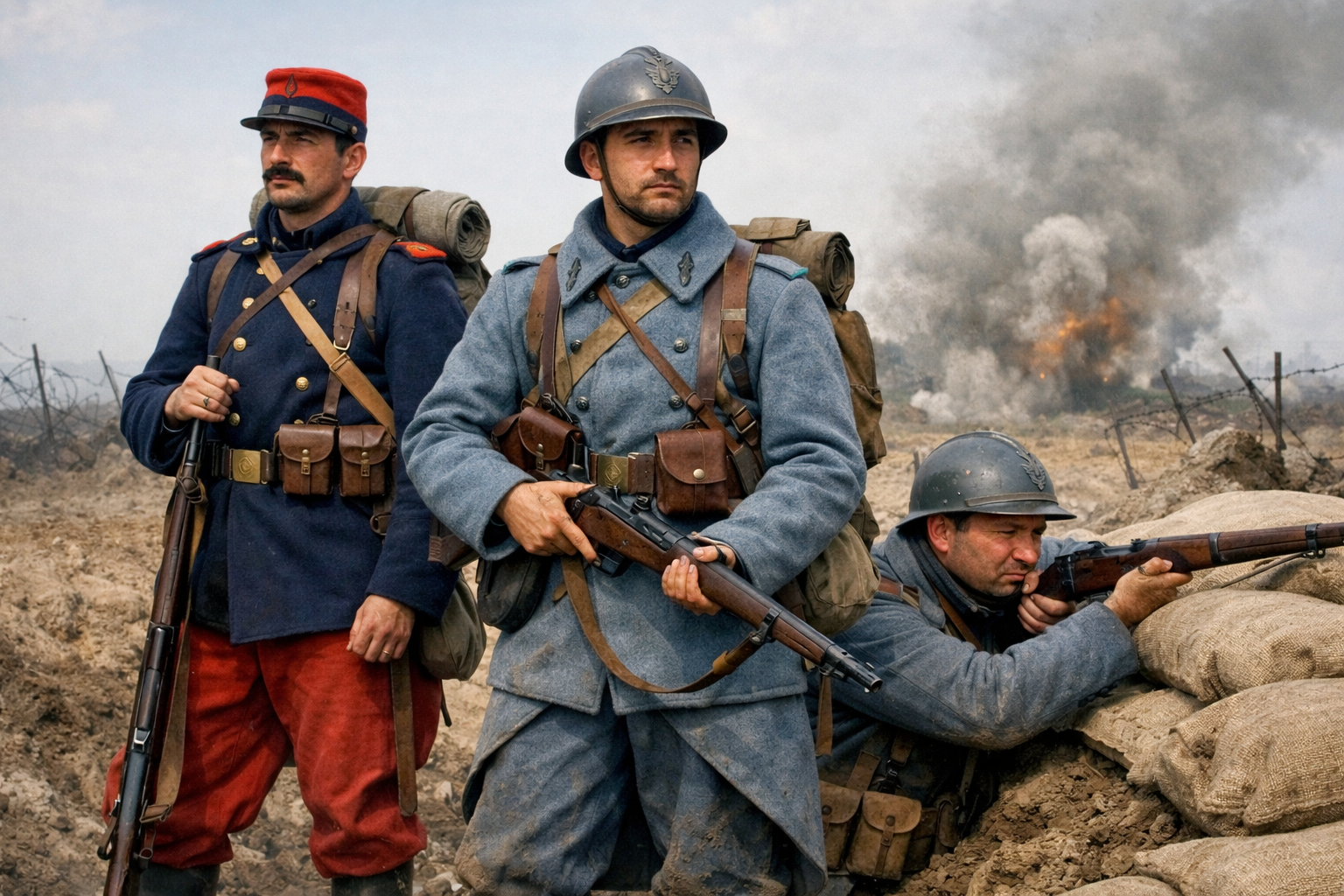
When war began in August 1914, France faced Germany with a plan built on speed and offense. The army believed morale and attack spirit would carry the day. Uniforms matched this belief. The famous red trousers and dark blue coats came from earlier conflicts. They looked strong on parade but failed in modern combat. Artillery dominated the battlefield. Machine guns punished exposed movement. Trenches spread across northern France. Soldiers in bright colors were easier to spot at long range. Soft caps offered no protection from shell fragments, which caused a large share of wounds. The problem was not bravery. It was preparation. France entered a new kind of war wearing old answers.
Uniform Features and Evolution
Materials
Early WW1 French uniforms were made mainly from heavy wool. Wool kept soldiers warm and lasted long, but it absorbed water and became very heavy in rain and mud. Records show standard cloth used coarse wool blends, chosen for durability rather than comfort. In trenches, wet wool increased fatigue and skin problems. Drying clothes was hard. Soldiers often wore damp uniforms for days.
Design Changes
The most visible change came in 1915 with the move to horizon blue. This pale blue-gray color replaced dark blue coats and red trousers. The dye used a mix of blue, white, and black fibers because pure blue dye was scarce during wartime. Horizon blue reduced contrast against sky, smoke, and distance. At the same time, the army introduced simpler cuts. Pockets became more practical. Buttons were reduced. Belts and packs were adjusted for trench life. These were slow steps, but they mattered.
Pros & Cons in Battle
At the First Battle of the Marne in 1914, French troops stopped the German advance but suffered huge losses. Visibility was a major issue. Units advancing in open ground drew fire quickly. The uniform’s bright colors offered no cover. At Verdun in 1916, conditions were different. Trench fighting dominated. By then, many soldiers wore horizon blue and steel helmets. This reduced some risks, especially from shell fragments. However, wool uniforms still struggled in mud and cold. Movement remained hard. The uniform improved safety but did not solve all problems. It was a partial fix in a brutal environment.
French Casualties Case Study (Agitate)
The scale of loss shows why uniforms mattered. During the Battle of the Somme in 1916, French forces suffered around 300,000 casualties, including killed, wounded, and missing. Artillery caused most injuries. Medical reports from the period show head wounds were common before steel helmets became standard. Early in the war, soldiers wore cloth caps that stopped neither shrapnel nor falling debris. Studies done by French military doctors in 1915 showed a sharp drop in head injuries once steel helmets were issued. At Verdun, where shelling was constant, this change was critical. Uniforms did not stop bullets, but better colors reduced exposure, and helmets reduced deadly wounds. Without these changes, losses would likely have been higher.
Solution: Uniform Improvements
The key solution was adaptation. The French army accepted that tradition could not beat modern weapons. The Adrian helmet, introduced in 1915, was light steel and easy to produce. By 1916, millions were issued. Statistics from wartime medical services showed head wound deaths fell by a large margin after adoption. Horizon blue uniforms reduced visibility compared to earlier designs. Equipment placement improved comfort and movement. These changes did not end suffering, but they showed learning under pressure. France’s uniform evolution became a model for other armies. It proved that small design choices could save lives.
FAQs
Why did France start WW1 with bright uniforms?
They were based on older wars and beliefs about morale and attack spirit.
What was horizon blue?
A light blue-gray cloth adopted in 1915 to reduce visibility.
When were steel helmets issued?
From 1915 onward, widely used by 1916.
Did uniforms really affect casualties?
Yes. Medical data showed fewer head wounds after helmet use.
Were French uniforms better by 1918?
They were more practical and safer, though still heavy and basic.
Did wool cause problems?
Yes. It absorbed water and added weight in trenches.
Conclusion
WW1 French uniforms tell a clear story. At first, they reflected pride and past success. In modern war, that approach failed. High casualties forced change. Through horizon blue cloth, steel helmets, and practical design updates, France adapted. These uniforms did not win battles alone, but they reduced risk and saved lives. In the mud of the Marne, the shellfire of the Somme, and the grind of Verdun, what a soldier wore mattered. Cloth, color, and steel became quiet tools of survival in France’s long Great War struggle.
