WWI AND KOREAN WAR AMERICAN UNIFORMS: FACTS, FEATURES, AND FIELD LESSONS
Published on Feb 12, 2026
Introduction
Imagine marching for miles in heavy wool clothes soaked with rain. Or standing guard in sub-zero weather with boots that freeze stiff overnight. That was real life for US soldiers in World War I and the Korean War.
Uniforms were not just about looks. They were survival gear. If they failed, soldiers paid the price. In World War I, American troops fought in trenches filled with mud, water, and gas attacks. In Korea, they battled mountains, snowstorms, and temperatures dropping to -30°F (-34°C).
The problem? Early uniforms were not always built for these extreme conditions.
The agitation? Poor fabric choices, weak cold protection, and limited mobility made combat harder and sometimes deadly.
The solution? Over time, the US Army improved design, materials, and layering systems based on real battlefield lessons.
Let’s break it down.
World War I US Uniforms
Key Features and Design
When the United States entered World War I in 1917, it had to quickly equip over 4 million men. About 2 million were sent overseas.
The standard uniform was the 1917 Service Uniform, often called the M1917 pattern.
Here’s what soldiers wore:
-
Service Coat: Olive drab wool, four front pockets, stand-and-fall collar
-
Breeches: Wool, knee-length, worn with leggings
-
Puttees: Long wool strips wrapped around the lower leg
-
Shirt: Wool flannel
-
Helmet: M1917 steel helmet (based on British Brodie design)
-
Overcoat: Heavy wool, about 5–6 pounds
The wool fabric weighed around 16–18 ounces per yard. It kept warmth in but absorbed water easily.
The M1917 helmet was made of manganese steel. It was designed mainly to stop shrapnel from artillery shells, not direct rifle fire. US Army reports show that head wounds dropped significantly after helmet adoption. British data (which influenced US adoption) recorded a sharp reduction in fatal head injuries after 1916.
But problems remained.
Wool uniforms became heavy when wet. In trench warfare, mud and rain were constant. Soldiers reported skin infections and trench foot due to damp conditions.
Real-World Case Study: Meuse-Argonne Offensive
The Meuse-Argonne Offensive (September–November 1918) was the largest US operation of World War I. Over 1.2 million American soldiers took part.
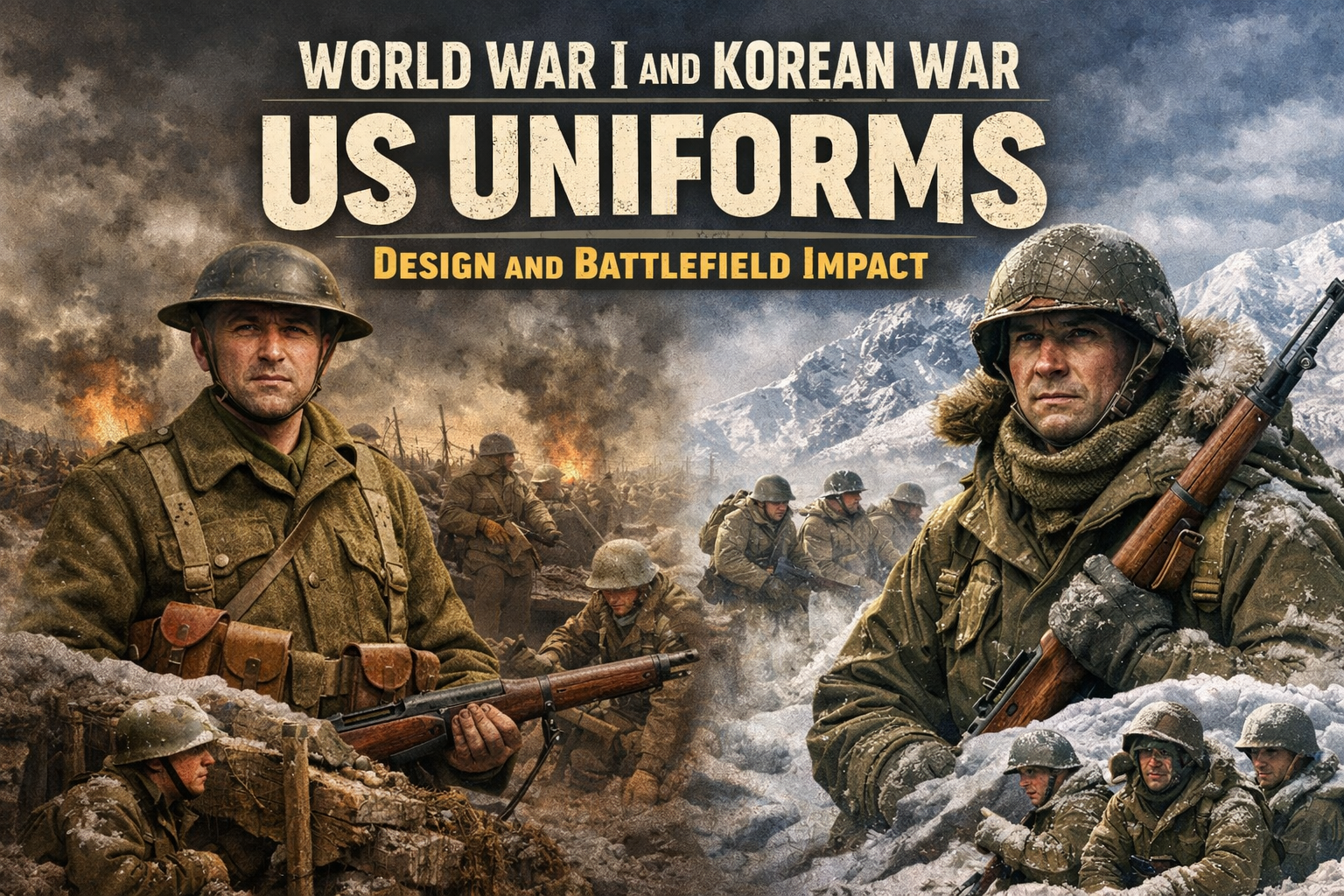
It lasted 47 days. Rain and mud were constant.
Official US Army records show over 26,000 American soldiers killed and about 95,000 wounded in this campaign.
Soldiers wrote about:
-
Heavy wool coats soaked with rain
-
Puttees filled with mud
-
Difficulty moving through thick terrain
The M1917 helmet proved useful against artillery fragments, which caused the majority of battlefield wounds. According to medical data from the war, artillery caused about 60% of casualties.
However, trench foot cases were common due to wet wool socks and poor drainage. Soldiers sometimes stood in water for hours.
So while the uniform provided warmth and basic protection, it was not ideal for long exposure to wet trench conditions.
Korean War US Uniforms
Key Features and Design
The Korean War (1950–1953) was very different. It involved mountains, snow, and extreme cold.
US forces deployed quickly in 1950. Early troops arrived wearing World War II-era uniforms.
Standard items included:
-
M-1943 Field Jacket: Cotton sateen outer shell
-
Wool shirt and trousers
-
Pile field jacket liner
-
Leather combat boots
-
Steel M1 helmet
The M1 helmet, first used in WWII, was made of manganese steel and had a fiber liner. It offered better side coverage than the WWI helmet.
But the biggest issue in Korea was cold weather.
During winter 1950–1951, temperatures in North Korea dropped to -30°F.
The Army responded by issuing:
-
Mickey Mouse boots (Vapor Barrier Boots)
-
M-1951 Field Jacket (improved wind resistance)
-
Layered clothing system
-
Parkas with liners
Production numbers were large. During the Korean War, the US mobilized about 1.8 million service members.
Still, early supply shortages meant many units lacked proper winter gear during the first winter.
Real-World Case Study: Chosin Reservoir Battle
The Battle of Chosin Reservoir (November–December 1950) is one of the clearest examples of uniform challenges.
US Marines and Army units fought in temperatures as low as -30°F.
Cold caused:
-
Weapons freezing
-
Frostbite cases
-
Boots stiffening overnight
US military reports recorded thousands of cold-weather injuries during the campaign. The 1st Marine Division reported over 6,000 non-battle casualties, many due to frostbite.
Some soldiers wore standard leather boots not designed for extreme cold. When sweat froze inside boots, it increased injury risk.
The later distribution of vapor barrier boots reduced frostbite rates in later winters.
Layering systems improved survival:
-
Cotton outer shell blocked wind
-
Wool layers trapped heat
-
Parkas provided added insulation
The lesson was clear: mobility and warmth were just as important as protection from bullets.
Pros and Cons Comparison
World War I Uniforms
Pros:
-
Wool provided warmth in cool weather
-
M1917 helmet reduced shrapnel head injuries
-
Olive drab color improved camouflage
-
Standardized production for large army (4 million mobilized)
Cons:
-
Wool absorbed water and became heavy
-
Limited rain protection
-
Puttees collected mud
-
Trench foot common in wet conditions
Korean War Uniforms
Pros:
-
Layering system allowed temperature adjustment
-
M1 helmet offered better coverage
-
Introduction of vapor barrier boots reduced frostbite
-
Field jackets improved wind resistance
Cons:
-
Early winter gear shortages
-
Cotton shells offered limited waterproofing
-
Leather boots froze in extreme cold
-
Initial reliance on WWII stock uniforms
FAQs
1. What materials were used in WWI US uniforms?
Mostly wool for coats and trousers. Helmets were manganese steel. Wool was chosen for insulation but absorbed water easily.
2. Why was the M1917 helmet important?
It reduced fatal head wounds from artillery fragments. Artillery caused the majority of battlefield injuries in WWI.
3. What made Korean War uniforms different?
They focused more on layering. Soldiers used field jackets, liners, and parkas for cold weather instead of single heavy coats.
4. What caused frostbite at Chosin Reservoir?
Extreme cold, sweat freezing inside boots, and early shortages of proper insulated footwear.
5. How many US troops served in each war?
About 4.7 million Americans served during WWI. Around 1.8 million served during the Korean War.
6. Were Korean War uniforms better than WWI uniforms?
Yes in terms of cold-weather design and flexibility, but early supply issues still caused problems.
7. Did helmets improve over time?
Yes. The M1 helmet used in Korea provided more coverage and stability than the WWI M1917 model.
Conclusion
So what’s the big takeaway?
In World War I, US uniforms were built fast for a growing army. They worked in basic ways—especially helmets—but struggled in wet trenches. Wool kept soldiers warm but also soaked up water. Movement was harder. Foot problems were common.
In Korea, the problem shifted. Cold became the main enemy. Early shortages hurt performance, but improved layering systems and vapor barrier boots showed how lessons were applied.
The pattern is clear: uniforms evolved because soldiers suffered first.
The US Army learned from mud in France and frost in Korea. Designs changed based on real battlefield data, casualty reports, and medical findings.
