FRENCH WW1 UNIFORM GUIDE: POILU GEAR, ADRIAN HELMET, AND CASUALTIES
World War 1 placed the French Army in one of the most difficult military situations in modern history. From 1914 to 1918, French soldiers—known as Poilus—fought in trenches under harsh weather, artillery fire, and constant shortages. The result was heavy human loss. French War Ministry records estimate around 1.4 million French soldiers were killed and about 4.2 million wounded during the war.
EDITORIAL DESK
Paddelaters Research Desk
ARTICLE PURPOSE
Historical reference for collectors, reenactors, and costume buyers.
LAST REVIEWED
March 06, 2026
Introduction: A Morning at Verdun
Ever wonder what a French soldier looked like in the trenches during World War 1?
Imagine the early morning of February 1916 near Verdun. A French infantry unit stands in muddy trenches while German artillery fires shells across the battlefield. The soldiers wear long coats, leather belts, and carry rifles that weigh more than four kilograms. Many still wear the early style of French uniform.
Within hours, artillery and machine-gun fire cause heavy losses. The Battle of Verdun (1916) eventually resulted in about 377,000 French casualties, according to French military archives and records from the Service Historique de la Défense.
Why were the losses so high?
Part of the answer lies in trench warfare, but another part involves equipment. The French army entered the war with uniforms designed for earlier conflicts. Bright red trousers and dark blue coats made soldiers visible in open fields. Protective helmets were also missing at first.
The French army learned quickly. By 1915–1916, new uniforms and protective gear appeared. These changes did not stop casualties entirely, but they improved survival rates in the trenches.
Let’s look closer at the features of the French WW1 uniform, the changes made during the war, and how these changes connected to the experience of the Poilu soldiers.
Main Features of the French WW1 Uniform
Poilu Uniform Details
The typical French soldier in World War 1 was called a Poilu, meaning “the hairy one.” The nickname referred to the rugged appearance of soldiers who often went weeks without shaving in the trenches.
At the start of the war in 1914, a standard French infantry uniform included:
-
Dark blue wool coat (capote modèle 1877)
-
Bright red wool trousers
-
Leather belt with cartridge pouches
-
Kepi cap instead of a helmet
-
Heavy leather boots and gaiters
-
Lebel Model 1886 rifle
The coat fabric weighed about 700–800 grams per square meter, according to French military supply manuals. This heavy wool helped in cold weather but became uncomfortable in mud and rain.
The bright red trousers were a major issue. When artillery and machine guns became common on the battlefield, soldiers wearing red cloth were easier to spot.
This visibility contributed to high casualties in early battles like the Battle of the Frontiers in 1914, where French forces suffered around 300,000 casualties in the first months, according to French War Ministry statistics.
Horizon Blue Uniform
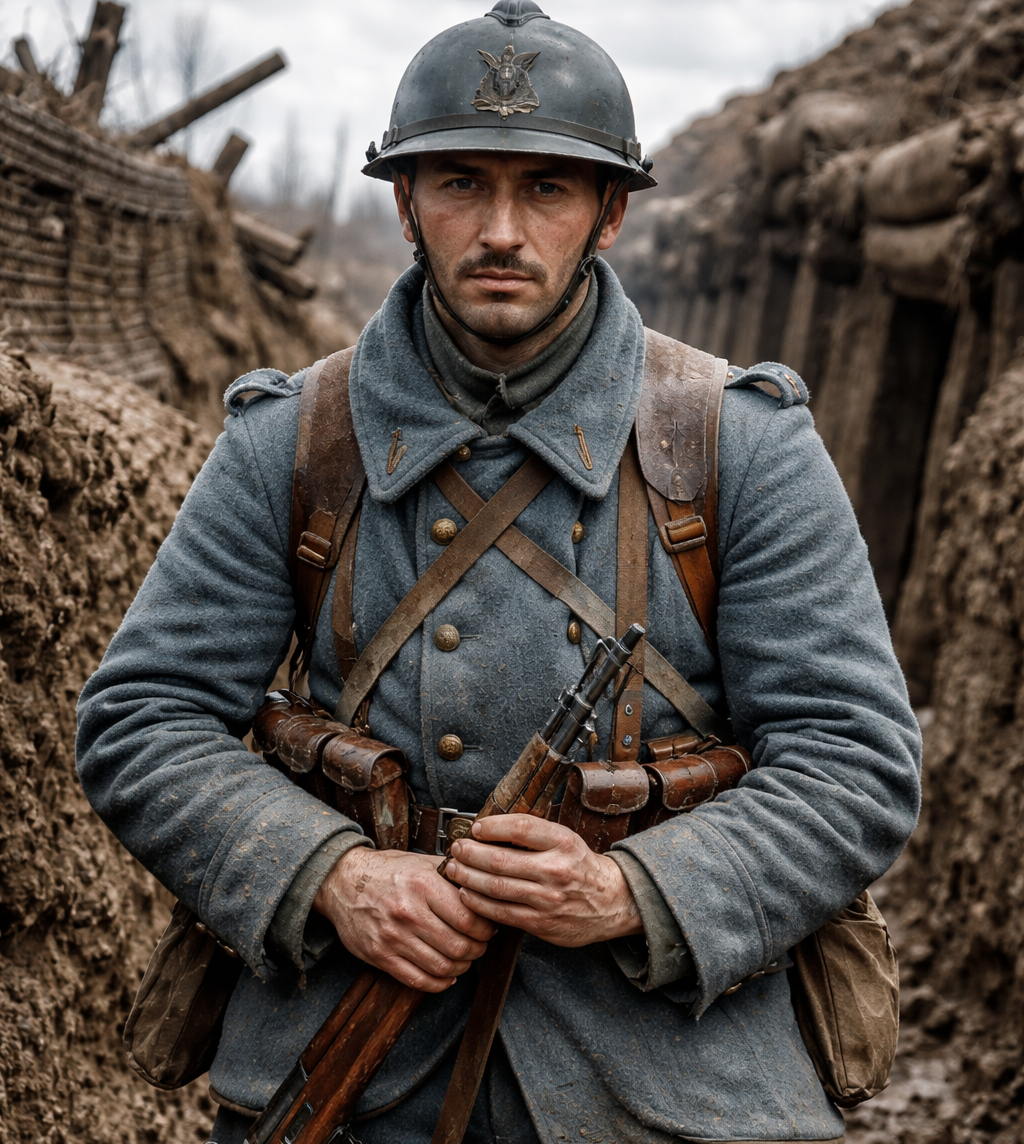
To address the visibility problem, the French army introduced a new uniform color in 1915 called horizon blue.
This fabric was produced by mixing white wool with dark blue fibers, creating a light blue-gray tone that blended better with trench landscapes.
Key specifications included:
-
Wool blend fabric for durability
-
Tunic and trousers in horizon blue
-
Reinforced stitching for field wear
-
Standard issue greatcoat for cold weather
The change reduced visual contrast on the battlefield. While it did not make soldiers invisible, it helped them blend with mud, smoke, and trench walls.
By 1916, most French soldiers had switched to this uniform.
Leather Equipment and Field Gear
The Poilu carried a variety of leather gear.
Typical items included:
-
Three cartridge pouches, each holding Lebel rifle ammunition clips
-
Leather shoulder straps for packs
-
Bread bag and water canteen
-
Entrenching tool for digging trenches
The full load could weigh 20–30 kilograms, according to equipment records in French infantry manuals.
Walking long distances with this gear in mud was exhausting. Soldiers often described the experience as similar to wearing a heavy raincoat while walking through wet clay.
Helmet Evolution
Adrian Helmet (1915)
One of the most important changes in the French uniform was the introduction of the Adrian helmet in 1915.
Before this, soldiers wore cloth caps that offered no protection from shrapnel.
The Adrian helmet featured:
-
Steel construction
-
Crest ridge on top to deflect debris
-
Weight of about 765 grams
-
Interior leather lining for comfort
According to French military testing reports, the helmet significantly reduced head injuries caused by shell fragments, which were a major cause of casualties in trench warfare.
Millions were produced and issued not only to French troops but also to soldiers in countries such as Belgium and Italy.
Pros and Cons of the French WW1 Uniform
Practical Advantages
1. Improved camouflage with horizon blue
The new color reduced visibility in battlefield environments.
2. Helmet protection
The Adrian helmet helped prevent many fatal head injuries from shrapnel.
3. Durable wool fabric
Heavy wool protected soldiers from cold weather during long trench deployments.
4. Standardized equipment
Uniform gear systems made logistics easier for supply units.
Real Drawbacks
1. Heavy clothing
The thick wool coat could absorb water and mud.
2. Early war visibility
Bright red trousers made soldiers easy targets before uniform changes.
3. Limited mobility
Full gear loads slowed movement during attacks.
4. Heat and discomfort
In summer months, wool uniforms caused overheating.
These limitations explain why uniform evolution became a priority during the war.
Real-World Examples: Uniforms and Casualties
Case Study 1: The Battle of the Frontiers (1914)
Early in the war, French soldiers fought wearing the traditional uniform with red trousers.
German machine guns and artillery caused severe losses. French military records show that hundreds of thousands of casualties occurred in the opening campaigns of 1914.
Historians often connect part of these losses to outdated uniform visibility combined with aggressive attack tactics.
The experience pushed the French army to change uniform design quickly.
Case Study 2: Verdun (1916)
The Battle of Verdun became one of the longest battles in World War 1.
French troops defending the city wore the newer horizon blue uniforms and Adrian helmets.
Despite improved gear, the fighting caused massive casualties:
-
About 377,000 French casualties
-
Roughly 300,000 German casualties
Uniform changes helped protect soldiers from shrapnel and weather, but trench warfare and artillery remained deadly.
Still, soldiers reported that the steel helmet reduced fatal head wounds compared with earlier battles.
Case Study 3: Chemin des Dames Offensive (1917)
The French offensive in 1917 resulted in around 187,000 French casualties, according to French military historians.
By this time, soldiers had the improved uniform system.
However, the battle showed that equipment alone could not overcome strong defensive positions and machine gun fire.
Uniform improvements helped with protection, but battlefield tactics and artillery remained the main causes of casualties.
FAQs About French WW1 Uniforms and Casualties
Why were French casualties so high in World War 1?
Trench warfare, artillery, machine guns, and repeated offensives caused massive losses. French War Ministry records estimate 1.4 million dead and 4.2 million wounded.
What color was the French WW1 uniform?
Early uniforms used dark blue coats and red trousers. Later versions used horizon blue, introduced around 1915.
What helmet did French soldiers use?
The Adrian helmet, introduced in 1915, was the standard protective headgear for French troops.
Who were the Poilus?
The term Poilu referred to French infantry soldiers. The word meant a rugged soldier who endured trench life.
Did the Adrian helmet reduce casualties?
Yes. Military medical reports indicated a reduction in shrapnel head injuries after helmets were issued.
How heavy was a French soldier’s equipment?
A full gear load could reach 20–30 kilograms, including rifle, ammunition, and tools.
Why were red trousers used at the start of the war?
They were part of traditional French military dress from earlier wars and had not been updated before modern warfare changed battlefield conditions.
Conclusion: Lessons from the Poilu Uniform
World War 1 forced armies to adapt quickly. The French Army entered the war with uniforms designed for older conflicts. Bright red trousers and cloth caps were not suited for modern artillery and machine guns.
Early battles proved this problem clearly. Casualties were severe, and the French army responded by redesigning uniforms and equipment.
The introduction of horizon blue clothing and the Adrian helmet became practical solutions. These changes helped reduce some injuries and improved camouflage in trench warfare conditions.
However, even improved uniforms could not fully protect soldiers from the realities of industrial war. Artillery, gas attacks, and machine guns continued to cause enormous losses.
For historians and collectors today, the French WW1 uniform tells a clear story. It shows how armies adapted to new technology and battlefield realities.
If you are collecting or studying military history, look for key features like the Adrian helmet, horizon blue fabric, and leather equipment. These details represent the experience of the Poilu soldiers who fought through one of the most demanding wars in modern history.
REQUISITION RELATED GEAR
EXPLORE MORE FIELD REPORTS
Browse all published guides and history articles.
