WW1 GERMAN FELDGRAU TUNICS: WHY THE M1915 BLUSE CHANGED EVERYTHING
Imperial German WW1 uniforms changed fast once trench warfare exposed early design flaws. Bright colors, stiff gear, and poor materials failed under fire. This guide walks you through those problems, shows how they worsened in the trenches, and explains why the M1915 Bluse field tunic became the practical answer. You’ll learn about materials, production facts, real soldier use, and what collectors look for today. If you’re into WW1 German feldgrau tunics or building a correct display or reenactment kit, this breakdown keeps things clear, factual, and easy to follow.
EDITORIAL DESK
Paddelaters Research Desk
ARTICLE PURPOSE
Historical reference for collectors, reenactors, and costume buyers.
LAST REVIEWED
February 06, 2026
Introduction
If you look at Imperial German WW1 uniforms at the start of the war, you’ll notice a problem right away. They were built for parade grounds, not trenches. Bright colors, stiff cuts, and shiny fittings looked sharp in peace time. In real combat, they stood out and wore out fast. Soldiers paid the price. That’s the core issue this article tackles.
World War I forced armies to rethink everything. Germany was no exception. Early uniforms failed under mud, rain, shell fire, and long marches. The shift to feldgrau helped, but it didn’t fix everything. You see that clearly when you study photos from 1914 and early 1915.
This is where the story of the M1915 Bluse field tunic begins. It wasn’t about style. It was about survival, speed of production, and keeping soldiers functional in the field. Using the PAS framework, we’ll walk through the problem, stir it a bit with real failures, and then show how the solution took shape.
If you collect Imperial German WW1 uniforms or plan a WW1 German feldgrau tunic setup, this matters. Details matter. Cuts matter. Materials matter. Let’s break it down in plain words, like two collectors talking over a table of original pieces.
Early Uniform Problems
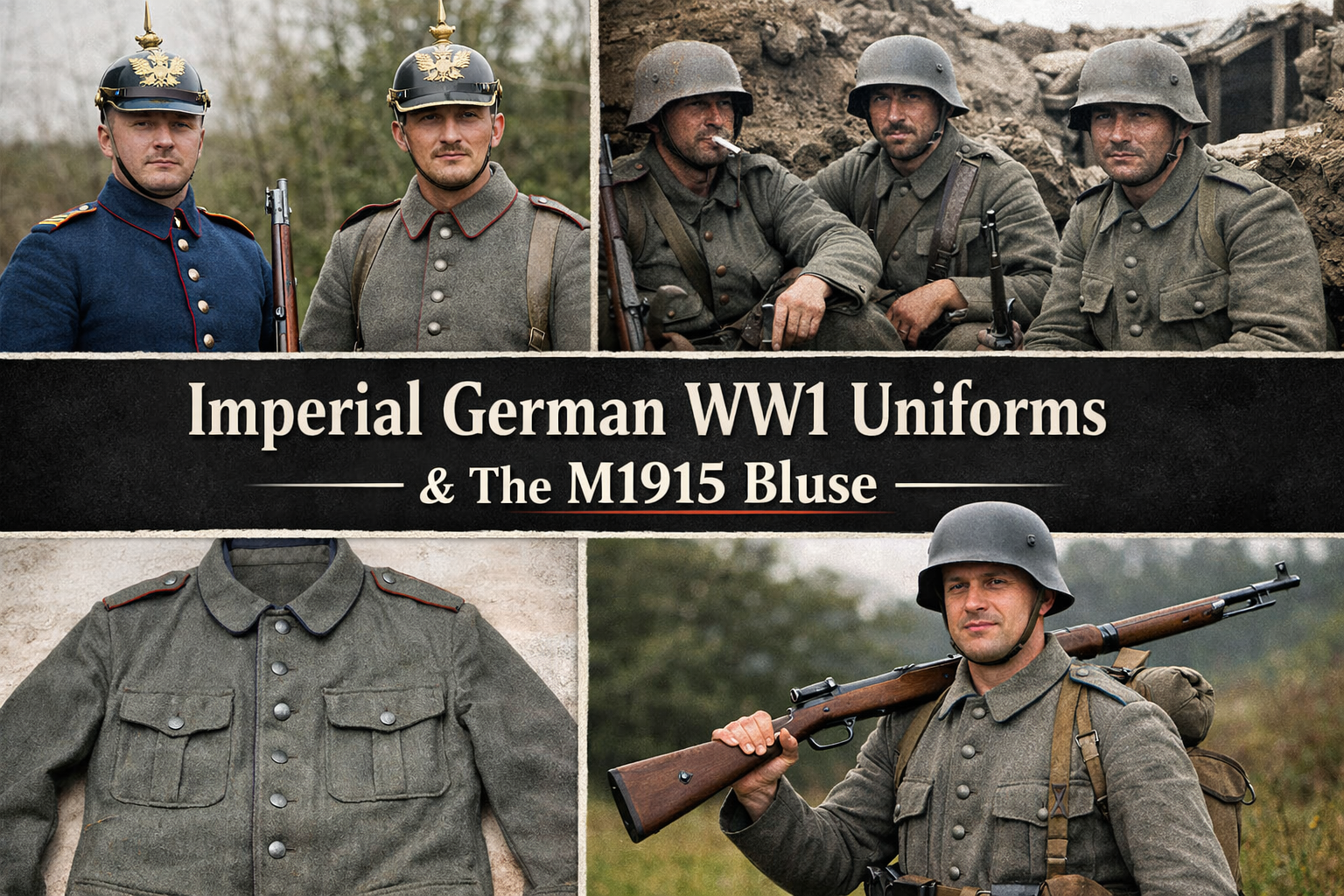
Early Imperial German WW1 uniforms carried over ideas from the 19th century. Wool tunics were well made but heavy. Buttons and piping were bright. Rank details stood out. This was fine when warfare meant short campaigns and open fields.
Once trench warfare began, these designs showed limits fast. Wool absorbed water and stayed wet. Dark blue and green shades faded unevenly. Tight cuts restricted movement. Soldiers crawling, digging, and hauling gear found uniforms working against them.
Another issue was cost and speed. Pre-war tunics used better finishes and extra tailoring steps. In 1914, Germany mobilized millions of men. Clothing them with older patterns slowed everything down. Factories struggled to meet demand using complex designs.
Records from army supply offices show rising complaints by late 1914. Uniforms wore out in months. Repairs became constant. This wasn’t sustainable in a long war.
Prussian Blue to Feldgrau Shift
Before 1910, Prussian blue dominated. It looked sharp but failed in combat visibility tests. Feldgrau was adopted to reduce contrast against terrain. By 1914, most field units wore some form of feldgrau.
But early feldgrau tunics still followed older cuts. They kept decorative elements and heavier cloth. Color alone wasn’t enough. Soldiers were harder to spot, but still uncomfortable and overburdened. The WW1 German feldgrau tunic needed more than a new dye. It needed redesign.
Agitating Failures in the Trenches
Trenches made every weakness worse. Mud clogged seams. Rain soaked wool. Lice spread in thick fabric folds. Soldiers spent days without changing clothes. A bad uniform became a health risk.
Supply reports from 1915 mention increased skin infections and frost issues linked to wet clothing. Tunics that took days to dry made winter worse. When men froze, combat strength dropped.
Combat also punished visibility errors. Shiny brass buttons caught light. Contrasting cuffs made arms easy targets. Small details had real consequences. These failures pushed the army to act faster.
Pickelhaube Helmet Drawbacks
The Pickelhaube helmet is iconic, but it was flawed. Leather cracked when wet. The spike made it visible. It offered limited protection against shrapnel.
By 1915, many units covered it with cloth or replaced it entirely. This mirrors what happened with tunics. Old symbols gave way to function. Uniform reform wasn’t optional anymore. It was urgent.
The M1915 Bluse Solution
The M1915 Bluse field tunic was Germany’s answer. It wasn’t perfect, but it solved many core issues. It simplified design, cut costs, and worked better in trenches.
The Bluse dropped decorative features. No colored piping. No bright buttons. Everything was toned down. This reduced visibility and sped up production.
The cut became looser. Soldiers could move, layer clothing, and work longer. Fewer parts meant fewer failures. This mattered when millions of tunics were needed fast.
By mid-1915, the M1915 Bluse field tunic became standard issue. It marked a clear shift in Imperial German WW1 uniforms toward modern field gear.
Key Features of the M1915 Bluse
The Bluse used a straight cut with four patch pockets. Pockets had simple flaps. Buttons were greyed steel or zinc. Shoulder boards stayed, but in subdued colors.
Collars were simplified. Cuffs lost complex shapes. All of this made repairs easier. A torn pocket could be fixed in the field. That was a big win.
Materials and Production Facts
Army documents list wool blends between 75–85% wool, mixed with recycled fibers later in the war. Fabric weight averaged around 700–750 grams per square meter.
Button metals shifted due to shortages. Early steel gave way to zinc. By 1916, production numbers ran into the millions annually. Exact figures vary, but depot logs confirm mass output.
Pros & Cons of M1915 Bluse
| Pros | Cons |
|---|---|
| Faster to produce | Less durable fabric later |
| Reduced visibility | Color variations common |
| Easier field repairs | Simpler look disliked by some |
| Better movement | Still heavy when wet |
Overall, the M1915 Bluse field tunic balanced speed and function better than earlier models.
Real-World Examples
Photos from the Somme in 1916 show wide use of the M1915 Bluse. Soldiers appear with mixed gear, but the tunic is consistent. Diaries mention fewer complaints about fit compared to 1914 patterns.
Modern reenactment groups report better endurance using accurate M1915 Bluse reproductions. Less strain. Better layering. That matches period feedback.
Collectors note original WW1 German feldgrau tunics often show depot stamps from 1915–1917. Wear patterns confirm long field use.
FAQs
Was the M1915 Bluse used by all units?
Most front-line units adopted it by late 1915.
Did officers wear the same tunic?
Officers often used private-purchase versions.
Are originals still available?
Yes, but condition varies widely.
Why do colors differ?
Dye shortages caused variation.
Is it good for reenactment?
Yes, it’s one of the most accurate choices.
Conclusion
Imperial German WW1 uniforms tell a clear story. Early designs failed under real war conditions. Feldgrau helped, but only the M1915 Bluse field tunic truly solved the main problems. It simplified, adapted, and delivered what soldiers needed most.
If you’re building a WW1 German feldgrau tunic setup or expanding your collection, understanding this shift matters. Accuracy starts with the right base layer.
Explore historically correct M1915 Bluse options at paddelaters.com. Built for collectors. Built for history.
REQUISITION RELATED GEAR
EXPLORE MORE FIELD REPORTS
Browse all published guides and history articles.
