Introduction
When the United States entered World War 1 in 1917, thousands of young men showed up for training. Many had never worn a military uniform before. The Army had to supply clothing for more than 4 million service members during the war, according to U.S. Army Quartermaster records. That was not easy. Early shortages meant rough wool coats, poor sizing, and boots that wore out fast. Soldiers complained about cold rain, muddy trenches, and heavy gear. Uniform problems were not just comfort issues. They affected health, morale, and even survival.
World War 2 brought a new test. This time, over 16 million Americans served between 1941 and 1945. The military had learned lessons from the first war. Still, new battlefields—from North Africa’s heat to Europe’s cold beaches—created fresh problems. Uniforms had to change. Fabric, design, and gear improved. Production scaled up to millions of sets.
In this post, you will see how U.S. uniforms evolved from WW1 to WW2. We will look at real battle examples, verified records, and practical pros and cons. Let’s start with World War 1.
WW1 US Uniforms: The Early Struggles
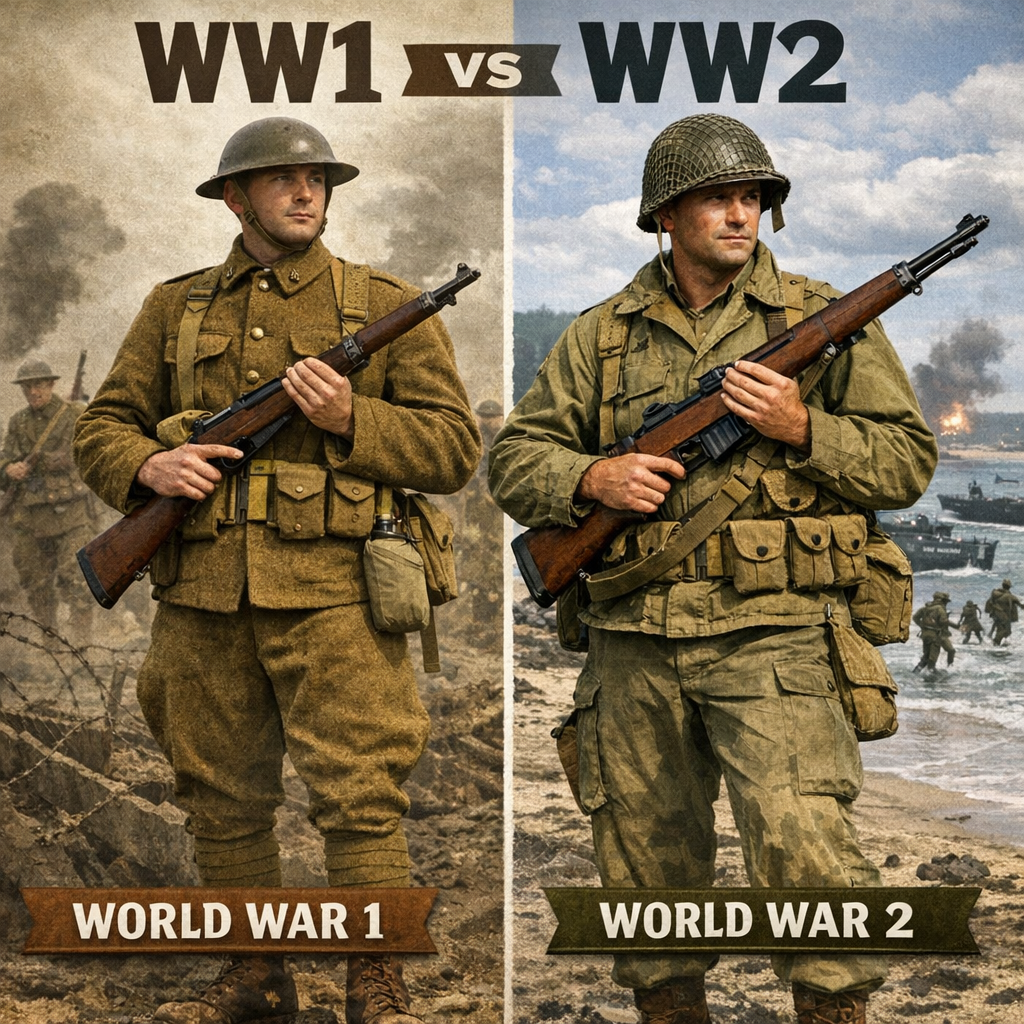
When America joined the war in April 1917, it had a small standing army. The rapid expansion exposed supply gaps. The standard field uniform was the M1917 service coat, made of olive drab wool. It replaced earlier blue dress uniforms. The change made sense. Bright colors stood out on modern battlefields.
But problems appeared quickly. Wool was heavy. In rain, it soaked up water. Soldiers in France faced cold, wet trenches. According to reports preserved by the Smithsonian National Museum of American History, doughboys often dealt with trench foot. Wet socks and boots played a role. Boots were made of russet leather with hobnails. They wore down fast in mud.
The steel helmet also arrived late. The U.S. adopted the M1917 helmet, based on the British Brodie design. Before helmets were issued widely, head injuries were common. U.S. medical data from 1918 shows that head wounds dropped once helmets became standard.
Key Features and Materials
The typical WW1 U.S. Army field uniform included:
-
Olive drab wool service coat (M1917 pattern)
-
Matching wool breeches
-
Puttees (cloth leg wraps)
-
Russet leather boots
-
Campaign hat early in training; steel helmet in combat
-
Cotton undershirts and wool socks
Wool was chosen for warmth. It could still insulate when damp. But it was itchy and heavy. The average loaded infantryman carried over 60 pounds of gear, according to Army records. Uniform weight added to that burden.
Production was massive for the time. By 1918, the U.S. had produced millions of coats and trousers. Still, size standardization was basic. Many soldiers altered their uniforms in the field.
Real-World Example: Meuse-Argonne Offensive
The Meuse-Argonne Offensive in September 1918 was the largest operation in U.S. military history at that time. Over 1.2 million American troops took part. Rain turned roads into mud. Soldiers moved through forests and trenches.
Wool uniforms provided warmth during cool nights. The M1917 helmet protected against shrapnel from artillery. According to U.S. Army medical summaries, shell fragments caused many casualties. Helmets reduced fatal head injuries compared to earlier months of the war.
However, boots failed often. Supply reports mention high replacement rates for footwear. Puttees trapped mud and water. Soldiers sometimes cut them off for relief.
WW1 uniforms solved visibility problems by using olive drab. Helmets improved survival. But comfort and flexibility were limited. These lessons shaped the next war.
WW2 American Uniforms: Built for Battle
By 1941, the U.S. Army had studied past mistakes. The Quartermaster Corps redesigned clothing for mobility and climate. The standard early-war field uniform was the M1941 field jacket paired with wool trousers. It looked lighter and shorter than WW1 coats.
The M1941 jacket was made from cotton poplin with a light wool lining. It was easier to move in. It dried faster than full wool coats. However, soldiers in Europe soon complained that it was not warm enough in winter.
As the war progressed, the Army introduced the M1943 field uniform. This was a big step forward. It included a longer field jacket with multiple pockets and layering options. Soldiers could wear wool liners underneath. This system approach improved flexibility.
Helmet design improved too. The M1 helmet replaced the old flat WW1 style. It had a deeper shape and a separate liner. The design offered better side protection and became standard across all theaters.
Design Upgrades and Pros/Cons
Major WW2 Design Upgrades:
-
Layered clothing system (especially M43 uniform)
-
Improved M1 steel helmet with liner
-
Paratrooper jump boots for airborne units
-
Herringbone twill (HBT) uniforms for hot climates
-
Better sizing and mass production
Pros:
-
Better mobility than WW1 uniforms
-
More climate flexibility
-
Improved helmet coverage
-
Stronger industrial production
Cons:
-
Early M1941 jacket lacked insulation
-
Cotton fabric wore out under heavy use
-
Supply delays in extreme climates
Production numbers were huge. The U.S. produced millions of M1 helmets and tens of millions of uniforms during the war. Industrial capacity allowed more consistent supply than in 1917.
Case Study: D-Day Landings
On June 6, 1944, over 150,000 Allied troops landed in Normandy. American soldiers wore a mix of M1941 and newer M1943 gear. Conditions were cold and wet.
The M1 helmet proved critical. After-action medical reviews noted reduced severe head injuries compared to WW1 data. Soldiers carried heavy packs, sometimes over 70 pounds including gear.
The M1941 jacket offered freedom of movement. But in cold winds off the English Channel, it was not warm enough. Many units later shifted to the M1943 system.
Pros during D-Day:
-
Helmet protection
-
Better boot traction than WW1
-
Improved pocket storage
Cons:
-
Limited cold resistance early on
-
Water resistance still basic
Even with flaws, WW2 uniforms showed clear progress from WW1.
Pros & Cons Comparison
| Feature | WW1 Uniforms | WW2 Uniforms |
|---|---|---|
| Main Fabric | Heavy wool | Cotton + wool layers |
| Helmet | M1917 (shallow) | M1 (deeper, liner system) |
| Mobility | Limited | Improved flexibility |
| Climate Adaptation | Basic | Layered systems |
| Production Scale | Millions | Tens of millions |
WW1 Strengths:
-
Warm wool fabric
-
Camouflage color shift to olive drab
WW1 Weaknesses:
-
Heavy when wet
-
Poor sizing and comfort
WW2 Strengths:
-
Modular clothing system
-
Improved head protection
-
Better industrial supply
WW2 Weaknesses:
-
Early jackets lacked warmth
-
Cotton durability issues
FAQs
1. What fabric was used in WW1 US uniforms?
Mostly olive drab wool for coats and trousers, with cotton underlayers.
2. What helmet did US soldiers use in WW1?
The M1917 steel helmet, based on the British Brodie design.
3. How did WW2 uniforms improve mobility?
Shorter jackets, lighter materials, and better boot design helped movement.
4. What was the M1 helmet?
A steel helmet introduced in WW2 with a separate liner and deeper coverage.
5. Were WW2 uniforms warmer than WW1?
Later WW2 uniforms with layering were more adaptable, but early versions were not always warmer.
6. How many Americans served in WW1 and WW2?
About 4 million in WW1 and over 16 million in WW2.
7. Why did uniforms change color?
Bright blue was replaced with olive drab to reduce visibility on modern battlefields.
Real-World Collector Tips
If you collect WW1 or WW2 uniforms, authenticity matters. Check stitching patterns and fabric type. WW1 wool has a coarse feel. WW2 HBT uniforms have a distinct twill weave.
Look for correct contract stamps inside jackets. The Smithsonian and U.S. Army archives provide reference photos. Original M1 helmets have specific seam placements depending on production year.
Reproductions are common. Compare weight and hardware. Original WW1 puttees are rare in good condition. For WW2, check liner markings inside helmets.
Condition affects value. M43 jackets in original state are often more sought after than early M1941 versions.
Conclusion
Uniforms in both wars solved real battlefield problems. In WW1, olive drab wool and steel helmets reduced visibility and head injuries. But heavy fabric and limited flexibility caused discomfort. By WW2, the United States applied lessons learned. The M1 helmet, layered clothing systems, and improved production made soldiers better equipped.
No uniform was perfect. Weather, terrain, and supply always created challenges. Still, the shift from heavy single-layer wool to modular systems marked real progress.
If you study military history or collect artifacts, understanding these uniforms helps you see the human side of war. Clothes were not just fabric. They were tools for survival.