Introduction: A D-Day Officer’s Reality
June 1944. Allied troops land on the beaches of Normandy. Across the line, German officers scramble to organize defensive positions. Among them stands an officer in a feldgrau tunic, visor cap pulled low, binoculars in hand. On his head might be a later-war M42 steel helmet, simplified for speed of production. His uniform is not just clothing. It reflects years of regulation changes, supply pressure, and battlefield need.
Fast forward to today. You’re at a militaria show or scrolling eBay listings. You see what claims to be an authentic WW2 German officer uniform paired with an M42 helmet. The seller says “original.” The price is high. But is it real?
That’s the problem. The market is crowded. Reproductions are common. Some are clearly labeled. Others are not. If you don’t know the specs, you risk paying original prices for a German steel helmet M42 reproduction.
Let’s break this down in plain terms so you can spot the difference and make smart decisions.
Why WW2 German Uniforms Matter
From 1935 to 1945, the German armed forces (Wehrmacht) produced over 3.5 million field tunics. Early-war models like the M36 had dark green collars. By the time of the M40 and M42, production was simplified. Materials changed. Details were reduced.
Collectors value these uniforms because:
-
They reflect wartime production shifts
-
They show rank and branch differences
-
They connect to major campaigns like France 1940 or the Eastern Front
A vintage Wehrmacht tunic M40 or officer-grade field blouse tells a story of regulation changes and supply pressure. That history is what you’re buying.
But that same demand also drives fakes.
Officer Uniform Features You Must Check
Let’s talk real specs. No hype. Just facts.
Tunic Fabric
-
Standard field tunic weight: around 9oz wool feldgrau
-
Officers often purchased private-tailored versions
-
Higher-quality wool, but still regulation color
-
Four front pockets
-
Five-button front (later simplified)
Check the wool. Original wartime wool feels dense but worn. Reproductions sometimes use lighter modern blends.
Collar and Insignia Placement
-
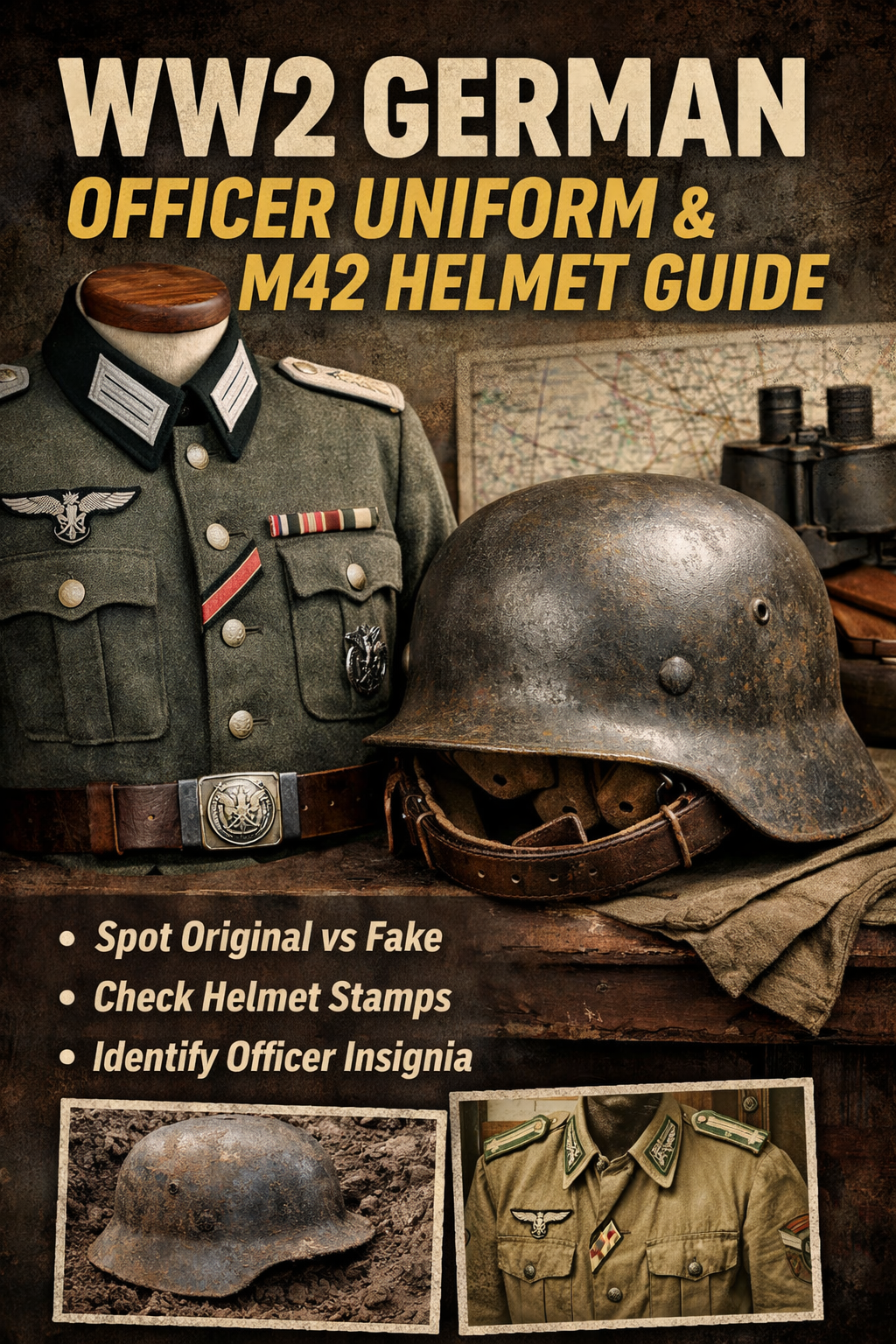
Early tunics: dark green collar (M36)
-
M40 and later: field-grey collar
-
Officer collar tabs hand-stitched
-
Breast eagle machine- or hand-sewn
Look at stitching. Wartime sewing is tight but not perfect. Bright white thread on an “aged” tunic is a red flag.
Shoulder Boards
Officer shoulder boards use twisted cords. Piping color shows branch:
-
White = Infantry
-
Pink = Panzer
-
Red = Artillery
Modern sets often use synthetic thread. Originals show age and slight dulling.
M42 Steel Helmet Breakdown
The M42 steel helmet was introduced in 1942. It simplified earlier models like the M35 and M40.
Key differences:
-
No rolled edge (raw cut rim)
-
Simplified manufacturing
-
Thinner finishing process
-
Reduced decals
Shell thickness averaged around 1mm to 1.1mm steel. Some late-war batches show thinner steel due to shortages.
Stamps and Markings
Inside the shell:
-
Manufacturer code (e.g., ET, NS, Q)
-
Lot number stamped at rear
You may see references to stamping variations such as production codes and batch numbers. Originals show clean but aged stamp impressions. Fresh, sharp stamps on a rusty shell should make you pause.
Liner Specs
-
Leather liner with 8 or 9 tongues
-
Aluminum or steel liner band (early aluminum phased out)
-
Drawstring inside liner
Reproduction liners often use new leather with uniform color. Originals show sweat darkening and natural wear.
The Real Problem: Spotting Fakes in Crowded Markets
Online listings make it easy to buy WW2 German field uniform online. But here’s the issue:
-
Parts are mixed (original shell, reproduction liner)
-
Insignia added post-war
-
Artificial aging applied
You might see a helmet dug from the Eastern Front. Sellers sometimes claim “battlefield recovery.” While many M42 helmets were issued to over 1 million troops after 1942, not every rusty helmet is authentic.
There are claims that up to 80% of certain Eastern Front relic helmets come from recovery digs. That sounds impressive, but condition matters. Corrosion, pitting, and missing liners reduce value.
If you don’t know what to look for, you can lose serious money.
Agitating the Risk: What Happens If You Guess?
Let’s say you pay full price for what you think is an original officer tunic. Later you learn:
-
The collar tabs are modern copies
-
The thread is synthetic
-
The tunic body is a post-war reproduction
Now resale value drops fast.
Same with helmets. A German steel helmet M42 reproduction might cost a few hundred dollars. An original with intact liner and stamps can cost much more. Mix them up, and you overpay.
That’s why details matter.
The Solution: A Practical Collector’s Checklist
Bring this checklist to shows or use it when browsing online.
Uniform Checklist
-
Check wool density and weave
-
Look for period stitching methods
-
Confirm correct insignia placement
-
Examine button backmarks
-
Inspect interior stamps or depot marks
Helmet Checklist
-
Confirm raw edge (not rolled like M35)
-
Inspect shell thickness and weight
-
Verify manufacturer stamp
-
Check liner band material
-
Look for consistent aging inside and out
Never rely on just photos. Ask for inside-shell close-ups and liner shots.
Pros & Cons of Collecting Original Gear
| Aspect | Pros | Cons |
|---|---|---|
| Historical Value | Direct link to WW2 history | Hard to verify without experience |
| Investment | Originals often retain value | High upfront cost |
| Display | Authentic look and feel | Fragile materials |
| Resale | Strong collector demand | Market flooded with fakes |
| Research | Deep dive into production changes | Time-consuming learning curve |
Original gear carries real weight—literally and historically. But the risks are real too.
Real-World Collector Examples
Example 1: Eastern Front Helmet Recovery
A collector purchases an M42 shell dug from Russia. Stamp matches known maker code. Liner missing. Price lower due to corrosion. After verification, value increases when paired with period-correct liner.
Example 2: Afrika Korps Officer Tunic
Surviving desert uniforms show lighter wear patterns. Sand exposure affects fabric differently than Eastern Front mud. Comparing wear helps confirm authenticity.
Example 3: Modern Reenactment Gear
Reenactors often use accurate reproductions of WW2 German camouflage smock patterns. These are fine for events but should never be sold as originals. Fabric feel and label tags often reveal modern production.
Learning from these examples helps you avoid costly mistakes.
FAQs
1. How to authenticate M42 stamps?
Check manufacturer code and lot number placement. Compare with documented wartime maker lists. Look for consistent aging inside the stamp impression.
2. What is the difference between M40 and M42 helmets?
The M42 lacks the rolled edge found on M35 and M40 models. It has a raw-cut rim.
3. Are all officer tunics private purchase?
Many officers bought higher-quality tunics, but they still followed regulation design and color standards.
4. How can I tell if insignia were added later?
Check stitching thread age and wear consistency. Fresh thread on aged wool suggests post-war addition.
5. Is a rusty helmet automatically authentic?
No. Corrosion alone proves nothing. Always confirm stamps and liner parts.
6. Can I safely buy WW2 German field uniform online?
Yes, but request detailed photos, provenance, and return policy. Avoid vague listings.
Wrap-Up: Buy Smart, Collect Smart
Collecting German WW2 uniforms is serious business. The difference between a true authentic WW2 German officer uniform and a reproduction can come down to wool weight, stitch style, or a small stamp inside a helmet shell.
Take your time. Study production changes from M36 to M42. Learn shell codes. Compare liner materials. When in doubt, ask experienced collectors.
If you’re ready to expand your collection, browse carefully curated surplus and reproduction stock at paddelaters.com. Whether you’re researching a vintage Wehrmacht tunic M40 or comparing helmet variants, knowledge is your best tool.