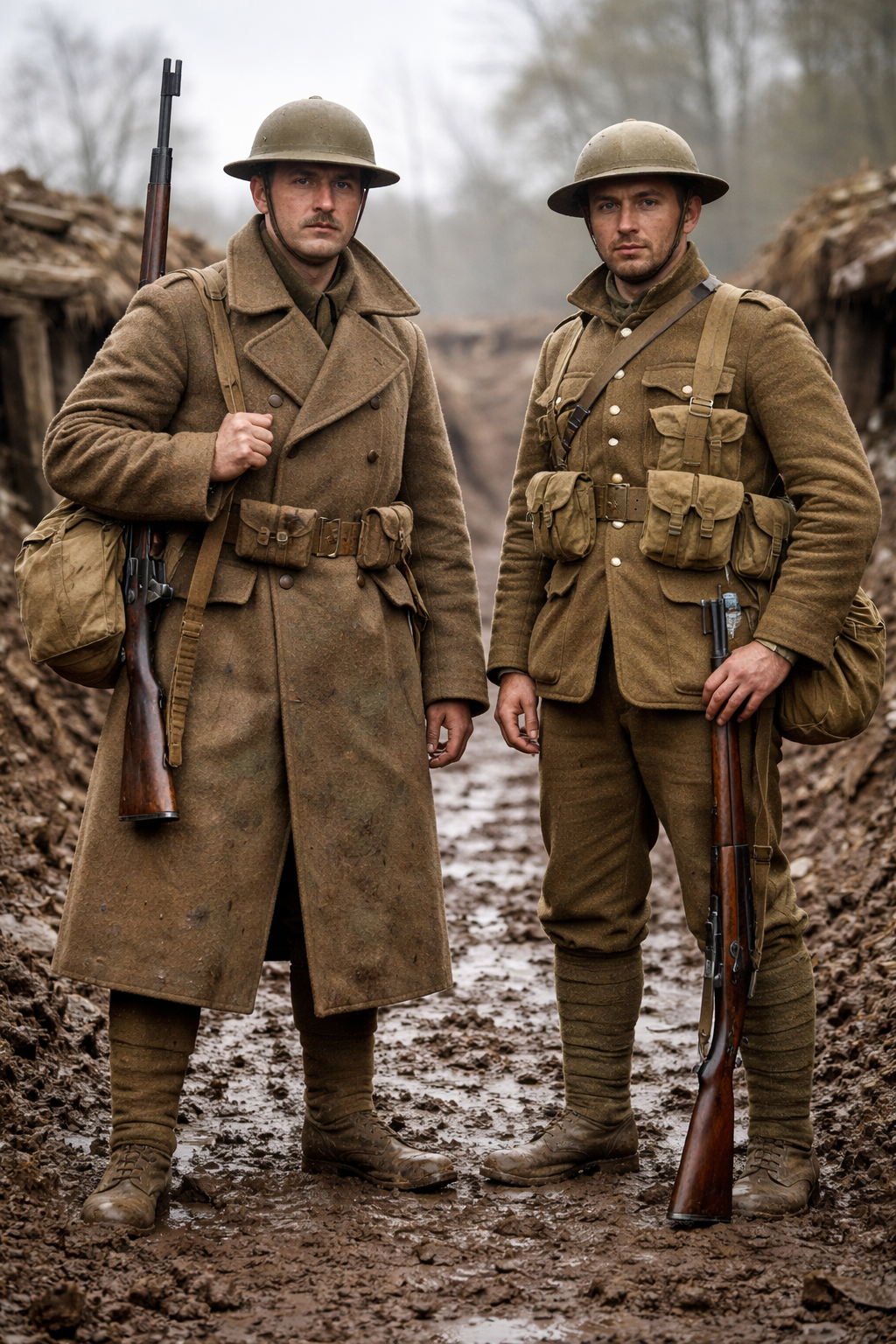
WW1 BRITISH TRENCH UNIFORM: GREATCOAT AND SERVICE DRESS TROUSERS

Published on Feb 18, 2026

Introduction

Picture this: mud up to your knees, cold rain soaking through your clothes, and the sound of shellfire in the distance. That was daily life for British soldiers between 1914 and 1918. Uniforms were not about style. They were about survival.

At the Battle of the Somme in 1916, many soldiers wrote home about wet coats that never dried and trousers stiff with mud. Records preserved by the Imperial War Museums show how trench conditions tested every piece of clothing. Soldiers in regiments like the King's Royal Rifle Corps faced long hours in waterlogged trenches. Clothing had to keep them warm, allow movement, and last for months.

The problem? Early trench warfare exposed serious limits in standard uniforms. Rain, lice, mud, and freezing winds made life harder. The solution came through practical items like the heavy wool WW1 coat and improved British trousers. In this guide, we break down how these garments worked, what they did well, and where they failed.


The Problem: Trenches That Froze Soldiers Solid

By late 1914, trench lines stretched for hundreds of miles across France and Belgium. At places like the Battle of the Somme, over one million men were wounded or killed. Many suffered as much from exposure as from enemy fire.

British soldiers were first issued the 1902 Service Dress uniform. It worked for short campaigns. It did not work for trench warfare. Rain filled dugouts. Soldiers stood for hours in water. Frostbite cases rose during winters like 1916–1917.

Letters from Ypres describe coats that grew heavy with water. Wool absorbed moisture. When soaked, it could weigh several extra pounds. Trousers stiffened with dried mud. Movement slowed. Skin infections spread because clothes rarely dried.

Medical reports from 1915–1916 mention “trench foot,” a condition caused by long exposure to damp and cold. Thousands of British soldiers were treated for it. Clothing was part of the problem. It was not designed for constant wet exposure.

This was the harsh reality. Soldiers needed warmth, flexibility, and protection from the elements. The war forced the British Army to adapt.


WW1 Coat Breakdown: Features That Mattered

The standard WW1 British coat was the 1914 Pattern Greatcoat. It was made from thick khaki wool. It was double-breasted and long, usually reaching mid-calf.

WW1 coat

Key Features

  • Heavy wool construction: Thick serge wool provided insulation.

  • Double-breasted front: Helped block wind.

  • Large collar: Could be turned up for neck protection.

  • Brass or horn buttons: Durable in rough use.

  • Belted waist: Helped trap body heat.

The coat was built for warmth, not lightness. It could weigh around 5 to 7 pounds when dry. When wet, it weighed more.

Real-World Example: Ypres

During the Second Battle of Ypres in 1915, British troops faced gas attacks and cold weather. Soldier accounts show that the greatcoat provided real warmth during night watches. Men often slept wrapped in it.

Pros:

  • Strong insulation in cold weather

  • Durable fabric

  • Useful as blanket substitute

Cons:

  • Heavy when wet

  • Slow to dry

  • Limited waterproof ability

Wool resists flame and retains warmth even when damp, which helped during shelling. But it was not fully waterproof. Soldiers often added groundsheets or improvised covers.

Despite flaws, the coat saved lives by preventing severe cold exposure. It was simple and reliable.


British MTP Pant Spotlight

The term “British MTP pant” today refers to modern camouflage trousers. During WW1, British soldiers wore khaki wool service dress trousers. These were not camouflage in the modern sense, but khaki did reduce visibility compared to bright colors used in earlier wars.

Key Features

  • Khaki wool fabric: Durable and practical

  • High waist design: Worn with braces

  • Straight cut legs: Allowed boot wrapping

  • Puttees worn below knee: Wool wraps that supported ankles

Puttees were long strips of cloth wrapped around the lower leg. They helped keep mud out of boots and provided ankle support.

Real-World Example: Somme 1916

During the Battle of the Somme, soldiers advanced across muddy fields. Reports describe trousers caked with clay. Wool trousers held up under rough crawling and climbing.

Pros:

  • Strong fabric

  • Good flexibility

  • Neutral color reduced visibility

Cons:

  • Poor water resistance

  • Heavy when soaked

  • Prone to lice infestation

Khaki was a major improvement over red uniforms of earlier centuries. It blended with dirt and fields. While not modern camouflage, it offered practical concealment.

Medical records show that keeping trousers dry was key to preventing trench foot. Soldiers rotated socks and used whale oil on feet. Clothing alone could not stop moisture problems, but better discipline improved outcomes.


Pros & Cons Comparison

Feature WW1 Coat British Service Trousers (MTP context)
Main Material Heavy wool serge Khaki wool
Warmth High insulation Moderate insulation
Waterproofing Low Low
Weight (Wet) Very heavy Heavy
Durability Strong Strong
Mobility Impact Slightly restrictive Flexible
Extra Use Blanket substitute Supported ankle with puttees

Soldiers from the King’s Royal Rifle Corps noted that the coat was “a comfort on night duty.” Others wrote that trousers “never truly dried.”

The coat worked best in freezing cold. The trousers worked best when combined with puttees and dry socks. Together, they formed a system built around endurance rather than comfort.


FAQs

1. How waterproof was the WW1 coat?
It was not fully waterproof. Wool resisted light rain but absorbed heavy water.

2. Did British soldiers have camouflage trousers?
No modern camouflage. They used khaki wool to reduce visibility.

3. How heavy was the greatcoat?
Around 5–7 pounds dry. Heavier when wet.

4. What were puttees for?
They wrapped around the lower leg to protect ankles and keep mud out.

5. Did uniforms reduce trench foot?
Not fully. Prevention required dry socks and foot care.

6. Were coats used in combat?
Often removed during attacks for mobility, but worn in cold conditions.

7. Are replicas available today?
Yes, many reenactment suppliers offer accurate wool reproductions.


Conclusion

WW1 British soldier clothing was built for survival, not comfort. The greatcoat gave warmth in freezing trenches. The khaki trousers offered durability and basic concealment. Neither was perfect. Both were tested at the Somme and Ypres.

Yet they addressed the real problem: keeping men alive in mud, rain, and cold. If you are a history fan or reenactor, studying these garments shows how simple materials met extreme conditions. Hunt for quality replicas and experience a piece of living history.

 
WhatsApp Chat