Introduction
Ever tried finding an original German WW2 uniform that hasn’t been altered, resized, or stripped of insignia? Many collectors run into the same problem. Tunics have postwar repairs. Leather coats are cracked from age. Sizes rarely match modern builds. Prices climb into the thousands, yet condition often disappoints. That frustration is real.
The Wehrmacht uniform WW2 system was built for mass mobilization, not for seventy-plus years of preservation. Wool shrinks. Leather dries out. Field repairs change original lines. During the war, soldiers wore these garments daily in mud, snow, and rain. They were tools, not museum pieces.
That is why understanding the facts behind the German WW2 uniform matters. When you know how the M36 German field blouse was constructed, or how a WW2 German officer leather coat was cut and lined, you can spot correct features. You can judge reproductions. You can build a kit that looks right and feels right.
Let’s walk through the real history—what soldiers wore, why changes happened, and what it means for collectors and reenactors today.
The Evolution of WW2 German Field Uniforms
When Germany entered the war in 1939, the standard WW2 German field uniform for the Army was the M36 tunic. It followed earlier Reichswehr designs but adapted for large-scale production. The early war Feldgrau uniform WW2 style used fine field-gray wool with dark green collars and pleated pockets.
But war changes clothing quickly.
By 1940, after campaigns in Poland and France, supply pressure increased. Millions of men required uniforms. Factories simplified construction. The result was the M40 tunic. It kept the feldgrau wool body but replaced the dark green collar with field-gray cloth. This reduced dye steps and production time.
By 1941, during the invasion of the Soviet Union, the German Army faced extreme cold. Summer-weight wool proved insufficient in Russian winters where temperatures fell below −20°C. Soldiers layered sweaters, captured coats, and later official greatcoats. Complaints appear in letters from the Eastern Front describing frozen fingers and stiff wool after snow exposure.
Further simplifications followed. The M42 removed scalloped pocket flaps. The M43 removed pleats entirely. Each step reduced tailoring time and material use. By 1944, production prioritized speed over appearance.
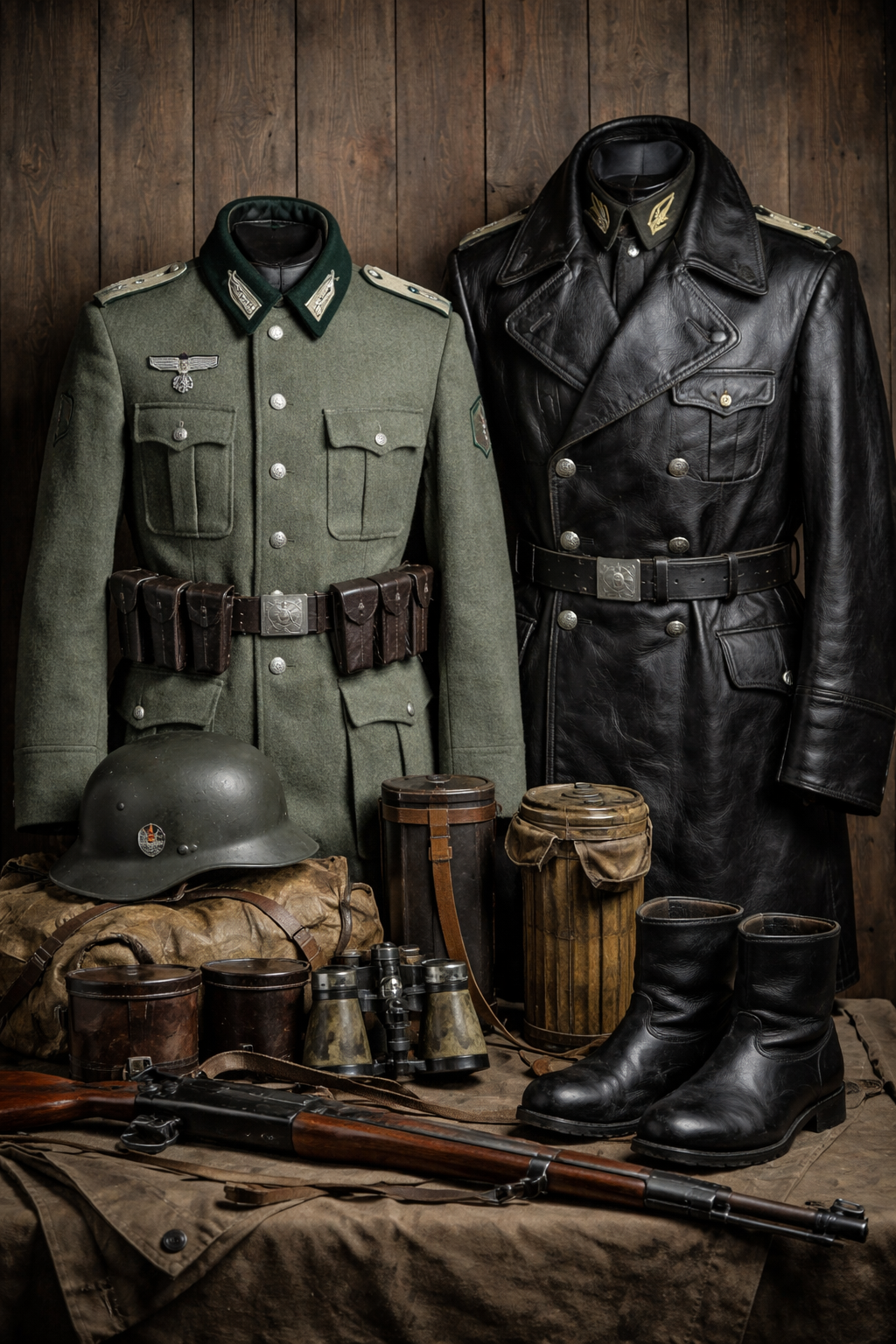
So when collectors compare early Dunkirk campaign uniforms from 1940 with late-war Ardennes gear in 1944, the difference is clear. The cut becomes simpler. Wool quality declines. Details disappear.
This evolution was not fashion. It was survival under industrial strain.
Key Features of the M36 and M40 Field Blouses
If you want to understand the core of the Wehrmacht uniform WW2 system, start with the M36 German field blouse.
Fabric and Color
The M36 used heavy feldgrau wool, typically around 550–600 grams per meter. The shade varied slightly by factory, but it stayed within a gray-green range designed for field camouflage. The dark green collar, known as “bottle green,” distinguished early war tunics.
The M40 kept similar wool weight but switched to a field-gray collar. This created a more uniform appearance and simplified supply.
Cut and Structure
Both M36 and M40 featured:
-
Four front pockets with pleats (on early models)
-
Scalloped pocket flaps
-
Five front buttons
-
Internal hook and eye closure at the collar
-
Shoulder boards for rank
The tunic was waist-length. It was meant to be worn with a leather belt and Y-straps distributing equipment weight.
Ever tried fitting into an original M36? Here’s what works. They were tailored for lean builds. The chest cut is narrow. Sleeves are shorter than modern sizing. Many originals measure smaller than the labeled size.
Insignia Placement
The WW2 German field uniform included:
-
Breast eagle on the right chest
-
Collar tabs (Litzen for enlisted)
-
Shoulder boards for rank
-
Sleeve chevrons for long service or specialty
Placement followed regulations from the Army High Command. Deviations often indicate field repair or postwar modification.
Durability in Combat
During the 1940 Dunkirk campaign, photographs show soldiers wearing clean M36 tunics with dark collars clearly visible. By contrast, Eastern Front images from 1942 display faded wool and replaced buttons. Field use caused rapid wear.
Wool resisted moderate moisture but absorbed heavy rain. Without proper drying, fabric stiffened. Soldiers brushed mud off daily to maintain function.
Understanding these details helps you judge authenticity. Stitch patterns, button types, and collar color all matter.
Inside the WW2 German Officer Leather Coat
The WW2 German officer leather coat is one of the most recognized items from the period. Often associated with senior officers, it was not standard issue to all ranks. Officers typically purchased their own uniforms through approved tailors.
Material and Construction
Most officer leather coats were made from black or very dark brown cowhide. Thickness averaged 1.2–1.4 mm. The coat was double-breasted with wide lapels and a belt at the waist. Length extended below the knee.
The interior lining was usually rayon or cotton blend. Some private-purchase coats included quilted linings for warmth.
Unlike enlisted greatcoats made of wool, leather coats offered better wind resistance. However, they were heavier. A full-length coat could weigh over 3 kilograms.
Use in the Field
In early campaigns such as France in 1940, officers are seen wearing leather coats during staff movements and inspections. On the Eastern Front, many officers switched to wool greatcoats or padded winter garments due to extreme cold.
Leather stiffens in freezing temperatures. Reports from winter 1941–42 mention cracking and limited flexibility.
Rank and Appearance
Officers’ leather coats often featured:
-
Shoulder boards indicating rank
-
Collar patches
-
Silver piping on shoulder boards
Because these coats were privately purchased, variations exist. That makes authentication more complex today.
Original WW2 German officer leather coat examples in good condition are rare. Leather dries over decades. Cracks near sleeves and belt loops are common.
For reenactors, high-quality replicas provide a safer option than wearing fragile originals.
Real-World Examples from WW2 Battles
To see how the German WW2 uniform functioned, look at real campaigns.
Dunkirk, 1940
During the advance through Belgium and France, most soldiers wore M36 tunics. Period photos show dark green collars clearly contrasting with feldgrau bodies. Equipment included bread bags, mess tins, and Kar98k ammunition pouches.
Weather was moderate. Wool performed adequately. Rapid movement meant less trench exposure compared to World War I.
Eastern Front, 1941–43
Operation Barbarossa changed everything. Soldiers marched hundreds of kilometers. Mud seasons clogged boots and coated wool tunics. Winter introduced severe cold.
Letters from soldiers describe wrapping scarves around collars and stuffing newspapers inside tunics for insulation. The Feldgrau uniform WW2 system was not designed for Siberian winters.
By late 1942, quilted parkas and reversible winter suits appeared. Tunics were often worn underneath for rank display.
Ardennes Offensive, 1944
During the Battle of the Bulge, German forces launched a winter offensive in December 1944. Many units wore simplified M43 tunics. Fabric quality was lower than early war examples.
Cold weather gear included white camouflage smocks. Officers sometimes retained leather coats during rear-area movement but relied on wool greatcoats in combat zones.
These case studies show adaptation under pressure. The uniform system evolved with climate and supply realities.
Pros and Cons for Collectors and Reenactors
If you are building a German WW2 uniform setup today, you face choices.
Pros of Originals
-
Authentic wartime materials
-
Verified manufacturing stamps
-
Historical value
Original M36 or M40 tunics carry production markings inside the lining. Some show depot stamps and size codes.
Cons of Originals
-
High cost
-
Fragile wool or cracked leather
-
Limited sizing options
Wearing a seventy-year-old tunic risks damage. Leather coats may tear at stress points.
Pros of Quality Replicas
-
Accurate feldgrau shades
-
Modern durability
-
Available sizing
Modern reproductions based on documented measurements replicate pocket shape, collar color, and stitch patterns. For reenactment, this is practical.
Cons of Poor Replicas
-
Incorrect fabric weight
-
Bright or incorrect shade
-
Wrong insignia placement
That’s why sourcing matters. Collectors and reenactors often look to trusted suppliers who focus on documented specifications rather than costume shortcuts.
If you are browsing paddelaters.com, focus on listed fabric weight, collar construction, and period-correct button types. Ask questions. Compare to wartime photos.
Frequently Asked Questions
1. How can I tell if an M36 German field blouse is original?
Check internal stamps, wool quality, and collar color. Originals usually show age, stitching irregularities, and period thread types.
2. What is the difference between M36 and M40 tunics?
The M36 has a dark green collar. The M40 uses field-gray collar fabric matching the body.
3. Were all officers issued leather coats?
No. Most WW2 German officer leather coat examples were privately purchased through tailors.
4. Is feldgrau always the same shade?
No. Dye lots varied by factory and year. Early war shades are often greener than late-war examples.
5. Can I safely wear an original leather coat?
It depends on condition. Dry or cracked leather may split under stress.
6. What size should I choose for a replica?
Measure chest, waist, and sleeve length. Originals ran small compared to modern sizing.
7. Are late-war tunics less detailed?
Yes. M42 and M43 removed pleats and simplified pockets to speed production.
Conclusion
The story of the German WW2 uniform is not about style. It is about adaptation under industrial pressure and battlefield stress. The early M36 German field blouse reflected a peacetime army with tailored detail. The M40 and later models reflected total war demands. The WW2 German officer leather coat represented personal purchase tradition within the officer corps, but even it faced limits in harsh climates.
Understanding these facts helps you collect smarter. It helps you reenact accurately. It helps you avoid costly mistakes.
If you are building a WW2 German field uniform setup, focus on documented specifications. Compare collar color. Check fabric weight. Study real campaign photos from Dunkirk, the Eastern Front, and the Ardennes.
And when you want reliable replicas built around historical measurements, browse paddelaters.com. It is easier to start with correct materials than to fix mistakes later.