Introduction
Let’s be honest. Buying a WW1 French horizon blue uniform can be confusing.
You search online. You see “authentic WW1 French tunic trousers.” Prices vary a lot. Some look right. Some don’t. But how do you know?
Here’s the problem. Many replicas mix early 1914 red trousers with 1915 horizon blue tunics. Some use the wrong wool shade. Others skip key details like pocket shape or button style. If you’re a collector or reenactor, those small details matter.
Now imagine spending serious money, only to later realize the cut is wrong or the fabric weight isn’t close to the original 1915 pattern. That’s frustrating.
The good news? The history of the French horizon blue uniform is well documented. Production numbers, fabric specs, and battlefield use during Verdun in 1916 all give us clear facts. If you know what to look for, you can buy smart.
Let’s break it down step by step.
H2: Quick History of Horizon Blue
When WW1 began in August 1914, French infantry still wore dark blue coats and bright red trousers. It looked traditional. It also made soldiers easy targets.
During the first months of the war, especially in the Battle of the Frontiers (August 1914), French forces suffered heavy casualties. Visibility on open fields played a role. The red trousers stood out.
By late 1914, the French army decided to change.
In 1915, the new “horizon blue” uniform was introduced. The color came from mixing white, dark blue, and light blue wool fibers. The result was a pale blue-gray tone. It blended better with sky and distant terrain.
By mid-1915, large-scale production was underway. Millions of meters of horizon blue cloth were ordered. The M1915 tunic gradually replaced earlier models. By 1916, during the Battle of Verdun, most front-line infantry were wearing horizon blue tunics and trousers.
This shift wasn’t about style. It was about survival.
H3: Key Parts – Tunic and Trousers Explained
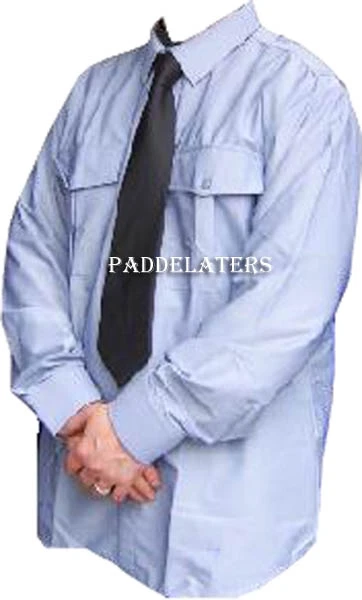
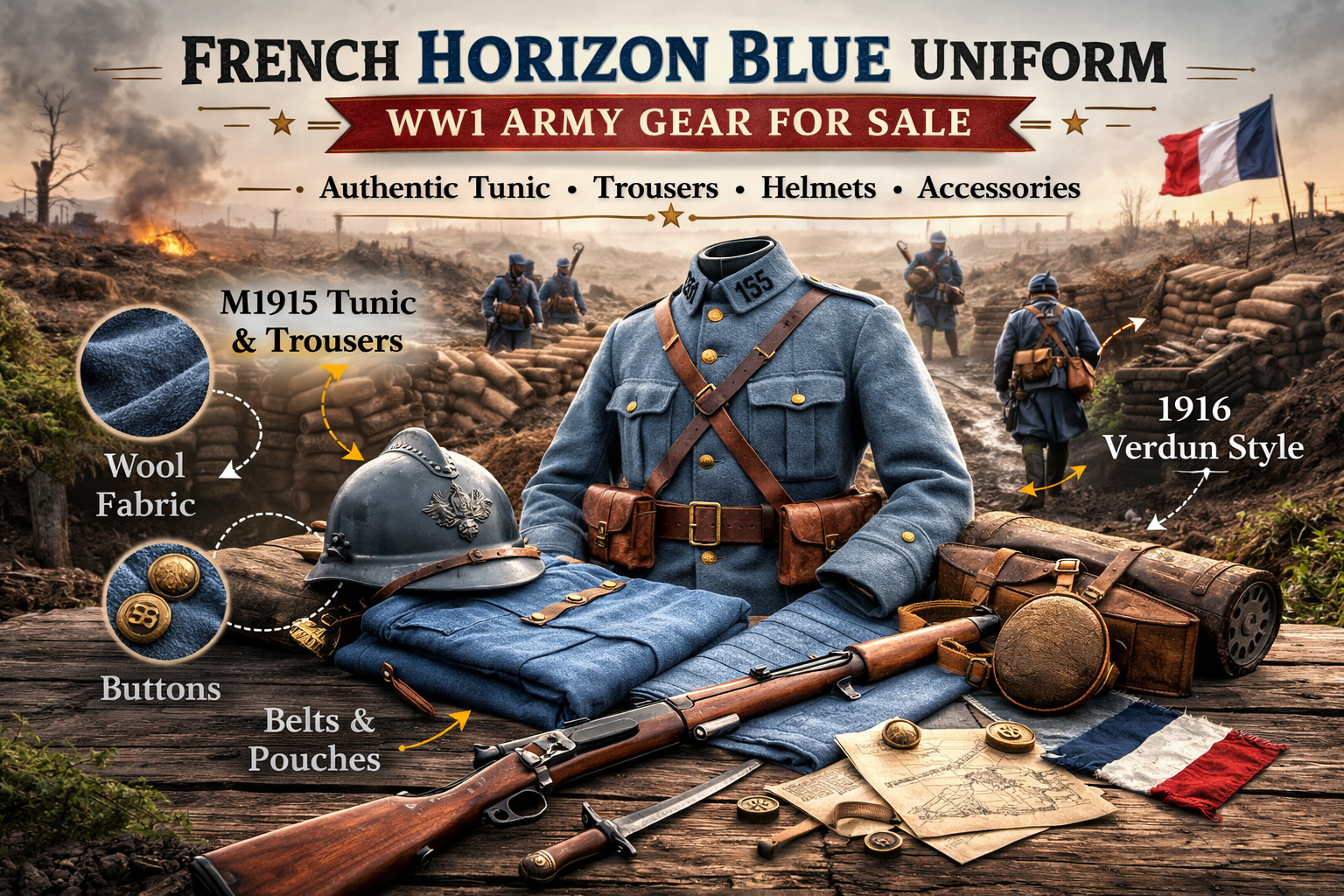
If you’re shopping for a WW1 French uniform for sale, focus on two main pieces: the M1915 tunic and the horizon blue trousers.
The M1915 Tunic
The M1915 tunic was made from wool cloth in horizon blue. It usually featured:
-
Stand-up collar
-
Four front pockets (two chest, two lower)
-
Five-button front closure
-
Simplified cut compared to earlier coats
-
Lining often in cotton
Buttons were typically metal, often stamped with the flaming grenade emblem for infantry. Some later wartime examples used simpler designs due to material shortages.
The tunic was designed for mass production. Early war coats were more complex. The M1915 reduced fabric waste and sewing time.
For replicas, check:
-
Correct pocket placement
-
Proper collar height
-
Accurate button style
-
Wool weight close to period standards
Thin costume fabric is a red flag.
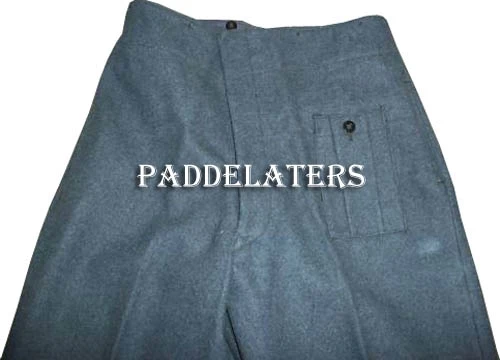
Horizon Blue Trousers
The trousers matched the tunic in color. They replaced the red “pantalon rouge” of 1914.
Key features:
-
Straight cut
-
Button fly
-
Reinforced seat in some models
-
Side pockets (varied slightly by manufacturer)
Original WW1 French trousers were not slim fit. They were practical and loose enough for movement in trenches.
When buying, avoid modern tailoring cuts. WW1 trousers had a functional military shape, not a fashion fit.
H4: From Red Pants to Blue – Real WW1 Shift
Let’s look at a real example.
In early 1914, French soldiers marched in red trousers during the opening battles. Casualty rates were high. After reports from the front, camouflage became urgent.
By spring 1915, units receiving new uniforms were transitioning to horizon blue. Soldiers at Verdun in 1916 largely wore the updated gear. Photos from Verdun show rows of infantry in pale blue-gray tunics and trousers, often worn with Adrian helmets introduced in 1915.
This wasn’t an overnight change. Some units still wore mixed uniforms for months. But by late 1915 and into 1916, horizon blue was standard.
If you’re buying a full WW1 French uniform set, make sure all components match the same period. A 1916 setup should not include bright red trousers unless you’re recreating an early 1914 impression.
H2: Features of Authentic Replicas
Not everyone can buy an original WW1 French uniform. Originals are rare and expensive. So replicas are common. But quality varies.
Here’s what strong replicas should offer:
1. Correct Horizon Blue Shade
It should be a light blue-gray. Not bright sky blue. Not dark navy.
2. Wool Fabric
Original uniforms used wool. Good replicas use heavy wool or wool blends. Avoid thin polyester fabric.
3. Period Buttons
Look for correct French military-style buttons. Generic brass buttons are a warning sign.
4. Accurate Cut
Loose, straight military fit. Not tapered modern tailoring.
5. Proper Stitching
Visible machine stitching is fine, but it should reflect early 20th-century construction style.
6. Matching Set Consistency
Tunic and trousers must match in shade. Some cheap sets mix slightly different blues.
Sizing is another issue. WW1 sizing was different from modern standards. Always check measurement charts instead of assuming your usual size.
Ask sellers about:
-
Fabric weight (grams per square meter if possible)
-
Lining material
-
Production reference (M1915 pattern, etc.)
If the seller cannot answer basic historical questions, that’s a risk.
H2: Pros & Cons for Buyers
Here’s a quick table to keep things simple:
| Pros | Cons |
|---|---|
| Accurate replicas improve reenactment realism | Good wool replicas cost more |
| Horizon blue matches 1915–1918 period | Cheap versions may fade quickly |
| Strong resale value for quality sets | Sizing may differ from modern fits |
| Suitable for display and museums | Shipping heavy wool can be costly |
Buying cheap can save money short term. But poor replicas often need replacement sooner.
H2: Real-World Examples
Let’s talk about real buyers.
A reenactor group in Europe preparing for a Verdun anniversary event required full horizon blue M1915 sets. Members who bought accurate wool replicas reported better comfort during outdoor events, especially in cold weather. Thin costume versions wore out faster.
Collectors who matched their tunic, trousers, and Adrian helmet to the 1916 period created more accurate displays. Museums often prefer complete, consistent sets rather than mixed-era pieces.
Another case involves private collectors comparing early 1914 red-trouser setups versus 1916 horizon blue gear. Displays showing the uniform shift helped explain the evolution of French military strategy during WW1.
Details matter. Historical accuracy increases value and credibility.
H2: Top FAQs on WW1 French Uniforms
1. When was horizon blue introduced?
In 1915, after heavy early-war casualties.
2. Did all soldiers switch immediately?
No. The transition took months, and some mixed uniforms were common.
3. What is the M1915 tunic?
A simplified, mass-produced French army tunic in horizon blue.
4. Were red trousers used after 1915?
Mostly replaced, though some early units still had them temporarily.
5. Is wool necessary for replicas?
For realism and durability, yes.
6. What battles saw horizon blue in use?
Verdun (1916) is a key example.
7. How do I avoid fake replicas?
Check fabric, shade, button details, and seller knowledge.
Conclusion
Buying a French horizon blue uniform from WW1 doesn’t have to be risky.
Now you know the history. You understand the 1915 rollout. You know the M1915 tunic specs and trouser details. You’ve seen how the shift from red to blue changed battlefield visibility and became standard by Verdun.
The main lesson? Match your pieces to the right period. Choose proper wool. Verify the cut and buttons. Ask questions.
If you’re serious about collecting or reenacting, don’t rush the purchase.
Get your horizon blue set today — but get the right one.