Introduction
Many people recognize German military uniforms from World War II. They appear in documentaries, museums, films, and collector markets. But when people talk about these uniforms, they often focus on the image rather than the facts. For example, people easily recognize Adolf Hitler’s brown uniform or the black SS uniform, but they may not know when these designs appeared, what materials they used, or why they looked the way they did.
This curiosity creates a problem. Military history gets mixed with myths. Some people think all German troops wore black uniforms during the war. Others believe Hitler always wore the same outfit. In reality, uniforms changed over time, and different branches of the German military used different designs.
When we look closer at real historical records, things become clearer. Archives from the Imperial War Museum, the German Federal Military History Museum, and wartime photographs show detailed information about fabrics, insignia, and construction. Uniform pieces such as the M35 field tunic, SS collar patches, and officer belts reveal how these uniforms worked in practice.
This guide explains German military uniforms with a focus on Hitler’s personal uniform and the SS uniforms used during World War II. It breaks down real features, materials, and field examples so readers can understand the uniforms in a factual and simple way.
Evolution of German Military Uniforms
German military clothing did not begin in World War II. Its roots go back to the Imperial German Army of World War I (1914–1918).
During World War I, soldiers wore feldgrau, a gray-green field color. This replaced bright uniforms used in the 19th century. Feldgrau helped soldiers blend into the environment and reduce visibility on the battlefield.
After Germany’s defeat in 1918, the Weimar Republic army (Reichswehr) kept similar uniform styles. The tunics still used wool fabric and field gray color. These designs later influenced uniforms used by the Wehrmacht, the German armed forces formed in 1935.
Key Uniform Development Points
-
1915: Field gray becomes the standard combat color.
-
1935: The Wehrmacht introduces the M35 field tunic.
-
Late 1930s: The SS develops separate uniform systems.
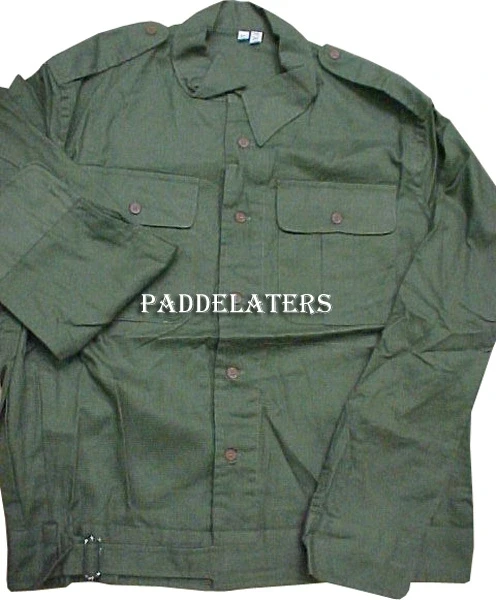
The M35 field tunic became one of the most recognized German uniforms. It used:
-
Wool fabric in field gray
-
Four front pockets with scalloped flaps
-
A dark green collar
-
Shoulder boards for rank
Many soldiers wore this tunic during the early years of World War II.
Hitler’s Iconic Uniform
Adolf Hitler did not wear a standard soldier uniform. Instead, he wore a political leadership uniform of the Nazi Party.
Most of the time, Hitler appeared in a brown uniform jacket. This design came from the Nazi Party’s paramilitary group, the Sturmabteilung (SA), in the 1920s.
The brown color had a practical origin. Large stocks of brown military shirts originally produced for colonial troops were sold cheaply after World War I. Early Nazi groups purchased them and used them as uniforms.
Hitler kept a simple version of this style.
Key Features and Materials
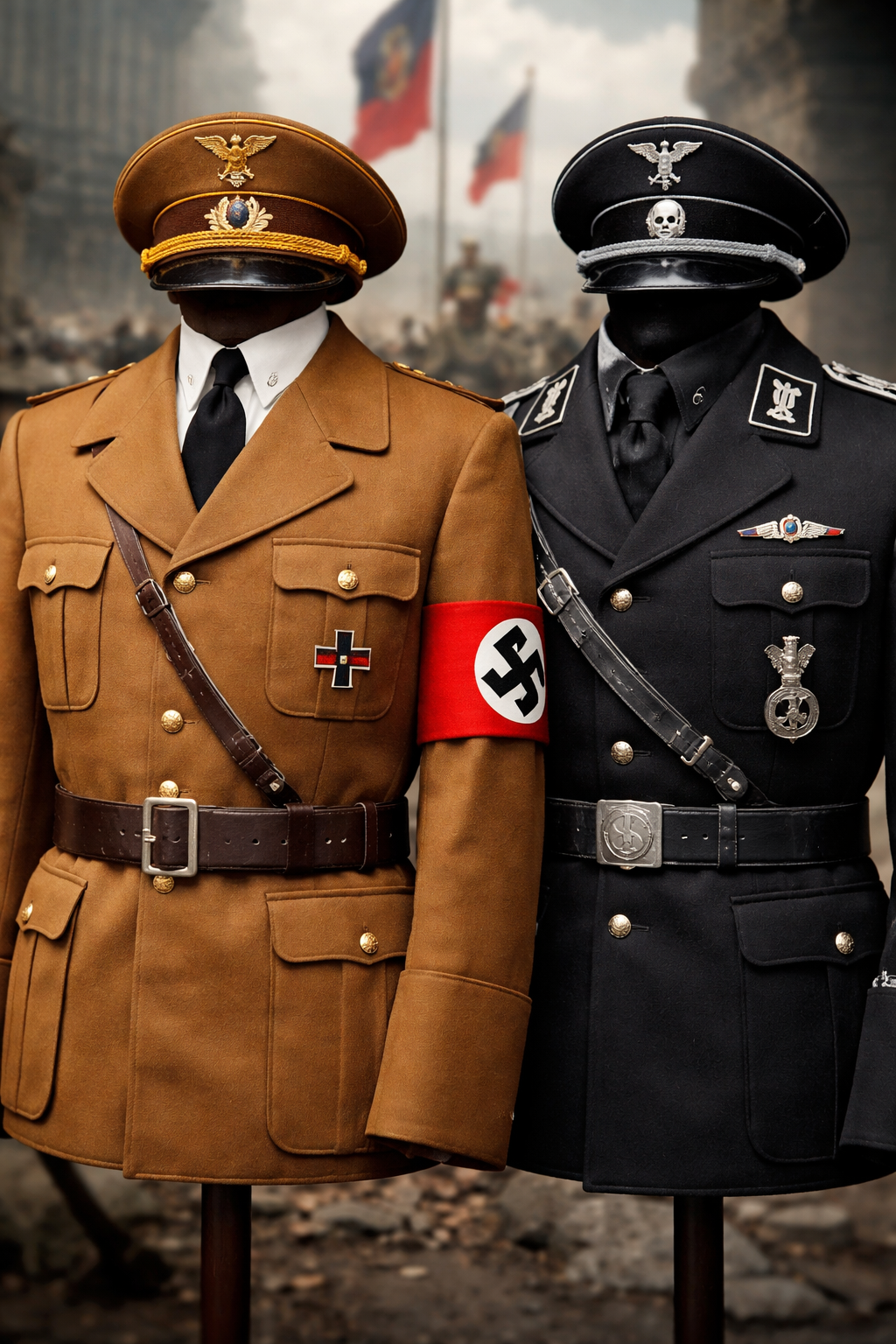
Hitler’s uniform usually included:
-
Brown wool tunic
-
Black tie and white shirt
-
Belt with metal buckle
-
Red armband with Nazi symbol
-
Party insignia on the chest
Unlike military officers, Hitler did not wear many medals or decorations. He often wore only the Iron Cross First Class, which he received during World War I in 1918.
Museum records show that several of Hitler’s uniforms were produced by German tailoring firms in Munich during the 1930s. These jackets used wool blends and cotton linings.
SS Uniforms and Their Design
The Schutzstaffel (SS) began as a small security group in the 1920s but expanded into a major organization during the Nazi period.
One of the most widely known SS uniforms is the black SS dress uniform introduced in 1932.
SS Black Uniform
The black uniform included:
-
Black wool tunic
-
Black trousers
-
White shirt and black tie
-
Leather belt with buckle
-
Silver insignia
Two important insignia appeared on the collar patches:
-
SS runes symbol
-
Totenkopf (skull emblem)
The skull emblem had earlier military roots. German units used skull symbols as far back as the Prussian cavalry units of the 18th century.
However, the black uniform was mostly used for parades and official functions. It was not practical for battlefield use.
Waffen-SS Field Uniforms
When the Waffen-SS combat units formed during World War II, they switched to field uniforms similar to Wehrmacht soldiers.
These included:
-
Field gray wool tunics
-
Camouflage smocks
-
Steel helmets
Camouflage designs used patterns like:
-
Plane tree pattern (1937)
-
Oak leaf pattern (1942)
-
Pea dot pattern (1944)
These camouflage garments were among the earliest widely issued military camouflage uniforms.
Practical Features of German Uniforms
German military uniforms combined several practical features.
Fabric and Construction
Most combat uniforms used wool fabric. Wool helped soldiers stay warm and provided durability.
Typical components included:
-
Wool tunic
-
Cotton lining
-
Metal buttons
-
Leather belts
Wool also allowed moisture to evaporate slowly, which helped in cold climates.
Insignia System
Uniforms displayed rank and unit identification through:
-
Shoulder boards
-
Collar patches
-
Sleeve eagles
This system allowed officers and soldiers to identify ranks quickly.
Pros and Cons in Historical Context
Advantages
Durability
Wool uniforms lasted through long field use. Many original examples from the 1940s still survive in museums.
Clear rank system
Insignia placement made it easy to recognize ranks.
Camouflage development
Waffen-SS camouflage patterns improved concealment compared with plain field gray.
Disadvantages
Heavy materials
Wool uniforms could become heavy when wet.
High visibility for some units
Black SS uniforms were highly visible and unsuitable for combat.
Production complexity
Detailed insignia and tailoring increased production time during wartime shortages.
Real-World Examples
Case Study 1: Battle of Stalingrad (1942–1943)
During the Battle of Stalingrad, German troops wore the M36 and M40 field tunics, both made from wool.
Winter conditions forced soldiers to add extra layers, including sheepskin coats and captured Soviet clothing.
Museum photographs show field gray tunics combined with scarves and gloves to survive temperatures below −20°C.
Case Study 2: Waffen-SS Camouflage Use
In 1943, Waffen-SS units began large-scale use of camouflage smocks.
The oak leaf camouflage pattern allowed soldiers to blend into forest environments. Military historians note that these smocks were reversible, providing different color schemes for spring and autumn.
Case Study 3: Hitler’s Personal Uniform Collection
Several of Hitler’s uniforms survived the war and are now held in museum archives and private collections.
Historical records show that Hitler often wore the same style of brown political uniform during speeches, meetings, and public appearances throughout the 1930s and early 1940s.
Case Study 4: Late War Uniform Simplification
By 1944, Germany faced shortages of raw materials.
Uniform designs changed:
-
Tunics used simpler pocket flaps
-
Collars lost the dark green color
-
Fabric quality declined
These late war uniforms appear in photographs from the Western Front in 1944–1945.
FAQs
1. Did Hitler wear a military general uniform?
No. Hitler mostly wore a Nazi Party political uniform, not a standard army officer uniform.
2. Why were SS uniforms black?
Black was chosen for symbolic and visual impact during ceremonies and political events.
3. What fabric did German uniforms use?
Most field uniforms used wool fabric with cotton linings.
4. What is the M35 field tunic?
The M35 was a German army tunic introduced in 1935, featuring four pockets and a dark green collar.
5. What does the Totenkopf symbol mean?
Totenkopf means “death’s head.” It is a skull symbol used by several German military units.
6. Did all German soldiers wear SS uniforms?
No. Most soldiers belonged to the Wehrmacht, not the SS.
7. Are WW2 German uniforms collected today?
Yes. Museums, historians, and collectors study and preserve original uniforms.
8. How can collectors identify authentic uniforms?
Authenticity checks include:
-
Fabric analysis
-
Stitch patterns
-
Manufacturer markings
-
Historical documentation
Conclusion
German military uniforms from the World War II era continue to draw attention from historians and collectors. At first glance, many people recognize the image of Hitler’s brown uniform or the black SS uniform, but the real story behind these garments is more detailed.
Historical records show how these uniforms developed from earlier German military designs. Items such as the M35 field tunic, SS camouflage smocks, and political leadership uniforms reveal practical choices about fabric, construction, and identification.
Understanding these uniforms also helps correct common myths. Not every German soldier wore black, and Hitler himself did not wear a typical army officer uniform.
By looking at real examples from battles, museum collections, and wartime photographs, we gain a clearer view of how these uniforms functioned in everyday military life. For history enthusiasts and collectors, studying these details provides a better understanding of one of the most recognizable uniform systems of the 20th century.