Introduction
If you collect or reenact, you know the problem. Finding a correct WW2 German field uniform is not easy. Many replicas miss small but important details. Wrong wool shade. Incorrect pocket shape. Boots without proper hobnails. For serious collectors, those details matter.
The German WW2 uniform changed over time, but early-war gear like the M36 German field blouse and marching jackboots set the standard. By 1940, over one million M36 blouses had been produced for the expanding army. Yet today, finding a replica that matches wartime specs can feel like guesswork.
Picture a Wehrmacht soldier trudging through mud in France in 1940. His feldgrau tunic fits close to the body. His jackboots grip the ground with iron nails in the soles. That gear was not decorative. It was built for daily field use. If you want authenticity, you need to understand the original specs first. Let’s break it down clearly and simply.
What Made the M36 Field Blouse a WW2 Staple?
Early war campaigns exposed weaknesses in older uniform designs. Soldiers needed clothing that could handle long marches, rain, and rough terrain. The answer in 1936 was the M36.
The Wehrmacht uniform WW2 standard issue in the late 1930s centered around this blouse. It was made from feldgrau wool, officially a field-gray tone. Early M36 versions featured a darker green collar, which collectors look for today.
During the 1939 invasion of Poland and the 1940 Battle of France, soldiers wore this blouse in varied climates. Reports from early campaigns show that wool retained warmth even when damp. That mattered in northern France and Belgium. However, the thick wool could feel heavy during long marches. By 1940–41, production simplified, leading to later M40 and M42 patterns.
Key Features of the M36 German Field Blouse
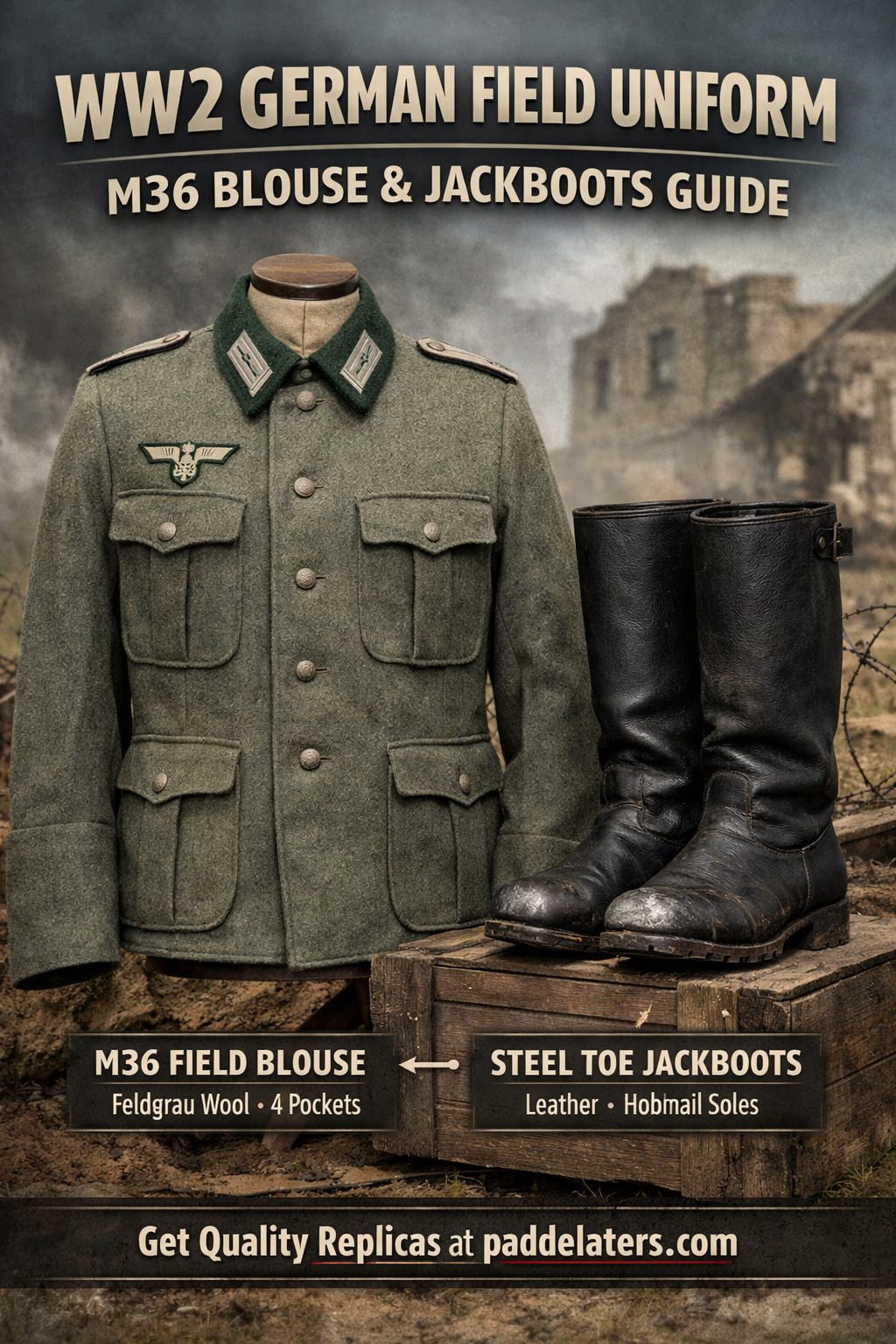
The M36 German field blouse followed strict construction standards:
-
Material: Feldgrau wool body. Early versions used higher-quality wool blends than later wartime models.
-
Collar: Dark bottle-green collar, separate from body fabric.
-
Pockets: Four pleated front pockets with scalloped flaps. Two chest, two lower.
-
Closure: Five-button front made from pebbled field-gray buttons.
-
Insignia Placement: Breast eagle on right chest, collar tabs for rank and branch color.
-
Lining: Partial lining with internal bandage pocket.
By 1940, over one million M36 blouses were in circulation. That scale of production made it one of the most recognized elements of the Feldgrau uniform WW2 system.
Collectors often confuse the M36 with the later M40. The difference? The M40 removed the dark green collar and used the same feldgrau fabric throughout to reduce cost and simplify production.
If you're looking for accurate reproductions, check period-correct options at paddelaters.com/m36-field-blouse. Attention to wool weight and pocket shape makes the difference.
WW2 German Jackboots: Built for the March
Alongside the tunic, footwear defined the early WW2 German field uniform. The standard marching boot, often called the “Marschstiefel,” was a high black leather jackboot.
Before 1943 ankle boots replaced them for cost reasons. But in 1939–41, jackboots were common across infantry units.
These boots reached just below the knee. They protected lower legs from mud, debris, and brush. Soldiers marching hundreds of kilometers during the 1940 Western campaign depended on that support.
Steel Toe Design and Durability Specs
The phrase WW2 German jackboots steel toe often comes up among collectors. While not all pairs had reinforced steel caps in the modern sense, many early-war boots included reinforced toe structure and heel irons for durability.
Key construction features included:
-
Upper Material: Thick blackened cowhide leather.
-
Sole: Leather sole with iron hobnails for traction.
-
Heel: Stacked leather heel reinforced with heel irons.
-
Toe Area: Reinforced structure to prevent collapse during long marches.
-
Height: Approximately 14–16 inches depending on size.
Hobnails provided grip on dirt and cobblestone but could slip on smooth indoor floors. During the 1940 campaign in France, soldiers marched long distances on mixed terrain. Boots with hobnails reduced sole wear significantly.
On the Eastern Front in 1941, leather boots combined with wool socks and foot wraps helped retain warmth. However, in extreme winter conditions, standard jackboots were not enough without additional insulation.
For accurate reproductions, see paddelaters.com/ww2-german-jackboots. Look for correct hobnail patterns and proper shaft height.
Real-World Examples from WW2 Campaigns
Let’s ground this in real campaigns.
Battle of France, 1940
During the rapid advance through Belgium and France, German infantry relied on the M36 blouse and jackboots. Photographs from Dunkirk show soldiers wearing early-pattern blouses with dark collars and tall boots.
Long marches tested stitching and leather strength. Period supply reports show heavy boot wear due to constant movement. Replacement boots were common logistical items.
Eastern Front, 1941
Operation Barbarossa brought different challenges. The wool Feldgrau uniform WW2 design provided insulation in moderate cold. But harsh winter conditions later forced additional layers like greatcoats.
Jackboots struggled in deep mud during autumn rasputitsa seasons. Soldiers sometimes stuffed straw inside boots for insulation. Despite limitations, early-war jackboots held up structurally better than many later simplified wartime boots.
These examples show that the Wehrmacht uniform WW2 was functional but adapted over time due to climate and production pressures.
Pros and Cons for Collectors and Reenactors Today
If you’re building a complete German WW2 uniform, here’s what to consider.
Pros
-
Recognizable early-war look.
-
Strong historical documentation.
-
M36 details like green collar add authenticity.
-
Jackboots create correct silhouette for 1939–41 impressions.
-
Durable materials when properly reproduced.
Cons
-
Wool can feel heavy in warm climates.
-
Jackboots require break-in time.
-
Correct sizing can be tricky.
-
High-quality replicas cost more than generic versions.
For reenactors focusing on 1939–1941 impressions, the M36 and tall boots are essential. Later-war impressions may require ankle boots and simplified tunics instead.
Quality matters. Cheap wool blends lose shape. Incorrect pocket cuts stand out immediately. That’s why serious collectors source from specialists like paddelaters.com who focus on accurate patterns and materials.
Frequently Asked Questions
1. What wool weight was used in the M36?
Early M36 blouses used heavy feldgrau wool, generally thicker than late-war fabric due to fewer shortages in 1936–1940.
2. How do I size an M36 correctly?
Measure chest and shoulder width carefully. Original tunics were tailored close to the body. Avoid oversized fits.
3. Did all WW2 German jackboots have steel toes?
Not in the modern industrial sense. Many had reinforced toe structures and heel irons, but not always a full steel cap.
4. How should I clean wool field blouses?
Use gentle brushing and dry cleaning. Avoid machine washing, which can shrink wool.
5. Are hobnails necessary for authenticity?
Yes. Hobnails and heel irons are key visual and functional details for early-war impressions.
6. When were jackboots phased out?
Gradually from 1943 onward, replaced by ankle boots with gaiters due to leather shortages.
Conclusion: Gear Up with Quality Replicas
The early WW2 German field uniform was built for movement and durability. The M36 German field blouse defined the look of 1939–1940 campaigns. Tall jackboots supported long marches across Europe. These were practical items, not parade pieces.
If you want a correct early-war impression, focus on accurate wool shade, collar detail, pocket shape, and proper hobnails. Small details separate a casual outfit from a serious reenactment kit.
Picture that Wehrmacht soldier marching through France. His tunic fits properly. His boots grip the road. That image only works if your replica matches the historical record.
For carefully researched reproductions built to historical specs, explore paddelaters.com and gear up with confidence.