Introduction
In June 1944, American troops landed on the beaches of Normandy during the D-Day invasion. Many of them wore the same outer layer: the US Army M-1943 field jacket. It was not designed to look impressive. It was built to solve a problem. Soldiers needed one jacket that worked in rain, wind, mud, and cold European winters.
Fast forward to today. Collectors search for the authentic US army M-1943 field jacket and often hit the same wall—confusion, high prices, and too many questionable listings. Some jackets are real. Some are post-war copies. Some are modern fashion versions labeled as “WWII.”
So how do you separate fact from hype? Let’s break it down clearly—like two collectors talking over coffee.
What Makes the M-1943 Special?
Before 1943, US soldiers wore different jackets for different climates. The M-1941 field jacket was light but not warm enough. Heavy wool coats worked in cold weather but were bulky.
The answer was the M-1943 field uniform system.
The M-1943 jacket was introduced in 1943 as part of a layered system. It worked with a wool liner and other cold-weather gear. It replaced earlier designs and became standard issue during late WWII campaigns in Europe.
Historical records show that over 3 million M-1943 field jackets were produced between 1943 and 1944. That large production run is one reason originals still appear in the vintage market today.
But finding a real one? That’s where things get tricky.
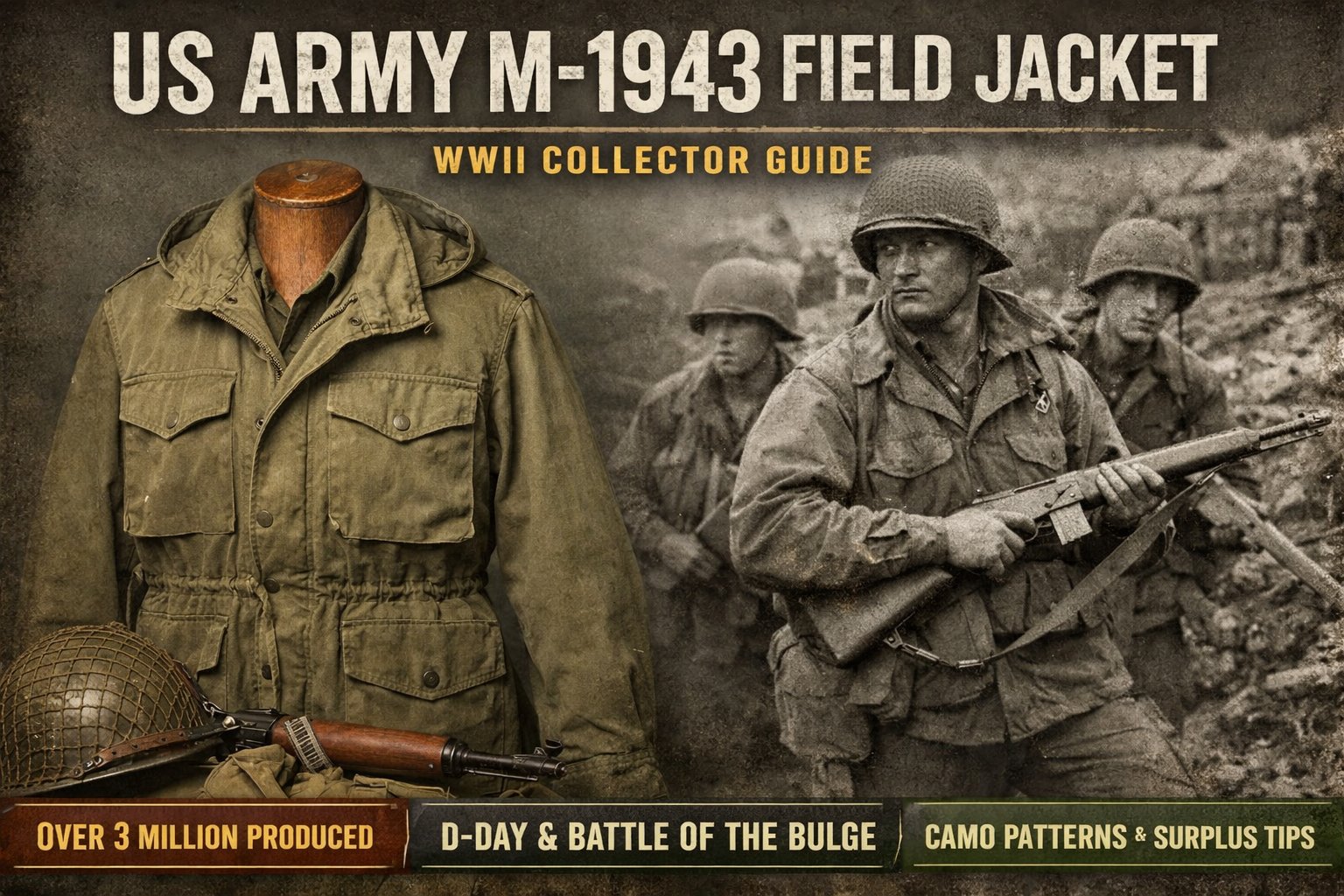
Key Features of the M-1943 Field Jacket
Let’s talk facts. No exaggeration. Just specs.
Material
-
Made from tightly woven cotton poplin
-
Treated for water resistance
-
Approximate weight: around 32 ounces (about 2 pounds) depending on size and condition
The cotton poplin shell was wind-resistant and dried faster than heavy wool coats. It was not fully waterproof, but it performed better in wet European conditions than earlier jackets.
Design
-
Four large front cargo pockets with button flaps
-
Concealed button front with storm flap
-
Drawstring waist
-
Adjustable cuffs
-
Attached hood (buttoned under collar)
The longer cut covered the hips. That mattered in muddy trench conditions.
Fit
The jacket was designed to be worn loose. Why? Because it was part of a layering system. Soldiers wore wool shirts and liners underneath. If you try one today and it feels roomy, that’s intentional.
The Problem: Finding a Real One Today
Here’s the reality collectors face.
You search for “buy original M-1943 jacket online.” You find dozens of listings. Prices range from $80 to $600. Some claim to be WWII originals. Others say “vintage style.” Some avoid clear wording.
The problems include:
-
Reproductions sold as originals
-
Post-war Korean War versions mislabeled as WWII
-
Missing tags or replaced buttons
-
Condition issues (moth damage, torn lining)
When it comes to vintage US army surplus uniforms, the details matter. A missing contract label can drop value. Wrong stitching pattern? That’s a red flag.
Now let’s agitate this a bit.
Why Fakes and Overpricing Hurt Collectors
Imagine paying $400 for what you think is a 1944 contract jacket—only to discover it’s a 1980s reproduction.
This happens more often than people admit.
Some jackets look aged on purpose. Sellers may wash them repeatedly or distress the fabric to mimic wear. Without checking:
-
Label markings (manufacturer, contract number, year)
-
Correct WWII button style
-
Fabric weave pattern
-
Proper olive drab shade (OD7 after 1943)
You can easily overpay.
Also, demand has increased. WWII collecting has grown online. That pushes prices up. A confirmed 1943 contract jacket in good condition can now sell between $250–$500 depending on size and condition.
That’s not cheap.
But here’s where the solution comes in.
The Solution: Why the Real M-1943 Still Delivers Value
Despite the confusion, the real M-1943 remains one of the most practical WWII garments you can own.
Historical Performance
-
Worn during D-Day (June 1944)
-
Used in Battle of the Bulge (Winter 1944–45)
-
Issued across European Theater of Operations
-
Part of a system that replaced older field gear
It survived rain, snow, and long marches. That alone says something about its durability.
Practical Design
Even today, the jacket works well for:
-
Reenactments
-
Film production
-
Outdoor use
-
Historical displays
The four-pocket layout is functional. The cotton poplin breathes better than modern synthetic shells in moderate weather.
Camouflage Patterns Explained
US Army Camouflage Patterns WWII
The standard M-1943 jacket itself was issued in olive drab (OD7). It was not originally produced in printed camouflage for standard infantry use.
However, camouflage entered the picture in related garments.
HBT Camouflage Types
HBT stands for Herringbone Twill. Some US Army uniforms during WWII used HBT fabric, especially in:
-
Jungle uniforms
-
Special camouflage experiments
-
US Marine Corps frog-skin patterns
The famous “frog skin” camouflage pattern was used by US Marines in the Pacific and briefly by US Army units in Europe during D-Day.
These camouflage garments were separate from the standard M-1943 field jacket but are often confused with it.
Collectors searching for US army camouflage patterns WWII should note:
-
The M-1943 jacket = solid olive drab
-
HBT camo uniforms = separate issue garments
-
Camouflage was limited and not universal
Some late-war experimental camouflage pieces exist, but they are rare and extremely expensive.
Pros & Cons
Here’s a simple breakdown.
| Pros | Cons |
|---|---|
| Durable cotton poplin shell | Not fully waterproof |
| Layering system flexibility | Can feel heavy when wet |
| Four large cargo pockets | Originals can be expensive |
| Historical authenticity | Many reproductions in market |
| Survived combat use in Europe | Sizing varies from modern fits |
The pros matter most for collectors who want history plus function.
Real-World Examples
WWII Field Use
During the Battle of the Bulge (1944–45), soldiers wore the M-1943 jacket layered with wool liners. Temperatures dropped below freezing. The jacket alone was not enough, but as part of the system, it helped soldiers survive harsh winter conditions.
Archival photos show troops wearing M-1943 jackets in muddy forest terrain. The longer cut provided better coverage than the older M-1941.
Production Scale
With over 3 million produced in 1943–1944, the jacket became one of the most widely issued US field garments of WWII.
Large production numbers explain why genuine examples still exist today—but condition varies widely.
Modern Collector Use
Today, reenactors prefer authentic M-1943 jackets because:
-
Stitch patterns match historical standards
-
Fabric drapes correctly
-
Color matches late-war olive drab
Film productions have also used original or accurate reproductions in WWII movies and series.
For collectors wanting to buy original M-1943 jacket online, verification matters more than price.
FAQs
1. How can I tell if an M-1943 jacket is authentic?
Check for:
-
WWII contract label inside
-
Correct olive drab OD7 shade
-
Button type consistent with 1943–44 production
-
Period-correct stitching
If the label is missing, look for stitching marks where it may have been removed.
2. Were M-1943 jackets used on D-Day?
Yes. Many US Army troops in June 1944 wore M-1943 jackets during the Normandy invasion.
3. Did the M-1943 come in camouflage?
Standard issue was olive drab. Camouflage versions were not typical for the M-1943 field jacket itself.
4. How much does an authentic US army M-1943 field jacket cost today?
Prices vary. Expect:
-
$150–$250 for worn examples
-
$300–$500 for good condition WWII contracts
-
Higher for rare sizes or verified history
5. Is it practical to wear today?
Yes, especially in cool weather. It works well as a light field jacket layered over sweaters or wool shirts.
6. What replaced the M-1943?
Post-war models evolved into the M-1951 field jacket and later the M-1965.
Conclusion
The US Army M-1943 field jacket was built for real combat. Cotton poplin shell. Four functional pockets. A layered system that helped soldiers through D-Day and the Battle of the Bulge. Over 3 million produced. That’s not marketing—it’s history.
For collectors, the challenge is not whether it’s iconic. The challenge is finding a genuine piece among reproductions.
If you’re serious about adding one to your collection, take your time. Verify details. Compare labels. And when ready, check current stock at paddelaters.com for available WWII-era gear and carefully sourced pieces.
Owning an authentic US army M-1943 field jacket isn’t just about clothing. It’s about holding a real part of WWII history.