Introduction
Imagine stepping into a reenactment of the Gallipoli Campaign. The sun beats down, and you're clad in a British Army uniform. The khaki fabric of the Service Dress feels authentic, fitting perfectly as you march across the battlefield, with history echoing in every step. However, the uniform you're wearing isn’t just any old replica; it's a meticulously crafted reproduction, with every detail—right down to the wool serge fabric and the brass buttons—true to history. The question remains: how do you ensure your uniform stands up to such historical scrutiny?
Collectors and reenactors often face a huge dilemma: finding historically accurate uniforms isn’t as simple as ordering off the shelf. Inaccuracies in fabric, stitching, or cut can make a significant difference. Authenticity gaps can compromise the overall experience—whether it's a reenactment, display, or even historical photography. So, how can you bridge this gap? Let’s explore the evolution of the British Army Service Dress, the challenges in collecting it, and how paddelaters.com offers the perfect solution for those aiming to own a faithful reproduction.
What is British Army Service Dress?
The British Army Service Dress (SD) is not just a uniform—it's a symbol of military history, worn by British soldiers from the early 1900s through the mid-20th century. It was the standard military attire for soldiers in both the British Army and, to a degree, in other Commonwealth countries. First introduced in 1902, it was designed for practical, day-to-day use during the British Empire’s global reach. But its historical value far exceeds its practicality. Whether during World War I or II, the Service Dress became an icon of British military service.
From Khaki Drill to Battle Dress Evolution
The evolution of the British Army Service Dress can be traced through several key phases, each influenced by both the practical needs of soldiers and the demands of the time.
Khaki Drill Uniform: The Early Years (1902-1914)
The Service Dress first made its appearance in 1902, featuring a distinctive khaki drill (KD) fabric, which was a response to the harsh conditions of British colonial deployments, particularly in the hot climates of India and Africa. The initial design used wool serge fabric at 18oz/yd², giving the uniform durability and a comfortable weight that was ideal for tropical climates.
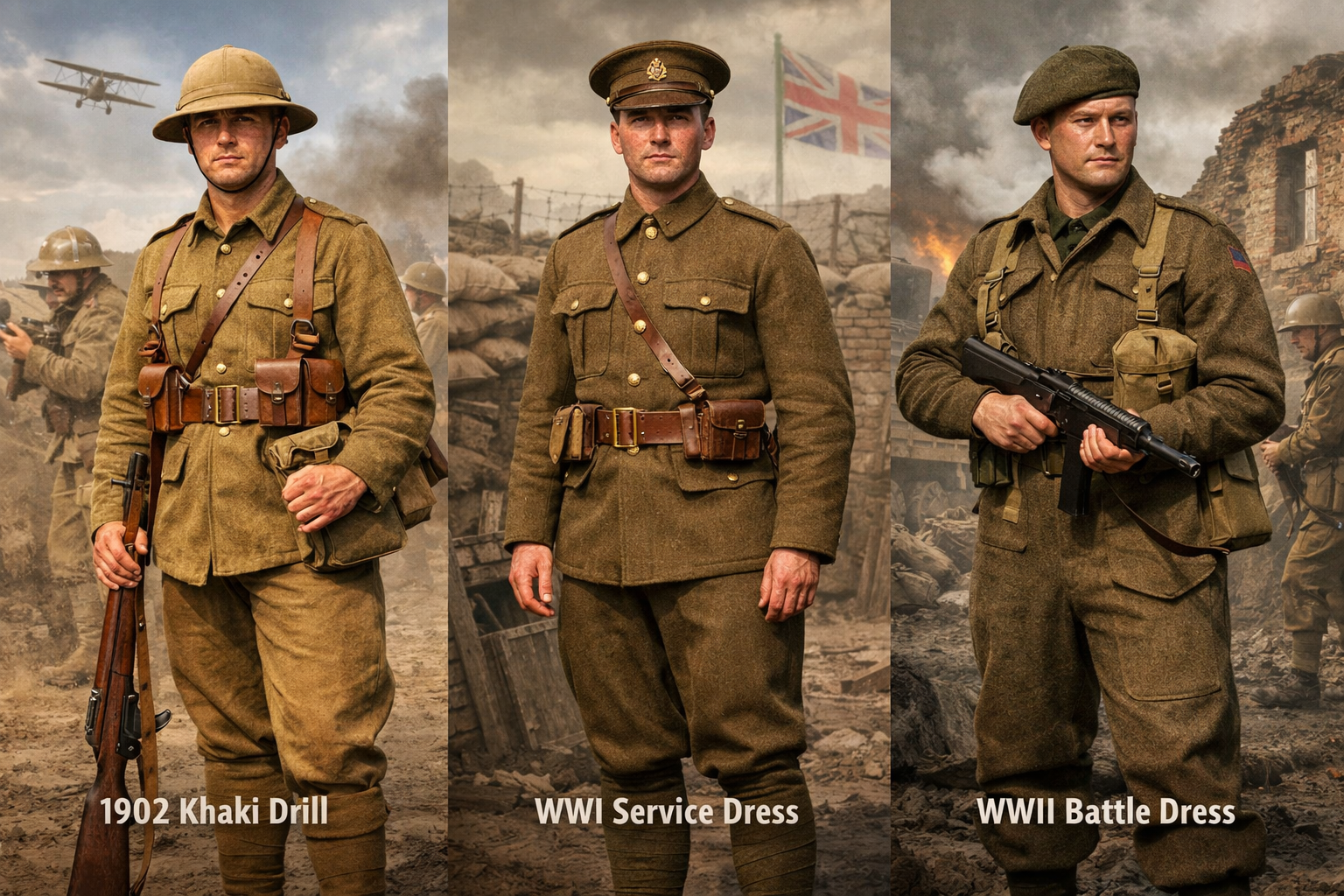
This uniform didn’t just look different; it was a practical solution. The khaki color allowed soldiers to blend in with the environment during military campaigns. The adoption of the khaki drill uniform marked a sharp departure from the traditional red coats of previous centuries, which were both impractical in combat and highly visible on the battlefield.
The Impact of WWI and the Shift to Battle Dress
The uniforms seen on the battlefields of World War I underwent some changes to meet the challenges posed by trench warfare. During the interwar years, the British Army refined the Service Dress uniform further, incorporating elements that reflected both the needs of the modern soldier and the changing military tactics.
However, by the time World War II arrived, the British Army needed something more versatile. Enter the Battle Dress (BD) uniform—a lightweight, functional alternative to the heavier and more formal Service Dress.
WWII Battle Dress: A Practical Upgrade (1939-1945)
Introduced in 1939, the Battle Dress uniform was designed for combat. It replaced the Service Dress for soldiers in active duty, offering a more streamlined fit, with a shorter jacket and a tighter cut. This allowed greater mobility for soldiers, a key advantage in the fast-moving environments of WWII. The Battle Dress was made from a wool serge fabric, similar to the earlier khaki drill, but it was cut to provide soldiers with more ease of movement and practicality.
Key Features and Components
British Army Service Dress, particularly from the 1902-1940s period, was built with several characteristic components that made it stand out.
The Jacket
The jacket was the centerpiece of the uniform. The Service Dress jacket was single-breasted, with four buttons (often brass), and featured a stand-up collar that could be turned down. The color was a distinctive khaki or olive-drab, depending on the period, and it had pleated breast pockets.
For the Battle Dress, the jacket’s fit became more streamlined and shorter to allow for movement, as it was designed specifically for combat scenarios.
Trousers and Belt
The trousers were a key part of the uniform's functionality. The Service Dress trousers were often pleated, with a straight cut. The Battle Dress trousers were more utilitarian, featuring a looser fit, ideal for the active demands of soldiers in the field. The belt, often leather or webbing, held the trousers in place and often had a brass buckle.
Insignia and Buttons
The uniform included various insignia that identified the rank and regimental affiliation of the wearer. These were usually displayed on the collar or cuffs. The brass buttons were usually embossed with the British Crown, and in the case of Battle Dress, they were slightly more utilitarian.
Materials and Design Facts
The fabric used for the British Army Service Dress was crucial to its functionality. The wool serge, used in both khaki drill and Battle Dress, was tough yet breathable—ideal for long service in tropical or varied climates. The 18oz/yd² wool was thick enough to offer protection but light enough to not overheat the wearer.
Pros & Cons for Reenactors/Collectors
As with any uniform, there are pros and cons to owning or wearing a British Army Service Dress, especially for reenactors or collectors looking to wear historical reproductions.
Pros
-
Authenticity: Service Dress uniforms are a direct link to history, especially for events like World War I and II reenactments. Owning a faithful reproduction makes you feel as though you're walking in the boots of history itself.
-
Durability: The wool serge fabric is tough and holds up well even after years of use in reenactments or displays.
-
Practicality: Though stylish, the uniform is designed with functionality in mind—whether in the trenches or on the parade ground.
Cons
-
Accuracy of Reproductions: Finding a faithful reproduction with accurate materials and stitching can be difficult, especially when fabric quality or the proper fit is a concern.
-
Cost: Authentic reproductions, made from the same materials used historically, can be pricey.
-
Wear and Tear: Although durable, like any wool uniform, it needs proper care, especially if worn regularly.
Real-World Case Study: Gallipoli Reenactment Success
Take, for example, Tim, a passionate reenactor and collector, who participated in a Gallipoli Campaign reenactment in Turkey. Tim’s aim was to wear an historically accurate British Army uniform for the event, which would give him a deeper connection to the soldiers who fought there.
When he found paddelaters.com, he was able to purchase a perfectly tailored British Army Service Dress reproduction made from the correct 18oz/yd² wool serge. The uniform was not only a perfect match to the originals in terms of design, but it also had the correct brass buttons, pleated trousers, and proper fit. Tim reported that the uniform allowed him to fully immerse himself in the experience, as he could trust its authenticity—allowing him to focus on the history, not adjusting his uniform.
FAQs
1. What is the primary difference between Khaki Drill and Battle Dress?
Khaki Drill is a lighter fabric used in the early 1900s, while Battle Dress was designed for combat and had a more practical fit and style during WWII.
2. What fabric was used in the British Army Service Dress?
The British Army Service Dress used wool serge fabric at 18oz/yd².
3. Can I wear a British Army Service Dress uniform for reenactments?
Yes, but make sure it is a high-quality reproduction to ensure historical accuracy.
4. Where can I get accurate British Army Service Dress reproductions?
Paddelaters.com offers some of the best-quality reproductions of the British Army Service Dress.
5. How should I care for my Service Dress uniform?
Keep your uniform clean by dry-cleaning it, and store it in a cool, dry place to maintain the fabric’s integrity.
Conclusion
The British Army Service Dress is not just a piece of history; it is a tangible connection to the soldiers who wore it with pride across the globe. For collectors and reenactors, having a faithful reproduction is crucial. With paddelaters.com’s accurate reproductions, you can rest assured that you’re getting the best in quality, authenticity, and design. Don’t settle for anything less—visit paddelaters.com and own a piece of history today.