Introduction (PAS Problem)
Ever wonder why WWI French uniforms changed so quickly during the war?
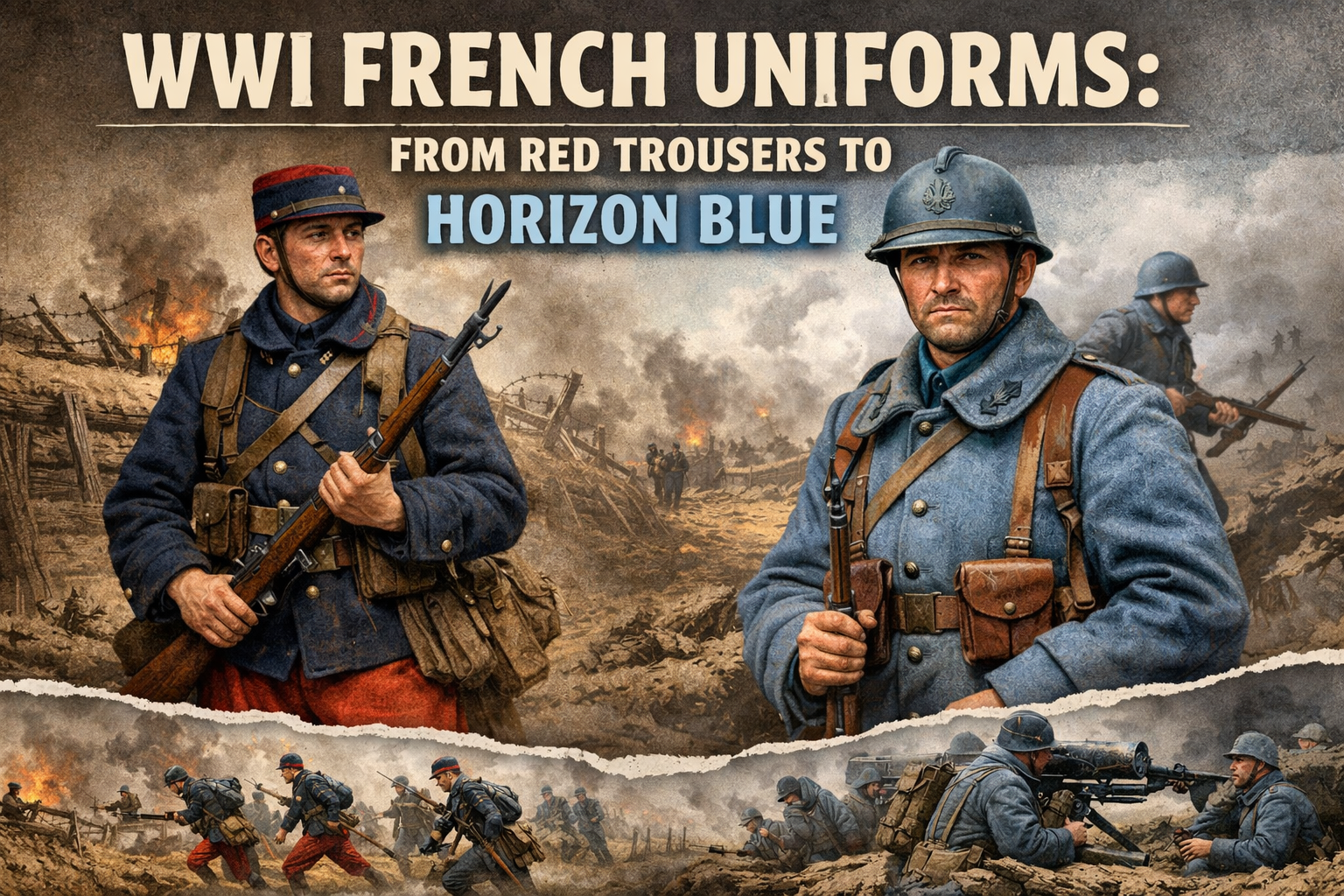
When World War I began in August 1914, French soldiers marched to the front wearing uniforms that looked very different from what we imagine today. Infantry troops wore dark blue coats called the capote and bright red trousers known as pantalon rouge. These colors had been part of French army tradition for decades. They looked impressive on parade grounds. But war in the trenches was not a parade.
Modern rifles, machine guns, and artillery made bright uniforms dangerous. Soldiers standing out in open fields became easy targets. Early battles in 1914 showed this clearly. French losses were high during the first months of fighting.
Military leaders soon realized that uniforms designed for earlier wars did not work well against modern weapons. The French army needed clothing that helped soldiers blend into the battlefield and survive harsh trench conditions.
So the army introduced major changes. The famous horizon blue uniform appeared in 1915. New helmets, coats, and gear followed. Millions of sets were produced and distributed across the Western Front.
Understanding these WWI French uniforms helps explain how the French army adapted to the realities of trench warfare between 1914 and 1918.
Core Features of Standard French Uniforms
Early WWI French uniforms followed designs used before the war. They included several key pieces of clothing and equipment.
Basic uniform components used by French infantry in 1914:
-
Capote coat – long wool coat in dark blue
-
Pantalon rouge – bright red wool trousers
-
Kepi hat – soft cap with flat top
-
Leather gear – belt, cartridge pouches, and straps
-
Puttees – cloth strips wrapped around lower legs
-
Leather boots
The coat and trousers were made mainly from wool fabric. Wool helped keep soldiers warm in cold weather. It also absorbed moisture but dried slowly.
Early war uniforms weighed several kilograms when fully worn with equipment. Soldiers also carried rifles, ammunition, packs, and tools.
By late 1914 the French army began testing new colors. The solution became horizon blue, a light blue-gray shade designed to blend with sky and ground at distance.
Horizon blue uniforms introduced in 1915 included:
-
Horizon blue wool capote
-
Horizon blue trousers
-
Simplified tunics for warmer weather
-
Cloth puttees instead of leather gaiters
According to French military records, millions of horizon blue uniforms were produced between 1915 and 1918. Factories across France worked to supply the growing army.
Another major addition was the Adrian helmet, introduced in 1915. This steel helmet helped protect soldiers from shell fragments, which were one of the main causes of battlefield injuries.
These changes marked a shift from parade-style clothing to practical battlefield gear.
Légion Étrangère Uniform Specifics
The Légion Étrangère, known in English as the French Foreign Legion, served as part of the French army during WWI. Legion units fought on several fronts, including the Western Front.
Their uniforms were very similar to those worn by regular French troops, but some details stood out.
Key elements of a Légion Étrangère uniform during WWI:
-
Horizon blue capote coat after 1915
-
Standard French infantry equipment
-
Adrian steel helmet after 1915
-
White kepi used in some non-combat settings
Before the horizon blue change, some Legion soldiers also wore the same dark blue coats and red trousers used by other French troops.
However, Legion traditions remained visible in certain items. The white kepi, associated with the Legion, continued to appear in rear areas or ceremonial situations. In active combat zones, soldiers usually wore helmets and standard field gear like other French units.
Legion troops also carried the Lebel Model 1886 rifle, the same weapon issued to many French infantry soldiers.
During the war, the Legion included volunteers from many countries. Historical records show thousands of foreign volunteers joined the Legion in 1914–1915 to fight alongside France.
Their equipment and uniforms therefore followed French army supply systems rather than separate Legion production.
Pros and Cons During WWI
Uniform changes during the war brought clear benefits but also some challenges.
Advantages of later WWI French uniforms:
-
Better camouflage: Horizon blue blended better with terrain than red trousers.
-
Improved protection: Adrian helmets reduced injuries from shrapnel.
-
War-ready design: Coats and gear suited trench conditions better than pre-war clothing.
-
Mass production: Factories produced millions of uniforms quickly.
Challenges soldiers still faced:
-
Heavy wool fabric: Wool coats became wet and heavy in rain.
-
Limited waterproofing: Trenches often flooded, soaking clothing.
-
Slow supply changes: Some units continued wearing older uniforms during early battles.
-
Cold weather exposure: Winter conditions in trenches remained harsh.
Ever wonder why helmets became so important?
Studies from WWI medical reports showed that many battlefield injuries came from shell fragments, not bullets. The Adrian helmet helped reduce head wounds caused by exploding artillery shells.
Even with improvements, trench warfare remained extremely difficult for soldiers wearing these uniforms.
Real-World French Military Examples
Historical battles show how these uniforms were used in real conditions.
Verdun 1916 – Horizon Blue in Action
The Battle of Verdun lasted from February to December 1916. By this time most French soldiers wore horizon blue uniforms and Adrian helmets.
French troops rotated through the front lines while defending the fortress region. Millions of artillery shells fell during the battle. Helmets helped reduce injuries from falling metal fragments.
Photographs from Verdun clearly show soldiers wearing horizon blue coats and helmets while operating artillery and defending trenches.
Champagne Offensive 1915 – Légion Étrangère Units
The Champagne battles of 1915 included participation from Legion units within the French army.
By this stage the horizon blue uniform had begun replacing older clothing. Legion soldiers fighting in Champagne used the same field equipment as other French infantry.
Reports from the period describe soldiers wearing wool coats, carrying the Lebel rifle, and using standard French gear.
Early War Battles 1914 – Red Trousers in Combat
During battles such as the Battle of the Frontiers in August 1914, French soldiers entered combat wearing dark blue coats and bright red trousers.
Historical photographs and army records show large formations dressed in these traditional uniforms.
The bright trousers made soldiers easy to spot across open ground. After these battles the French army accelerated uniform redesign.
Western Front Trench Life 1917
By 1917 French soldiers across the Western Front typically wore:
-
Horizon blue capote coat
-
Adrian helmet
-
Puttees and boots
-
Leather cartridge belts
-
Packs and tools
Uniforms often appeared dirty and worn due to constant trench conditions. Mud, rain, and long service made clothing look very different from newly issued gear.
These real examples show how French army gear evolved between 1914 and 1918.
FAQs
Why did WWI French soldiers wear red trousers at the start of the war?
Red trousers were part of French military tradition dating back to the nineteenth century. They were originally intended for visibility and national identity rather than battlefield camouflage.
When did the horizon blue uniform appear?
The French army introduced horizon blue uniforms in 1915 after early war battles showed the need for better camouflage.
What helmet did French soldiers use in WWI?
French troops used the Adrian helmet, introduced in 1915. It was one of the first steel helmets widely issued during the war.
Did the Légion Étrangère wear different uniforms?
Legion soldiers usually wore the same field uniforms as other French troops. However, they kept certain traditions like the white kepi for non-combat use.
What rifle did French soldiers carry?
Many French soldiers used the Lebel Model 1886 rifle, a bolt-action rifle widely issued during the war.
How many uniforms were produced during WWI?
French factories produced millions of horizon blue uniforms between 1915 and 1918 to supply the large wartime army.
What materials were used in WWI French uniforms?
Most uniforms used wool fabric, sometimes blended with cotton. Leather was used for belts, straps, and cartridge pouches.
Did uniforms protect soldiers from bullets?
Uniforms did not stop bullets. Helmets mainly protected against shell fragments and falling debris.
Conclusion (PAS Solution)
WWI French uniforms tell a story about how armies adapt during war.
At the start of World War I, French soldiers marched into battle wearing traditional clothing designed for earlier conflicts. Dark blue coats and red trousers reflected national pride but offered little help on a modern battlefield.
The harsh lessons of trench warfare forced rapid change. By 1915 the French army adopted horizon blue uniforms and the Adrian helmet. These improvements helped soldiers survive in a war dominated by artillery, machine guns, and long months in muddy trenches.
Units like the Légion Étrangère fought in the same gear as other French troops while maintaining parts of their long military traditions.
From the early battles of 1914 to the trenches of Verdun and beyond, WWI French uniforms evolved alongside the war itself. Studying this gear today helps historians and collectors understand the daily life of soldiers who served between 1914 and 1918.