Introduction: The Problem Soldiers Faced in Trench Warfare
Picture this: a British infantryman standing in a muddy trench somewhere in northern France in 1916. Rain is falling, artillery shells are landing nearby, and the ground is thick with water and mud. The soldier’s clothing is not just about appearance anymore. It must keep him warm, help him blend into the battlefield, and allow him to move quickly when ordered to attack.
Before World War I, many military uniforms across Europe were designed with visibility and tradition in mind. Bright colors, polished buttons, and decorative designs made soldiers easy to identify. That worked during earlier wars fought in open fields. But the First World War introduced machine guns, long-range rifles, and artillery that made visibility dangerous.
British soldiers quickly learned that their clothing had to change. Early trench fighting exposed problems such as poor camouflage, uncomfortable wool garments, and limited protection against falling debris from explosions. Soldiers also had to carry equipment like rifles, ammunition, water bottles, and gas masks while moving through mud.
This article explores how British soldier uniforms evolved to meet those challenges. We'll look at how the design changed from older traditions, examine the key parts of the uniform, compare them with German WWI uniforms, and explain the real pros and cons experienced by soldiers on the front line.
Evolution from Napoleonic Era British Uniforms
To understand WWI uniforms, it helps to go back a century earlier to the Napoleonic Wars (1803–1815).
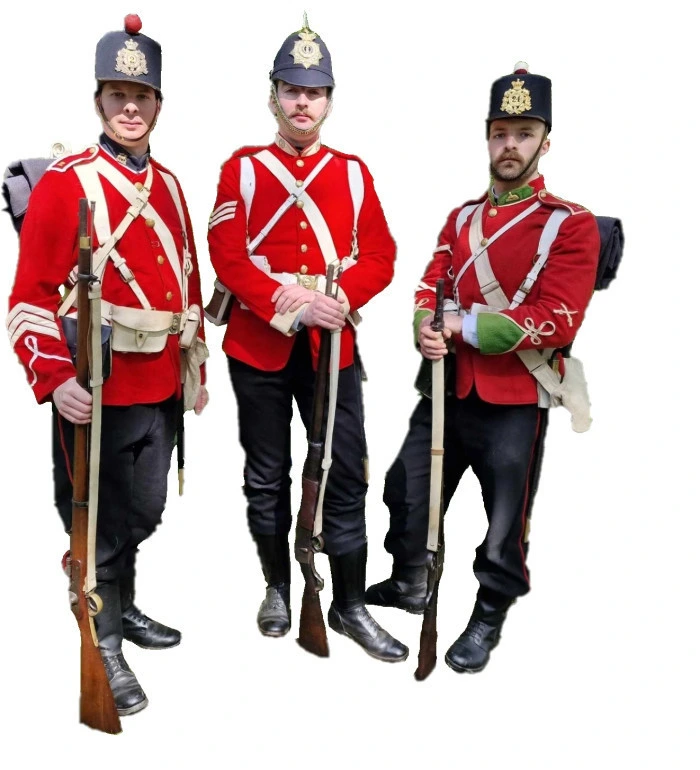
During that time, British soldiers wore red coats, white crossbelts, and tall headgear like the shako. These uniforms were designed for line infantry tactics where soldiers stood in formation and fired volleys.
The bright red coat had two purposes:
-
It helped commanders identify units during battle.
-
It represented tradition and national identity.
However, the rise of accurate rifles in the late 19th century changed everything. Soldiers standing in bright uniforms became easy targets.
By the late 1800s, the British Army began experimenting with khaki uniforms, first used during colonial campaigns in India and Afghanistan. Khaki, which comes from an Urdu word meaning "dust-colored," blended better with natural environments.
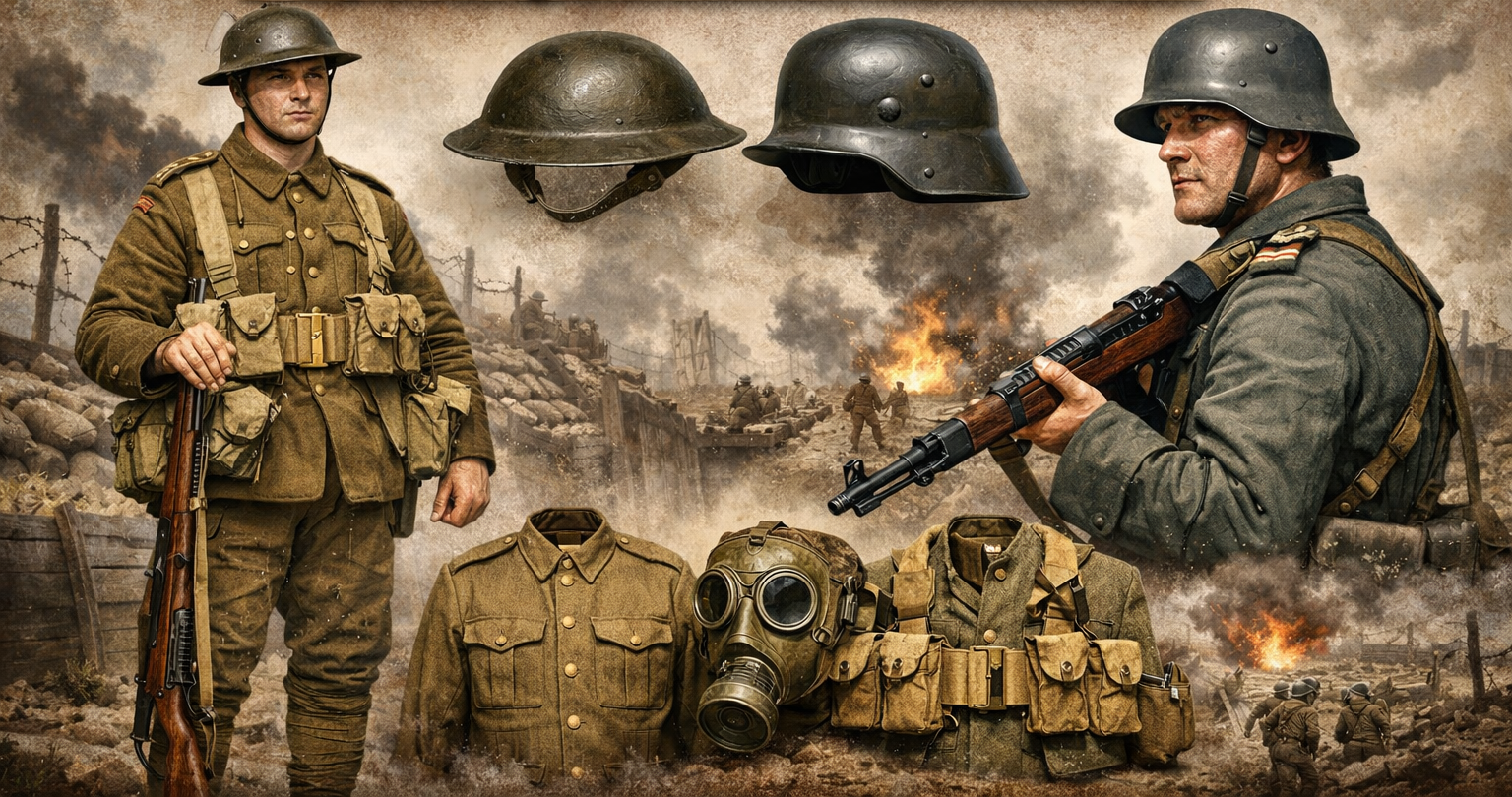
When World War I began in 1914, the British Army had already adopted khaki service dress as standard clothing. This decision proved important once trench warfare started.
Key Features of WWI British Soldier Uniforms
The Khaki Service Dress Tunic
The standard WWI British tunic was made of wool and colored khaki. It usually had four front pockets, brass buttons, and shoulder straps.
The design allowed soldiers to store small items such as notebooks, maps, and field equipment.
According to records from the Imperial War Museum, this service dress uniform was introduced in 1902 and remained the basic clothing system for British soldiers throughout the war.
Wool provided warmth in cold weather but also had drawbacks. When soaked with rain, the fabric became heavy and uncomfortable.
Trousers and Puttees
British soldiers wore wool trousers along with puttees, which were long strips of cloth wrapped around the lower legs.
Puttees served several purposes:
-
They provided ankle support during long marches.
-
They helped keep mud and debris out of boots.
-
They reduced wear on the trousers.
However, wrapping puttees properly took time and training.
The Brodie Helmet
One of the most important developments in British WWI uniforms was the Brodie steel helmet, introduced in 1915.
Before that, soldiers wore soft caps that provided no protection.
The Brodie helmet had a wide brim and shallow bowl shape. It was designed to protect soldiers from falling debris and shrapnel from artillery shells.
According to British Army production records, more than 7.5 million Brodie helmets were produced during the war.
Web Equipment and Gear
British soldiers also carried equipment attached to webbing belts.
Typical items included:
-
Rifle ammunition pouches
-
Water bottle
-
Bayonet
-
Gas mask
-
Entrenching tool
The 1908 Pattern Web Equipment allowed soldiers to distribute weight evenly across their body.
Pros and Cons of the Uniform in Real Combat
Advantages for Soldiers
The biggest advantage of the WWI British uniform was camouflage.
Khaki blended well with the muddy terrain of the Western Front. This made soldiers harder to see compared to the bright uniforms used in earlier wars.
The Brodie helmet also improved survival rates against shrapnel. Military reports from 1916 suggested a noticeable drop in head injuries once helmets became widely used.
Webbing equipment also helped soldiers carry heavy loads more efficiently.
Challenges and Limitations
Despite improvements, British uniforms still had problems.
Wool clothing absorbed water easily. During long periods in trenches, soldiers often had wet clothing for days.
This contributed to conditions like trench foot, which occurred when feet remained wet and cold for extended periods.
The uniform also offered little protection against bullets or gas attacks.
Gas masks eventually became standard issue, but early models were uncomfortable and difficult to use during combat.
Real-World Case Study: British vs German WWI Uniforms
A useful comparison can be made between British khaki uniforms and German field-grey (feldgrau) uniforms.
German soldiers adopted field-grey clothing around 1910. This color was a mix of grey and green tones designed for camouflage.
During battles such as the Somme in 1916, soldiers from both sides fought in similar trench environments.
Historical analysis from the Imperial War Museum suggests that both khaki and field-grey worked well for concealment compared with older bright uniforms.
However, German helmets—the Stahlhelm introduced in 1916—offered stronger head protection than the British Brodie helmet.
The Stahlhelm covered more of the head and neck, while the Brodie helmet mainly protected against overhead shrapnel.
This difference reflected different battlefield priorities.
British designers focused on artillery shrapnel falling from above, while German designers focused more on frontal protection.
How Uniform Design Affected Soldier Life
Uniform design affected everyday survival in the trenches.
British soldiers had to march long distances carrying gear that could weigh more than 25 kilograms.
Comfort and durability were therefore important factors.
Letters from soldiers preserved in the Imperial War Museum archives often mention muddy clothing, worn boots, and constant maintenance of equipment.
For example, soldiers frequently had to clean their rifles and dry their clothing whenever possible.
Uniforms were not just clothing—they were part of a larger survival system that included boots, helmets, and field equipment.
FAQs
What made the Brodie helmet a game-changer?
The Brodie helmet provided the first widespread steel head protection for British soldiers. It reduced injuries caused by shrapnel falling into trenches during artillery bombardments.
Why did the British Army choose khaki uniforms?
Khaki provided better camouflage in dusty or muddy environments compared to bright colors used in earlier uniforms.
Did British soldiers wear body armor in WWI?
No standard body armor existed for infantry soldiers during WWI. Protection mainly came from helmets and trench cover.
How heavy was a WWI British soldier’s equipment?
A typical British infantryman carried between 25–30 kilograms of gear including rifle, ammunition, water, and personal items.
What boots did British soldiers wear?
Soldiers wore ankle boots with hobnails for durability. These boots were paired with puttees for support.
How did German uniforms differ from British uniforms?
German soldiers wore field-grey clothing and later used the Stahlhelm helmet, which provided more head coverage than the British Brodie helmet.
Are original WWI British uniforms still preserved?
Yes. Museums such as the Imperial War Museum in London maintain collections of original uniforms and equipment used during the war.
Conclusion: The Solution Found Through Practical Design (150 words)
World War I forced armies to rethink something as basic as clothing. The British Army learned quickly that traditional uniforms designed for open-field battles were no longer suitable for trench warfare.
The shift to khaki service dress, the introduction of the Brodie helmet, and the use of practical web equipment helped soldiers adapt to the harsh environment of the Western Front.
These changes did not eliminate all problems. Soldiers still faced wet clothing, heavy gear, and limited protection from bullets and gas. But the uniform system represented a clear move toward practicality rather than tradition.
When compared with earlier Napoleonic uniforms or even with German WWI gear, British uniforms showed how military design evolves through experience.
In simple terms, the WWI British uniform became a tool for survival. It reflected the realities of industrial warfare and set the foundation for modern military clothing systems used by armies today.