Introduction
If you look at British soldiers in the early 1800s, you would see bright red coats, white cross belts, and tall headgear. These uniforms worked well in open battlefield formations such as those used during the Napoleonic Wars. But by the early 1900s, warfare had changed. Rifles had longer range, artillery was more powerful, and battles were fought from trenches instead of open fields.
British military records show that by the late 19th century the army had already begun replacing red coats with khaki uniforms during colonial campaigns in India and South Africa. Khaki helped soldiers blend into dusty landscapes and reduced visibility to enemy marksmen. However, when World War I started in 1914, the British Army still had to adjust its uniforms for the harsh realities of trench warfare in France and Belgium.
Soldiers faced mud, rain, cold winters, and constant artillery fire. Diaries from British infantrymen held by the Imperial War Museum often mention wet uniforms, heavy equipment, and poor protection from shrapnel during the early months of the war.
Let's dive in and look at how specific WWI British uniform types—infantry, officers, and nurses—developed to meet these challenges. You might be surprised how quickly these uniforms changed once the war revealed their weaknesses.
From 1800s British Army Uniforms to WWI Khaki
During the 1800s, the British Army was famous for its “Redcoat” uniform. The bright red wool tunic was a symbol of discipline and identity. But it was not designed for modern warfare.
By the late 19th century, military planners realized that camouflage mattered more than appearance. British troops fighting in India and Africa started wearing khaki uniforms. Khaki comes from the Persian word for “dust,” and the color helped soldiers blend with the terrain.
By the time WWI began, British soldiers already wore khaki service dress. According to British Army clothing regulations from 1902, the standard uniform included:
-
Khaki wool tunic
-
Khaki trousers or breeches
-
Puttees wrapped around the lower legs
-
Leather boots
-
A peaked service cap
However, trench warfare quickly revealed new problems. Soldiers needed better head protection, stronger fabrics, and equipment designed for long periods in muddy trenches.
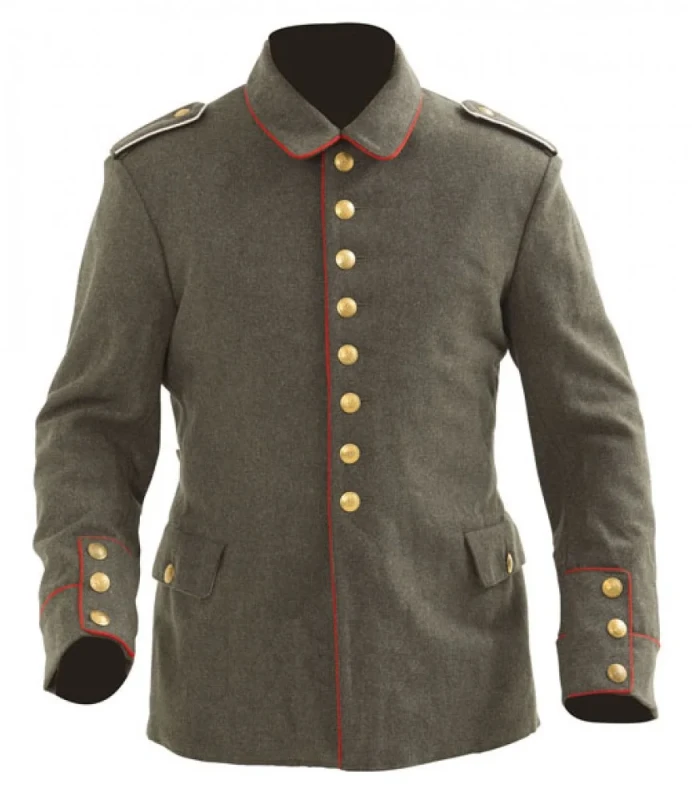
German soldiers faced similar issues but wore a different style uniform known as field grey. German helmets like the Pickelhaube initially offered little protection against artillery fragments.
This set the stage for important changes in British uniforms during the war.
Infantry Uniform Breakdown
British infantry soldiers made up the majority of the army, and their uniform had to be practical.
Fabric and Construction
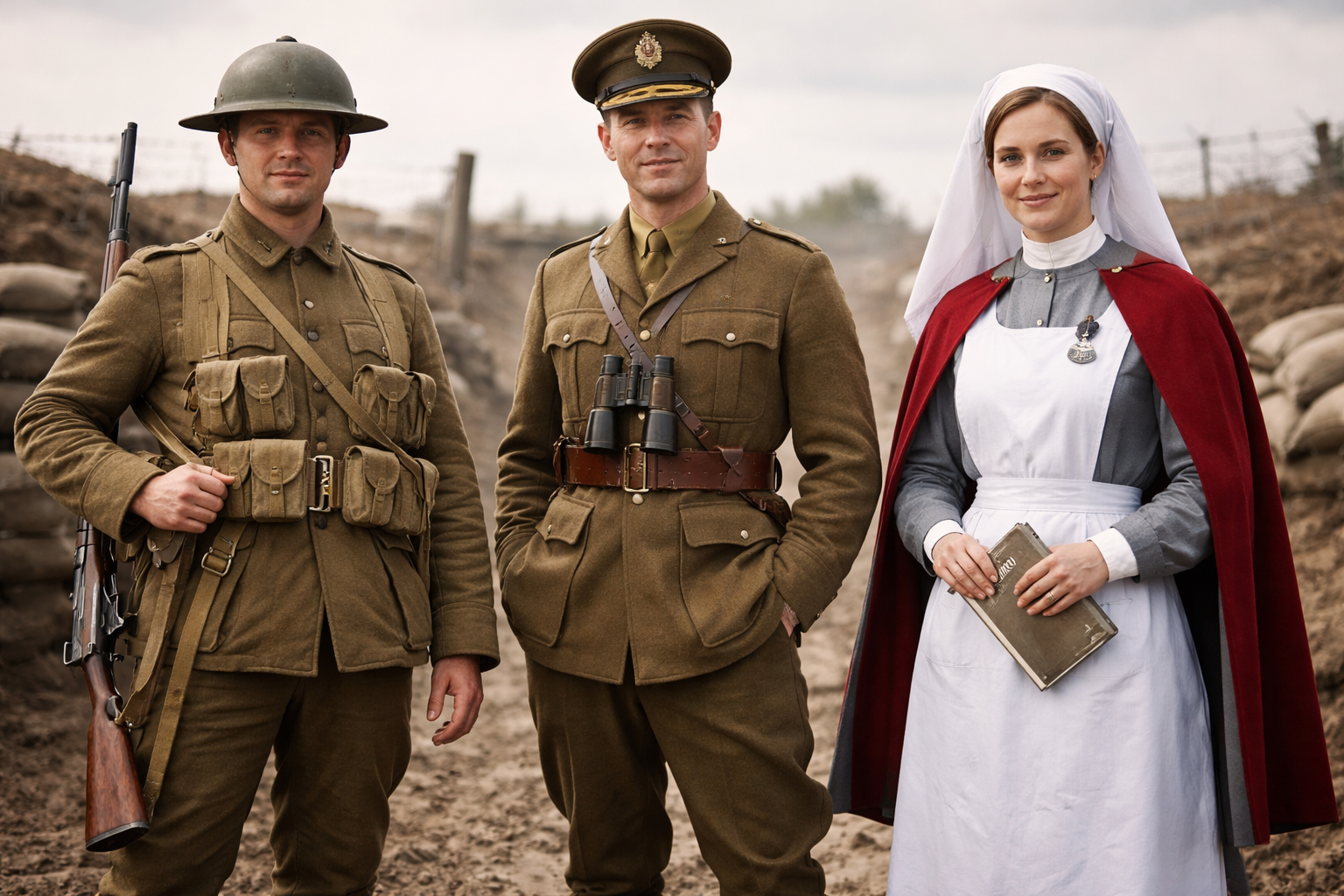
The infantry uniform used wool serge cloth. Wool helped retain warmth even when damp, which mattered in cold trench conditions. The tunic usually had four front pockets and brass buttons with regimental insignia.
According to British Army supply records from 1914–1918, millions of these uniforms were produced for the expanding army.
Trousers were often replaced with breeches, worn with puttees. Puttees were long strips of cloth wrapped around the lower leg. They helped support the ankles and kept mud out of boots.
Equipment and Webbing
British soldiers carried equipment using the 1908 Pattern Web Equipment system. This webbing system distributed weight evenly across the body.
Typical infantry gear included:
-
Ammunition pouches
-
Water bottle
-
Bayonet and scabbard
-
Entrenching tool
-
Backpack
Soldiers often carried over 25 kilograms of equipment during combat.
Helmet Evolution
At the start of WWI, British troops wore soft caps. But artillery casualties quickly revealed the need for head protection.
In 1915 the Brodie helmet was introduced. It was made of pressed steel and designed to protect soldiers from falling shrapnel.
Imperial War Museum research shows that helmet use significantly reduced head injuries caused by artillery fragments.
Officer Uniforms and Identification
British officers wore uniforms similar to infantry soldiers but with some key differences.
Tailoring and Fabric
Officer uniforms were often privately purchased and tailored. The fabric was still khaki wool, but it was usually higher quality.
Officers also wore Sam Browne belts, a leather belt with a shoulder strap that helped support a sword or pistol.
Rank insignia appeared on the shoulders. This allowed soldiers to identify leadership quickly.
Field Practicality
At the beginning of the war, officers were easy targets because their uniforms looked different and they often carried swords.
German snipers sometimes targeted officers first because eliminating leadership caused confusion among troops.
As a result, British officers gradually adopted simpler uniforms similar to ordinary soldiers. This helped reduce visibility on the battlefield.
Real Example from Soldier Accounts
Diaries from British Lieutenant Arthur Carr describe how officers removed distinctive clothing in trenches to avoid enemy snipers.
This shift shows how quickly battlefield realities changed military traditions.
Nurses’ Uniforms in Action
British nurses played a major role during WWI, especially in military hospitals and field stations.
Queen Alexandra’s Imperial Military Nursing Service
The main nursing organization was Queen Alexandra’s Imperial Military Nursing Service (QAIMNS).
Their uniforms were designed for cleanliness and discipline.
Typical elements included:
-
Grey or blue dress
-
White apron
-
Veil or cap
-
Red cape for outdoor wear
These uniforms helped identify nurses clearly in medical areas.
Practical Use in Wartime
Nurses worked long hours treating wounded soldiers from the Western Front. Hospital records show that thousands of casualties arrived daily during major battles like the Somme in 1916.
The uniform needed to allow movement while maintaining hygiene standards.
Photographs from the Imperial War Museum show nurses wearing protective aprons during surgical procedures.
Comparison with 1800s Nursing Uniforms
Nursing uniforms in the 1800s were similar in style but less standardized.
During WWI, the British military enforced stricter regulations for medical uniforms to maintain organization in wartime hospitals.
Pros and Cons vs German WWI Uniforms
Comparing British and German uniforms helps explain why certain designs improved during the war.
German Pickelhaube Helmet
Early German soldiers wore the Pickelhaube, a leather helmet with a metal spike on top.
This helmet looked distinctive but offered little protection against shrapnel.
By 1916, Germany replaced it with the Stahlhelm, a steel helmet similar in purpose to the British Brodie helmet.
Camouflage and Visibility
British khaki uniforms blended well with muddy terrain. German field grey uniforms also provided camouflage, though the shade differed.
Both armies learned that bright uniforms from earlier centuries were no longer practical.
Mobility and Equipment
The British 1908 webbing system allowed soldiers to carry gear efficiently. German soldiers used leather equipment systems that were durable but heavier.
In trench warfare, even small equipment improvements could affect soldier endurance.
FAQs
1. What did British infantry soldiers wear in WWI?
British infantry wore khaki wool uniforms with breeches, puttees, boots, and webbing equipment. Later in the war they also wore the steel Brodie helmet.
2. Why did the British Army switch from red uniforms to khaki?
Red uniforms were too visible for modern warfare. Khaki helped soldiers blend with the environment and avoid enemy fire.
3. What was the Brodie helmet used for?
The Brodie helmet protected soldiers from shrapnel caused by artillery shells, which were responsible for many battlefield injuries.
4. How were officer uniforms different from infantry uniforms?
Officer uniforms were often privately tailored and included Sam Browne belts and rank insignia, though they became simpler during the war.
5. What did WWI British nurses wear?
British nurses typically wore grey or blue dresses with white aprons and caps, along with red capes in outdoor conditions.
6. How did German WWI uniforms differ from British uniforms?
German uniforms were field grey and initially used the Pickelhaube helmet before switching to steel helmets later in the war.
7. Were WWI uniforms comfortable?
Soldier diaries show that uniforms were often heavy and uncomfortable, especially in wet trench conditions.
Conclusion
World War I forced the British Army to rethink uniforms that had developed over centuries. The shift from bright red coats of the 1800s to practical khaki service dress shows how technology and battlefield conditions influence military design.
Infantry uniforms focused on durability and equipment support. Officer uniforms gradually became less distinctive to reduce risk on the battlefield. Nurses wore standardized medical uniforms that helped maintain order and hygiene in wartime hospitals.
The introduction of the Brodie helmet was one of the most important improvements, providing real protection against artillery fragments.
Comparisons with German uniforms show that both sides learned quickly and adapted equipment as the war continued.
Today, these uniforms remain important historical artifacts. Museums such as the Imperial War Museum preserve them because they tell the story of how soldiers, officers, and nurses faced the challenges of modern warfare.