Introduction
Military uniforms often change when war changes. The United States Army learned that lesson between the late 1800s and World War I.
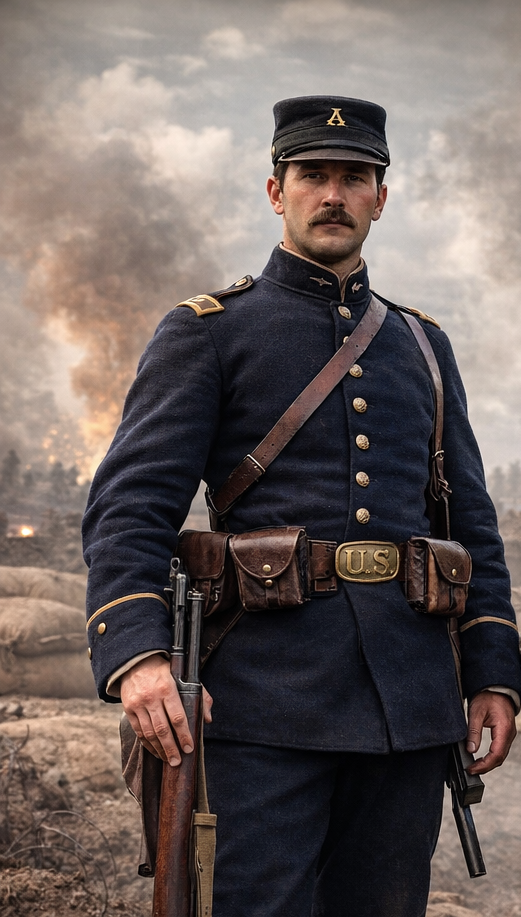
In the 1880 period, American soldiers still wore dark blue wool uniforms similar to Civil War styles. These uniforms worked well for ceremonies and for frontier service. But they were not designed for modern industrial warfare.
When the United States entered World War I in 1917, everything changed quickly. The battlefield in Europe looked very different from earlier American conflicts. Trench systems stretched for miles, artillery shells landed constantly, and machine guns dominated open ground.
The United States mobilized around 4 million troops during the war. These soldiers became part of the American Expeditionary Forces (AEF) under General John J. Pershing.
Early uniform systems had problems in trench warfare. During the Meuse-Argonne Offensive in 1918, one of the largest US campaigns of the war, soldiers faced cold weather, mud, and long exposure in the field. The offensive caused around 26,000 American combat deaths and many more injuries and cases of illness or exposure.
The solution was the move toward olive drab combat clothing, stronger equipment, and better helmet protection. Those changes shaped the modern American military uniform.
Key Features of World War I American Uniforms
By 1917, the US Army had moved toward a uniform designed for field combat rather than appearance.
The standard WW1 American uniform included:
-
Olive drab wool tunic
-
Matching breeches
-
Canvas leggings or puttees
-
Leather boots
-
Steel helmet
-
Web gear for carrying ammunition and tools
This uniform focused on durability and camouflage rather than style.
Military Uniform Parts Breakdown
A WW1 American soldier carried many different clothing items and equipment parts.
Tunic (Service Coat)
The service coat was made from olive drab wool, often called OD #33 fabric after standardization in 1917. The jacket had four pockets and brass buttons. Soldiers used the pockets to carry small tools, notebooks, and maps.
Breeches
Breeches were wide around the thigh and tighter below the knee. This design allowed easier movement when marching, running, or climbing trench ladders.
Puttees or Leggings
Early in the war, US troops used cloth puttees similar to British forces. Later they often used canvas leggings, which helped protect the lower leg from mud and debris.
Helmet
American soldiers used the M1917 helmet, based on the British Brodie helmet design. The steel shell protected soldiers from artillery fragments, which caused many injuries during trench warfare.
From US Army Uniform 1880 to 1918 Olive Drab
The evolution of the American uniform shows how military thinking changed over time.
1880s Uniform System
-
Dark blue wool coats
-
Brass buttons and decorations
-
Kepi or campaign hat
-
Designed mainly for frontier duty
These uniforms looked impressive but did not provide camouflage.
Early 1900s Changes
The US Army began testing olive drab clothing after observing European armies using more neutral colors.
1917 AEF Standardization
When American troops arrived in France, General John J. Pershing required practical field clothing.
Key features included:
-
Olive drab wool fabric (OD #33)
-
Steel helmets
-
Web equipment for carrying ammunition
-
Sturdy boots and leggings
These changes helped American troops blend better into the battlefield environment.
Pros and Cons from Real WW1 Battles
Uniform design affected soldiers in real combat situations. The Meuse-Argonne Offensive of 1918 shows how equipment performed under pressure.
This campaign lasted from September to November 1918 and became the largest US military operation of the war.
American forces faced several problems:
-
Cold autumn weather
-
Thick mud in trenches
-
Long periods of exposure during attacks
The conditions tested uniforms and equipment.
Pros
-
Olive drab color reduced visibility in the field
-
Steel helmet protected against shrapnel
-
Web gear allowed soldiers to carry more ammunition
-
Wool clothing provided insulation during cold weather
Cons
-
Wool uniforms became heavy when wet
-
Boots often wore out in muddy trenches
-
Limited waterproof gear caused discomfort during long exposure
-
Canvas leggings sometimes trapped mud
Despite these problems, the olive drab system worked better than earlier blue uniforms designed for parade use.
Sourcing Military Uniform Parts and Full Sets Today
Today, WW1 American uniforms are popular with collectors, historians, and reenactors.
You can find both original parts and modern replicas.
Typical Prices
Prices vary depending on rarity and condition.
Common ranges include:
-
Puttees or leggings: $50 – $120
-
Helmet replicas: $80 – $200
-
Original WW1 helmets: $200 – $500
-
Full replica uniform set: $300 – $700
Original pieces in good condition often cost more.
Where Collectors Buy
Popular places include:
-
eBay military collectibles
-
Amazon reenactment gear stores
-
Military surplus shops
-
Historical reenactment suppliers
Before buying, collectors should check several details.
Buying Tips
-
Check seller ratings and reviews
-
Ask for clear photos of stamps or markings
-
Compare with museum references
-
Avoid listings with very low prices and limited information
Because many WW1 uniforms were heavily used during the war, original complete sets are rare today.
Real-World Comparisons to German Military Uniforms
American uniforms were not the only ones evolving during the war. German forces also changed their clothing and equipment.
German soldiers typically wore feldgrau, a gray-green color designed for camouflage.
US Army Uniform
-
Olive drab color
-
M1917 steel helmet
-
Canvas leggings
-
Web gear system
German Army Uniform
-
Feldgrau tunic and trousers
-
Leather boots
-
Early Pickelhaube helmet, made from leather with a metal spike
The Pickelhaube helmet looked impressive but had a major weakness. It offered little protection from artillery fragments.
Because of this problem, Germany introduced the Stahlhelm steel helmet in 1916, which gave much better protection.
These changes across different armies show how trench warfare forced rapid improvements in military equipment.
FAQs
What did American soldiers wear in World War I?
American soldiers wore olive drab wool uniforms with a tunic, breeches, leggings, boots, web gear, and the M1917 steel helmet.
Why did the US Army switch from blue to olive drab uniforms?
Blue uniforms were too visible on the battlefield. Olive drab helped soldiers blend into the environment and reduced visibility to enemy troops.
How many US troops served in WW1?
Around 4 million American troops were mobilized during World War I.
How much do WW1 American uniform parts cost today?
Small items such as leggings or puttees can cost $50 to $120, while helmets or full sets may range from $200 to $700 or more.
Are WW1 uniforms legal to collect?
Yes. WW1 military uniforms and equipment are legal to collect in most countries and are commonly used in historical displays and reenactments.
Conclusion
The story of World War I American uniforms shows how quickly armies must adapt to new types of war.
The 1880-era blue uniforms were designed for a different time. They worked well for frontier duty but not for the industrial battlefield of World War I.
When the United States entered the war in 1917, the Army moved to olive drab combat clothing, steel helmets, and stronger equipment systems. These changes helped soldiers handle the harsh conditions of trench warfare.
Campaigns like the Meuse-Argonne Offensive in 1918 proved that practical uniforms mattered. Soldiers needed clothing that worked in mud, cold weather, and constant artillery fire.
Today, collectors and history enthusiasts still study and collect these uniforms. Whether you buy individual military uniform parts or a full WW1 American uniform set, each item tells a real story from one of the most important conflicts of the twentieth century.