Introduction
If you look at photos from early wars, soldiers often wore bright colors that made them easy to see on the battlefield. That was a serious problem once modern rifles and machine guns appeared. By the time World War I started in 1914, the British Army had already begun solving that problem with the khaki service dress uniform.
Still, the early war uniform had its own issues. Soldiers faced cold rain, deep mud, rats, and constant artillery fire in trench warfare. Clothing that worked during training sometimes failed in real combat conditions.
The scale of World War I made these problems very clear. During the Battle of the Somme in 1916, British forces suffered about 1.2 million casualties over the campaign. In such brutal conditions, even small changes in clothing and equipment could affect survival and efficiency.
The solution came through gradual improvement. Between 1914 and 1918, the British soldier uniform evolved to handle trench warfare better. Today, these uniforms are studied by historians and collected by military enthusiasts around the world.
Key Features of WW1 British Soldier Uniforms
The standard WW1 British soldier uniform was known as Service Dress. It was designed to be practical, durable, and less visible than older military clothing.
Typical components included:
-
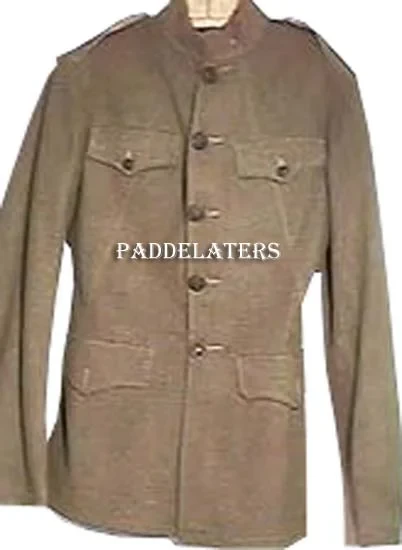
Khaki wool tunic
-
Matching trousers or breeches
-
Puttees (cloth leg wraps)
-
Leather boots
-
Webbing equipment for carrying gear
-
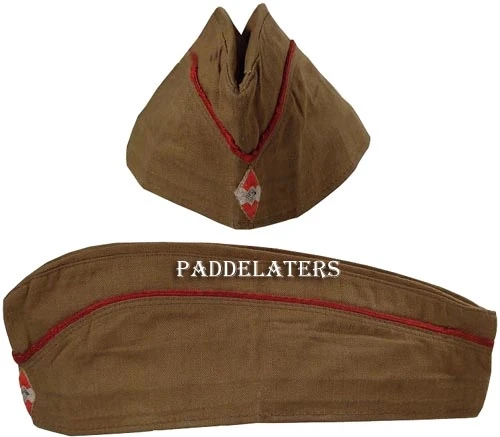
Headgear such as a peaked cap or steel helmet
Unlike earlier military uniforms, the focus here was not appearance but function.
Materials and Design Basics
The main material used for the WW1 British uniform was wool serge fabric. Wool was chosen for several practical reasons:
-
It provided insulation in cold weather
-
It remained usable even when damp
-
It was durable under rough conditions
The tunic usually had four pockets, brass buttons, and shoulder straps. Soldiers used these pockets for small items like notebooks, maps, and personal tools.
Another distinctive item was the puttee. These long strips of cloth were wrapped around the lower leg between the ankle and knee. They helped support the leg while marching and kept mud from entering boots.
The equipment belt system was also important. The 1908 Pattern Webbing allowed soldiers to carry ammunition, water bottles, and tools without heavy leather belts.
Evolution from 1914 to 1918
The early uniform worn in 1914 looked similar to late-19th-century British service dress. But trench warfare quickly forced changes.
Key developments during the war included:
1914 – Early War Uniform
-
Khaki service dress tunic and trousers
-
Soft peaked cap
-
Leather gear
1915 – Introduction of the Brodie Helmet
-
Steel helmet introduced after heavy head injuries from shrapnel
-
Wide brim helped protect from falling debris in trenches
1916–1918 – Late War Improvements
-
Better webbing systems
-
Reinforced boots
-
Increased use of steel helmets
These changes came from real battlefield experience. When soldiers reported problems, the army adjusted equipment where possible.
Pros and Cons in Real WW1 Action
Uniform design directly affected soldiers in combat. The experience of the Battle of the Somme (1916) provides a good example.
British forces launched a major offensive against German positions along the Somme River in France. The fighting lasted months and involved massive artillery barrages and trench assaults.
During the campaign:
-
British casualties reached roughly 1.2 million
-
The first day alone saw about 57,000 casualties
Uniforms and equipment played a role in how soldiers handled these conditions.
Pros
-
Khaki color reduced visibility compared to earlier bright uniforms
-
Wool material retained warmth in cold weather
-
Puttees protected legs from mud and debris
-
Webbing allowed soldiers to carry ammunition efficiently
Cons
-
Wool became heavy when soaked
-
Trench mud damaged boots quickly
-
Early soft caps offered little protection before steel helmets appeared
-
Limited waterproofing caused discomfort during long trench rotations
The introduction of the steel helmet in 1915 helped reduce head injuries caused by artillery fragments, which were a major threat in trench warfare.
World War 1 British Uniforms for Sale Today
Today, WW1 British uniforms are popular among collectors, historians, and reenactors. You can find both original pieces and modern replicas.
Typical prices vary depending on condition and authenticity.
Price ranges:
-
Basic replica uniform: $200–$400
-
Full reenactment set with webbing and helmet: $400–$700
-
Original WW1 pieces: $700–$1000 or more
Where to Buy
Common places where collectors search include:
-
eBay military collectibles
-
Amazon historical costume stores
-
Specialized military surplus shops
-
reenactment gear suppliers
When buying online, always check several factors.
Authenticity tips:
-
Look for seller history and reviews
-
Ask for close photos of labels or stamps
-
Compare details with museum examples
-
Be cautious if prices seem unusually low
Original WW1 uniforms are rare because many were worn out or discarded after the war. As a result, many collectors buy high-quality replicas for display or reenactment.
Comparing to Real-World German Military Uniforms
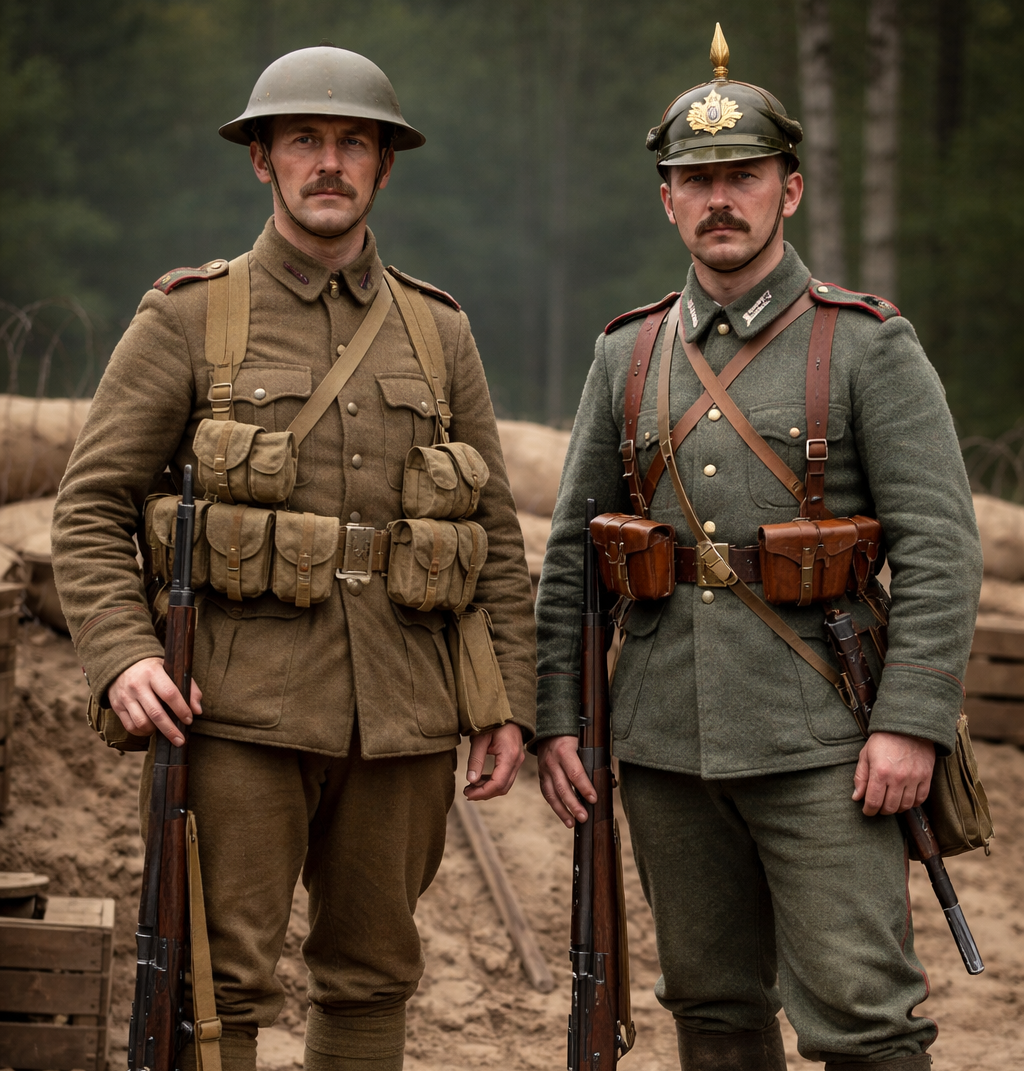
WW1 German uniforms looked different from British service dress but had a similar goal: reduce visibility and improve practicality.
The German army used feldgrau, a gray-green color designed for camouflage.
Key differences included:
British Uniform
-
Khaki color
-
Puttees around lower legs
-
Brodie steel helmet from 1915
German Uniform
-
Feldgrau tunic and trousers
-
Leather boots instead of puttees
-
Early use of the Pickelhaube helmet, a leather helmet with a metal spike
The Pickelhaube became a problem in modern warfare. It offered little protection against artillery fragments. Because of this, Germany later introduced the Stahlhelm steel helmet in 1916, which provided far better protection.
These comparisons show how both armies adapted their clothing during the war as battlefield realities changed.
FAQs
What did WW1 British soldiers wear?
British soldiers wore khaki service dress uniforms made from wool. The outfit included a tunic, trousers, puttees, boots, webbing equipment, and later the Brodie steel helmet.
Why was khaki used in WW1 uniforms?
Khaki helped reduce visibility on the battlefield. Earlier bright uniforms made soldiers easy targets for modern rifles and machine guns.
When was the steel helmet introduced?
The British Army introduced the Brodie helmet in 1915 after heavy casualties from artillery shrapnel.
How much does a WW1 British uniform cost today?
Replica uniforms usually cost $200 to $700, while original pieces can reach $1000 or more depending on rarity and condition.
Are WW1 uniforms legal to collect?
Yes. Military uniforms from World War I are legal to collect in most countries. Many collectors purchase them for historical displays or reenactments.
Conclusion
The WW1 British soldier uniform tells a clear story about how warfare changed in the early 20th century. Armies moved away from bright parade clothing and toward practical gear designed for survival in modern combat.
Battles such as the Somme in 1916, with massive casualties, proved that equipment mattered just as much as strategy. The khaki service dress, steel helmet, and improved webbing systems were all responses to the harsh reality of trench warfare.
Today, these uniforms are more than old military clothing. They are historical artifacts that help us understand how soldiers lived and fought during one of the largest conflicts in history.
If you are interested in military history, collecting a World War 1 British uniform can be a great starting point. Whether you choose a replica for reenactment or an original piece for display, these uniforms offer a direct connection to the past—and to the soldiers who wore them more than a century ago.