Introduction: Why German Uniform History Still Confuses People
Ever wondered why today’s German soldiers look so different from the soldiers seen in old war photos? Many people assume modern uniforms are just new fashion. In reality they are the result of long trial and error.
Collectors and history fans often face two main problems. First, myths spread quickly online. Some claim modern gear has no link to early German uniforms. Others believe old designs were perfect and modern armies only changed them for style.
The second problem is sourcing. Many collectors want accurate replicas of uniforms from World War I or World War II. But finding items made with correct cloth, color, and cut can be difficult. Laws in some regions also restrict symbols linked to past regimes, which adds another layer of confusion.
Understanding the evolution helps solve both issues. When you see how modern uniforms grew from earlier designs, the changes make sense. Today’s German soldiers wear gear built for safety, comfort, and field survival, yet many details still link back to early twentieth century designs.
Let’s walk through that story step by step.
Evolution from History to the Modern Bundeswehr
The German army learned many lessons from early modern war. During the nineteenth century soldiers wore bright uniforms meant for parade and pride. That changed quickly once long range rifles and machine guns became common.
By the early twentieth century, Germany adopted practical field clothing. The color feldgrau, which means field grey, became the base tone. It helped soldiers blend into the land better than dark blue coats used earlier.
After World War II, Germany rebuilt its armed forces under a new system. The modern military, known as the Bundeswehr, was formed in 1955. Designers studied older uniforms but removed elements linked with past political systems.
Over the next decades, German uniforms slowly changed. Fabrics became lighter and stronger. Pockets moved to places that were easier to reach while wearing body armor. Camouflage patterns replaced simple grey cloth.
The biggest change came after the 1990s when Germany joined many global missions. Soldiers needed gear suited for forests, deserts, and cold regions. This led to the development of modern field systems such as the Multi-Tarn camouflage and modular equipment sets.
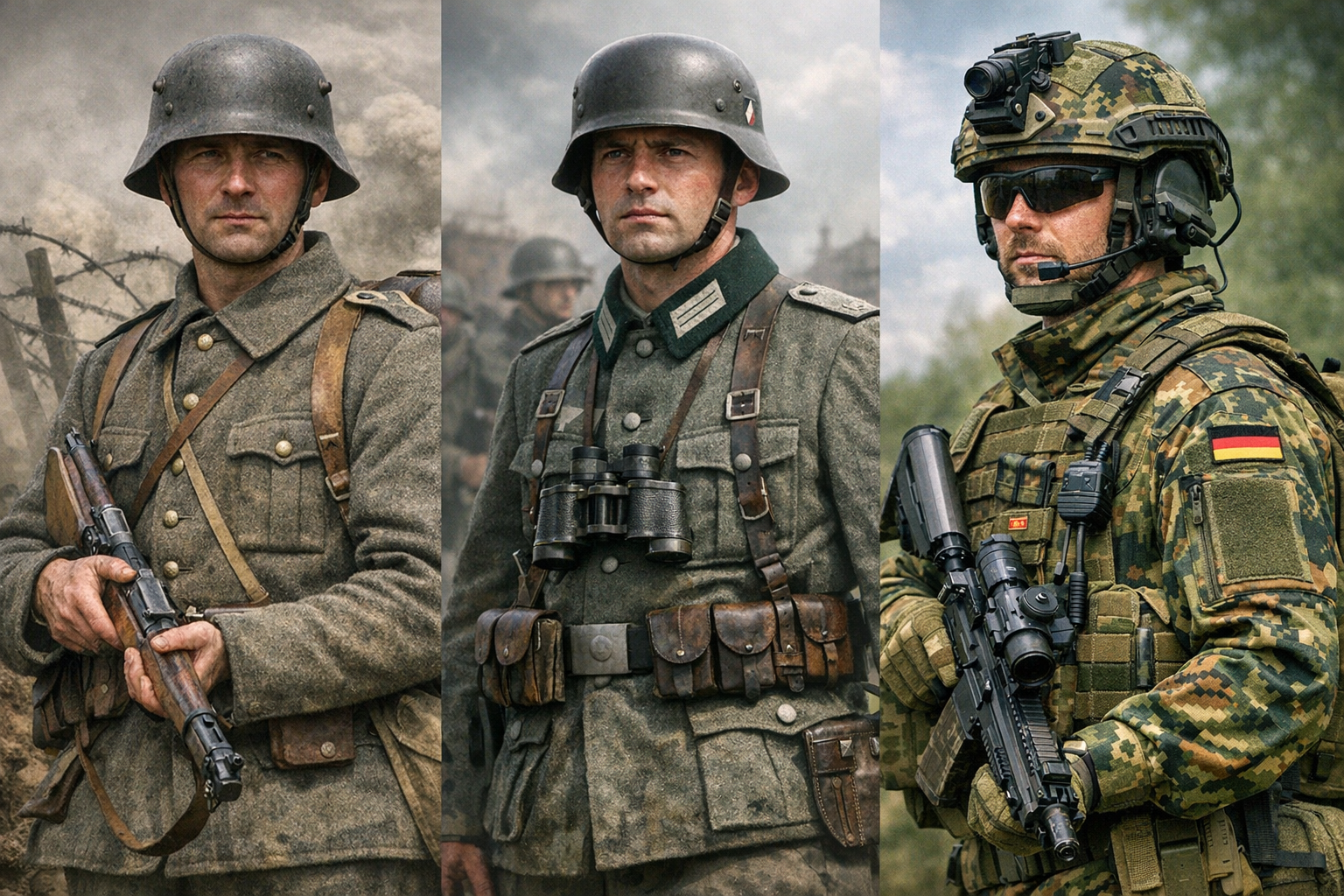
Even with these changes, the idea behind the uniform remained the same: practical clothing that helps soldiers move, hide, and survive.
WW1 Feldgrau Case Study
One of the most studied uniforms in military history is the feldgrau uniform used during World War I.
Before the war, German troops wore tunics made from thick wool cloth. The grey-green color helped reduce visibility in the field. Compared with bright uniforms used by some armies at the time, feldgrau offered a clear tactical benefit.
The standard WW1 tunic had several key traits:
-
Heavy wool cloth around 500–600 grams per square meter
-
Four front pockets with flaps
-
A high stand collar
-
Field grey color with slight green tone
Soldiers also wore matching trousers, leather boots, and a steel helmet introduced in 1916.
For collectors today, feldgrau uniforms remain widely reproduced. Licensed sellers and reenactment suppliers often produce replicas using wool blends close to the original weight. Prices for full replica sets commonly range between 150 and 400 dollars depending on fabric quality.
The popularity of these replicas shows how strong the historical interest remains.
WWII Feldbluse Development
The feldbluse jacket became the main German combat tunic during World War II. It evolved directly from the earlier feldgrau design but was simplified for mass production.
The early M36 feldbluse kept the dark green collar and high quality wool cloth. Later wartime versions removed some details to speed up production.
Key design points included:
-
Shorter waist length for easier movement
-
Five front buttons instead of four
-
Internal belt support hooks
-
Slanted pockets on later models
These changes made the uniform easier to produce while still keeping the field grey tone.
Replica feldbluse jackets are common in the collector market today. Many sellers provide versions labeled M36, M40, or M43 based on the wartime pattern they copy. These are often sold for reenactment or museum display, not military use.
Key Modern Features of Bundeswehr Uniforms
Modern German soldier uniforms used by the Bundeswehr are very different from early twentieth century clothing. Yet they still follow the same idea: protect the soldier and support field work.
Multi-Tarn Camouflage
One major change is the camouflage pattern called Flecktarn, introduced in the 1990s. The pattern uses small spots in green, brown, and black tones. This helps break up the shape of a soldier when viewed from distance.
The design works well in central European forests and fields.
Modular Combat Clothing
Modern uniforms are built in layers. A soldier may wear:
-
Base thermal layer
-
Combat shirt or jacket
-
Weather resistant outer shell
This system allows troops to adjust clothing based on climate.
Integrated Gear Systems
New uniforms work together with body armor and digital gear. The German IDZ program, which stands for “Infantryman of the Future,” introduced equipment designed for modern combat.
The clothing includes strong fabric blends such as cotton and poly fiber. These resist wear and dry faster than old wool uniforms.
Real World Uniform Examples
Looking at specific uniforms helps explain how history connects with modern gear.
Example 1: WW1 Feldgrau Tunic Replica
Reenactment stores often sell wool feldgrau tunics based on early war patterns. These usually follow the four pocket design and heavy cloth weight used by German forces in 1914. Museums and film studios also use similar replicas for displays and movies.
Example 2: WWII M36 Feldbluse Replica
Collectors value the M36 pattern because it shows the early wartime design before mass production changes. Replica jackets often use grey wool with a dark green collar. Prices vary widely depending on cloth quality and stitching accuracy.
Example 3: Bundeswehr Flecktarn Field Uniform
The modern combat uniform used by the Bundeswehr includes a jacket and trousers made from strong cotton blend cloth. The Flecktarn pattern remains standard issue in many units.
Example 4: IDZ Combat System Gear
The IDZ system combines uniform, body armor, helmet, and tech equipment. The goal is to give soldiers better mobility and situational awareness in modern missions.
These examples show a clear timeline from heavy wool coats to lightweight modular combat gear.
Pros and Cons: Modern vs Historical Uniforms
Collectors often compare modern uniforms with earlier designs.
Advantages of Modern Uniforms
-
Lighter fabric improves mobility
-
Camouflage reduces detection
-
Modular layers work in many climates
-
Integration with armor and gear
Disadvantages for Collectors
-
Modern uniforms feel less historic
-
Synthetic fabric lacks the classic wool feel
-
Harder to display in traditional reenactments
Advantages of Historical Uniforms
-
Strong connection to major historical events
-
Authentic wool texture and weight
-
Popular in reenactment communities
Limitations
-
Heavy fabric can be uncomfortable
-
Less practical for real field use
-
Accurate replicas can be expensive
Both types have value depending on the purpose. Soldiers need practical gear, while collectors often seek historical accuracy.
FAQs About German Soldier Uniforms
1. Why did German uniforms change from grey to camouflage?
Grey worked well in early war conditions, but camouflage patterns hide soldiers better in mixed terrain.
2. Are WW1 and WW2 uniforms legal to collect?
In most places yes, but certain symbols may be restricted depending on local law.
3. What fabric was used in early German uniforms?
Most WW1 and early WW2 uniforms used thick wool cloth.
4. What camouflage does the modern German army use?
The main pattern is Flecktarn, used by the Bundeswehr since the 1990s.
5. Are modern Bundeswehr uniforms available to civilians?
Surplus versions sometimes appear in military stores after they leave service.
6. Why do collectors like the feldgrau color?
It represents one of the earliest large scale attempts at practical field camouflage.
Conclusion
The story of German soldier uniforms is really a story about adaptation. Each major conflict forced the army to rethink what soldiers should wear.
The feldgrau coats of World War I introduced practical field color. The feldbluse jackets of World War II refined the design for mass production. Decades later, the Bundeswehr built modern uniforms that combine camouflage, mobility, and protective gear.
For collectors, these uniforms form a clear timeline of military design. Replicas allow people to study history closely, while modern equipment shows how armies apply lessons from the past.
So next time you see a German soldier in modern camouflage, remember that the design did not appear overnight. It grew from more than a century of experience, research, and real battlefield lessons.