Introduction
Picture this: You spend weeks preparing for a World War reenactment. You buy a uniform online that claims to be “authentic WW2 style.” When the event starts, the buttons look wrong, the fabric feels thin, and other reenactors immediately notice the problem.
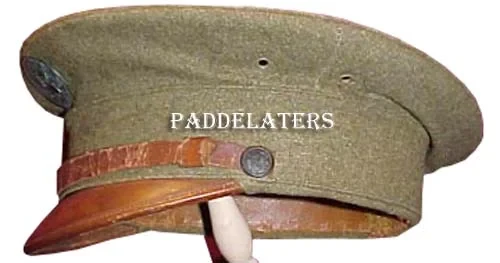
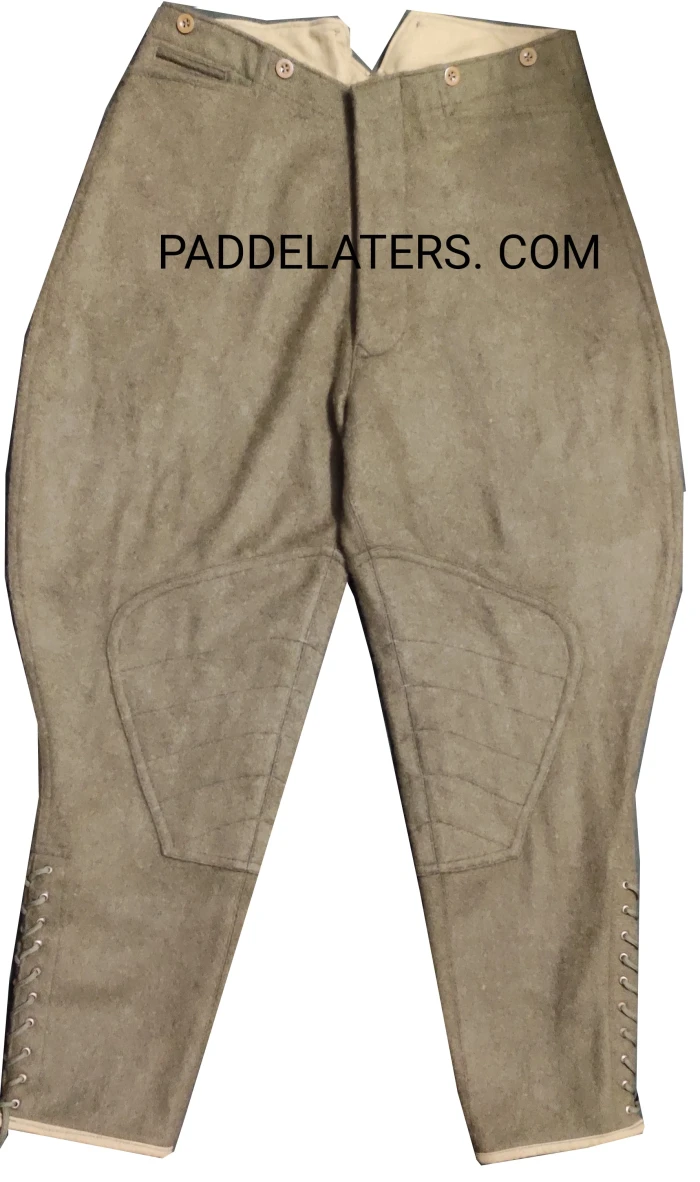
This situation happens often in the reenactment community. Many replicas on the market copy the look of American uniforms but ignore the real specifications used by the US Army. Fabric weight may be incorrect. Colors may fade quickly. Helmet shapes can be slightly wrong. Small details like pocket angles or insignia placement also reveal when a uniform is inaccurate.
For collectors and reenactors, authenticity matters. A proper uniform tells the story of the soldiers who wore it. During both World War I and World War II, the United States Army developed standardized gear through the Army Quartermaster Corps. These items followed strict material rules, production numbers, and field testing.
Understanding those details helps reenactors build better impressions. It also prevents wasted money on poor reproductions.
This guide explains the real features of American WW1 and WW2 uniforms, common reenactor problems, and practical tips for building an accurate kit.
Common Headaches with WW1 and WW2 US Uniforms
Many reenactors discover problems only after they attend their first event.
One of the biggest issues is fake replicas. Some uniforms look correct in photos but fail under close inspection. For example, original WW1 service coats used thick wool cloth. Some replicas use lighter synthetic blends, which change the shape of the uniform.
Another issue is incorrect colors. The US Army used olive drab shades for both wars, but the tone varied by production period. Cheap replicas sometimes use bright green fabric instead of the darker olive drab used historically.
Sizing problems are also common. Original military uniforms were produced using chest measurements and standardized lengths. Modern replicas often simplify sizing, which can make coats fit poorly during reenactments.
Fabric durability creates another headache. Many reenactors spend long days outdoors in heat, rain, or mud. Thin reproduction fabrics can fade or tear quickly. Original wartime uniforms were built for field use, not just appearance.
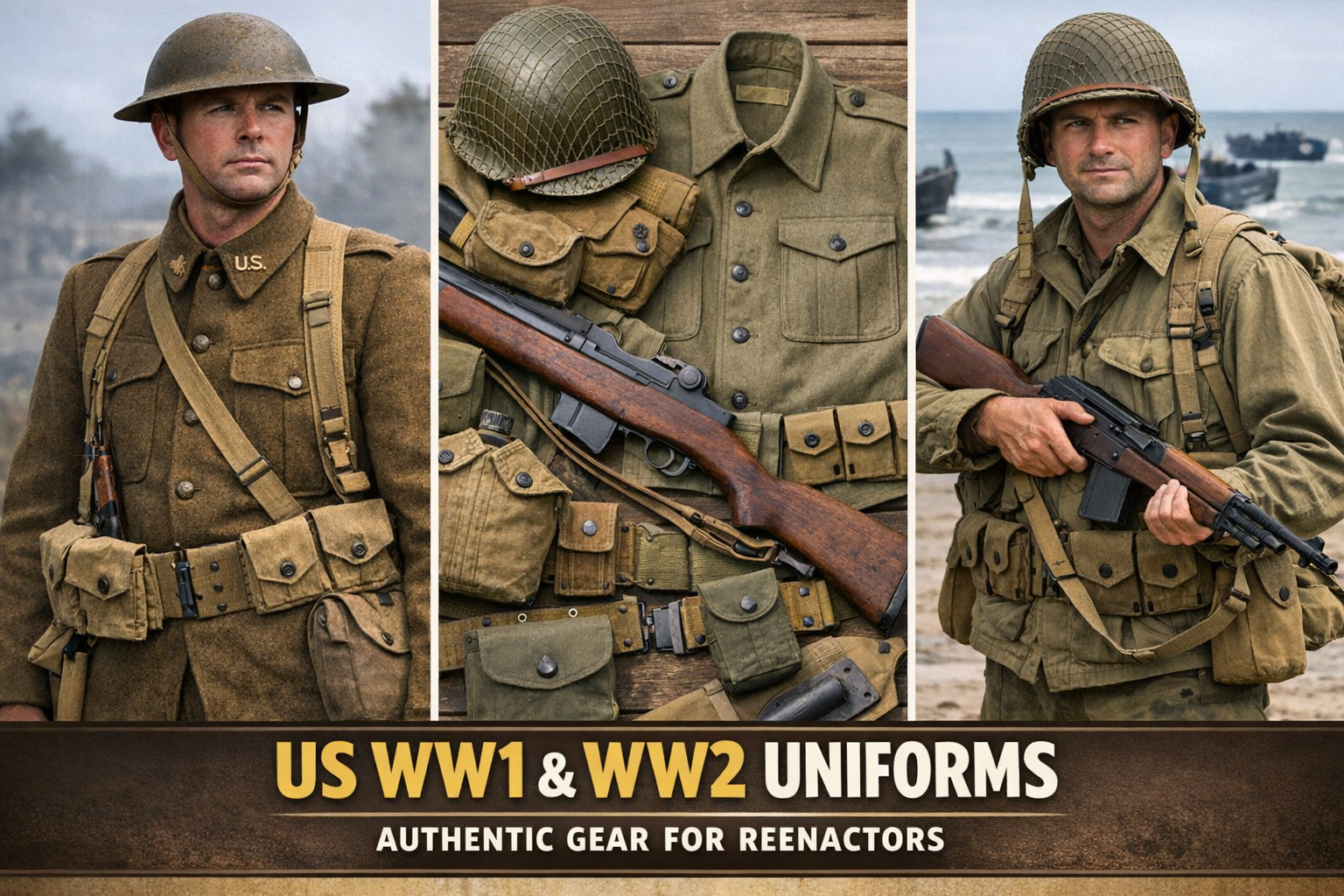
Helmets and gear accessories cause problems as well. The shape of a helmet rim, the texture of canvas webbing, or the style of a buckle can quickly show whether an item is accurate.
These issues frustrate collectors because they reduce historical realism. Reenactments aim to show how soldiers actually looked and lived during the wars. When equipment fails or looks wrong, it breaks that illusion.
Core Features of American WW1 and WW2 Gear
The solution to most reenactment problems is learning the real construction details of American military clothing.
During World War I, the United States Army relied heavily on wool uniforms. Wool provided warmth, durability, and moisture resistance. The standard service coat used olive drab wool fabric and brass buttons.
Many WW1 service coats weighed around 2 to 2.5 pounds, depending on size. The fabric was thick enough to hold its shape and protect soldiers in rough conditions.
Buttons usually displayed the US eagle emblem. Pocket flaps had pointed ends, and the coat typically included four front pockets.
Insignia placement followed strict rules. Rank patches appeared on sleeves, while divisional patches were added later in the war.
World War II introduced more variety in uniforms. Combat conditions required lighter fabrics and specialized clothing.
One important material was herringbone twill cotton, often called HBT. This fabric appeared on fatigue uniforms used for training and field work.
HBT fatigues had several defining features:
-
Cotton herringbone weave pattern
-
Large chest pockets
-
Olive drab shade known as OD7
-
Durable stitching designed for field use
Another major development was the M1943 field uniform system. This uniform included a field jacket, trousers, and layering options for different climates.
The M1943 field jacket featured:
-
Wind-resistant cotton sateen fabric
-
Four front pockets
-
Drawstring waist
-
Button front with storm flap
These features allowed soldiers to adapt their clothing to weather conditions during long campaigns.
Real-World Example: The WW1 US Doughboy Uniform in Action
The typical American soldier of World War I was often called a Doughboy. His uniform reflected the needs of trench warfare in Europe.
The WW1 service uniform included several key pieces:
-
Olive drab wool service coat
-
Wool trousers
-
Puttees (cloth leg wraps)
-
Campaign hat or steel helmet
-
Leather field gear
Historical records from the US Army Quartermaster show that millions of service coats were produced between 1917 and 1918 when the United States expanded its army rapidly.
The uniform used heavy wool cloth weighing around 18 ounces per yard, which helped protect soldiers from cold and damp trench environments.
During reenactments today, participants often replicate the Doughboy uniform with reproduction wool coats and canvas equipment. When done correctly, the result closely matches period photographs from American Expeditionary Forces units in France.
Many WW1 reenactment groups also recreate marching drills and trench displays to show how the uniform functioned in real conditions.
Real-World Example: WW2 M1 Helmet and Uniform at Reenactments
The M1 helmet became one of the most recognized pieces of American military equipment during World War II.
Adopted in 1941, the helmet replaced the earlier M1917 style used in World War I. The new helmet used a two-piece system consisting of a steel shell and a removable liner.
Production numbers were very high. Historical manufacturing records show that over 22 million M1 helmets were produced during World War II.
The helmet’s design allowed soldiers to replace liners easily and attach camouflage covers when needed.
At modern reenactment events, the M1 helmet remains a central part of the American soldier impression.
Reenactors often combine the helmet with other WW2 gear such as:
-
HBT fatigue uniforms
-
M1943 field jackets
-
Web belts and cartridge pouches
-
Canvas backpacks
During D-Day reenactment events, many participants specifically wear M1943 field jackets, since the uniform system became widely used by American troops in Europe during the later part of the war.
These reenactments help demonstrate how the uniform worked in amphibious landings, field combat, and long marches across Europe.
Pros and Cons for Reenactors and Collectors
WW1 and WW2 US uniforms offer many benefits for reenactors, but they also present some challenges.
Pros
One major advantage is historical documentation. American military uniforms are well documented through photographs, Quartermaster records, and museum collections. This makes accurate reproduction easier.
Another benefit is variety of gear. WW2 uniforms especially include many clothing combinations such as HBT fatigues, field jackets, and cold weather gear.
Availability is also good. Reproduction equipment for American soldiers is widely produced by reenactment suppliers.
Cons
However, accurate gear can be expensive. Wool service coats and proper helmets often cost more than standard costume uniforms.
Heat is another issue. WW1 wool uniforms can become uncomfortable during summer reenactments.
Finally, authenticity rules vary between reenactment groups. Some events require exact historical accuracy, while others allow simplified gear.
Frequently Asked Questions on US WW Uniforms
What color were WW1 US uniforms?
Most WW1 American uniforms used olive drab wool fabric designed for field camouflage.
Did WW2 soldiers wear the same uniform throughout the war?
No. Several uniform types existed, including HBT fatigues, service uniforms, and the M1943 field uniform.
How heavy was a WW1 service coat?
Many original coats weighed about 2 to 2.5 pounds depending on size.
Why is the M1 helmet so common in reenactments?
It was produced in very large numbers during WW2 and became the standard helmet for American forces.
Can original uniforms still be used in reenactments?
Most collectors prefer not to use originals in the field because they are valuable and fragile.
Conclusion
Recreating an authentic American soldier impression from World War I or World War II requires more than just buying a uniform that looks correct in photos.
Real US Army uniforms followed strict specifications for fabric, weight, and design. Wool service coats, herringbone twill fatigues, and the M1943 field jacket all served practical purposes for soldiers in combat.
For reenactors, learning these details helps avoid common problems like fake replicas or poorly fitted gear.
When building your kit, look for suppliers that follow original Quartermaster specifications. Study historical photographs and museum examples whenever possible.
A well-researched uniform not only improves reenactment accuracy—it also helps preserve the story of the soldiers who wore these uniforms in real wartime conditions.