Introduction (Hook with PAS Problem)
Hey, if you’re into WW2 reenactments or collecting German military gear, you’ve likely hit this snag: you want equipment that looks right, feels right, and stands up to real use. But too often folks end up with pieces that look “off”, fit strangely, or just don’t match what real soldiers wore. That problem is real — and it can make your display or reenactment feel less believable.
The Real Challenges with WW2 German Uniforms (PAS Agitate with reenactment pain points)
Getting authentic‑looking German uniforms for World War Two is tricky. A lot of replicas online are cheap and miss key details — wrong fabric weight, wrong pocket shape, wrong collar color. When you’re standing beside other reenactors or showing gear at a museum event, small errors stick out fast.
Many reenactors complain that tunics are too shiny, too stiff, or the wrong shade of feldgrau. Feldgrau wasn’t a single color — it varied by year and manufacturer — but most bad reproductions just use one shade because it’s cheap to make. That means your “authentic” outfit ends up looking like generic costume gear, not history.
Then there’s fit. German uniforms were cut for soldiers of the 1930s and 40s; modern sizes don’t always match. That means sleeves too long, collars too big, and jackets that hang weirdly. And if you want accessories — correct insignia, boots, belts — sourcing those cheaply is another challenge entirely.
For collectors, fake or mis‑labeled items are especially frustrating. You can pay for what’s marketed as “original” but find out later it’s a post‑war remake. That ruins value and dampens enthusiasm. It’s painful when your hard‑earned gear doesn’t tell the story you want.
Key Features of Authentic German WW2 Gear (PAS Solution start; cover M36 tunic, feldgrau fabric, insignia)
Let’s fix that. Here are the uniform pieces and real details that help you build a correct WW2 German impression that holds up under scrutiny.
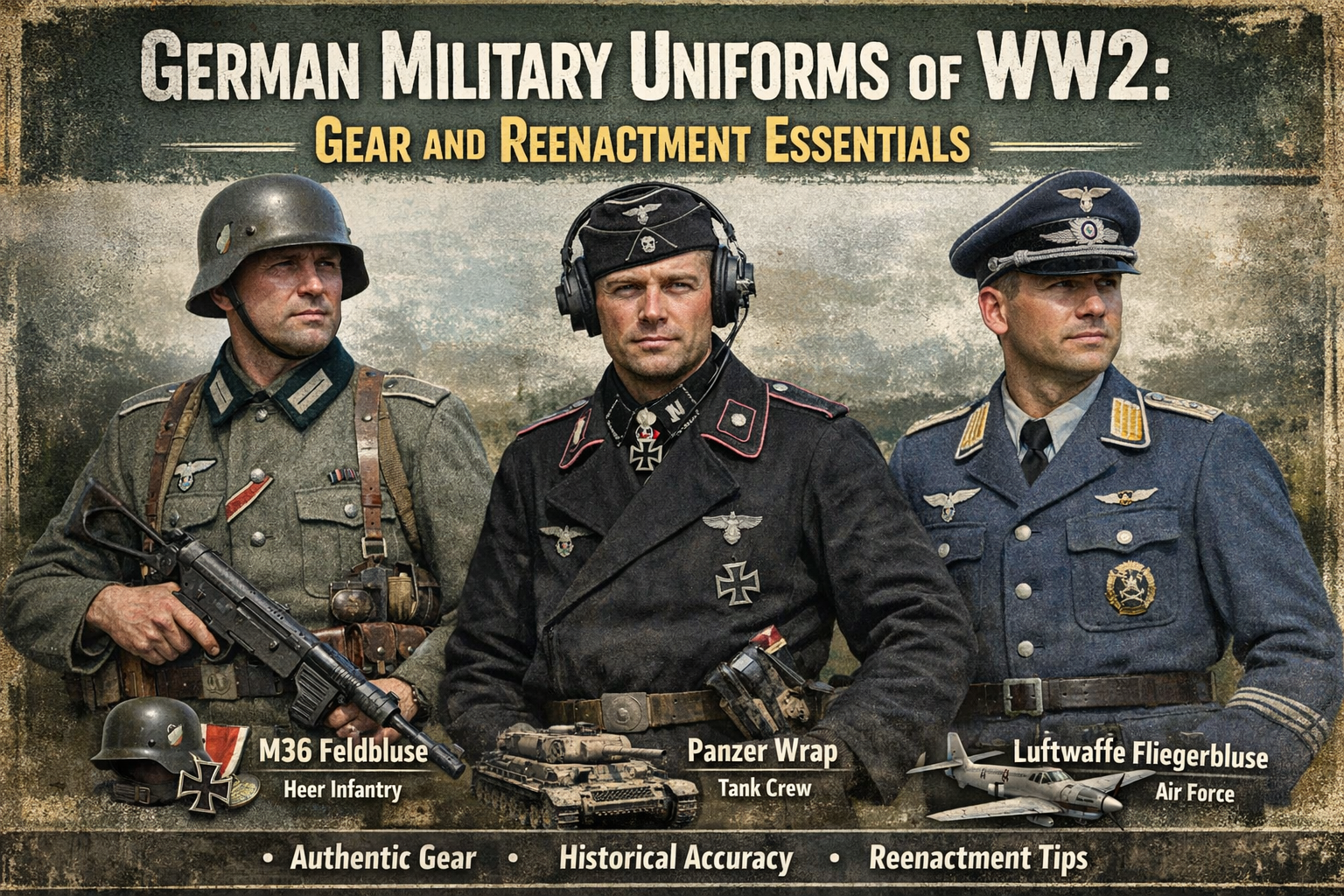
M36 Feldbluse Tunic (Heer Infantry)
A foundation piece for most Wehrmacht impressions is the M36 feldbluse, the standard German Army tunic in the early war years. This jacket was originally made from feldgrau wool — a grey‑green wool cloth — and had four pleated front pockets with scalloped flaps, a dark green collar facing, and five buttons down the front. It also included an internal first‑aid or field dressing pocket, and partial cotton twill lining.
Authentic‑style reproductions often weigh around 1.2 kg and use a 70–30 wool‑poly or wool blend to match period look and feel.
If you’re doing a specific impression, make sure any insignia — like branch collar tabs, shoulder boards, or Wehrmacht eagles — are the correct pattern and applied in the right place for that unit and time period.
Panzer Wrap or Tank Crew Jacket
German panzer crews (tank units) wore shorter, wrap‑style jackets designed not to catch on gear inside armored vehicles. These panzer wraps were typically black or very dark wool and often included branch‑colored piping (pink for panzer troops).
A quality reproduction weighs about 1.0–1.5 kg depending on pattern and wool blend, and matches the mid‑war “wrap” style that shows up in many period photos and displays.
For reenactments, choose a wrap that correctly reflects the branch you want to portray — Heer panzer versus SS panzer wraps differ mainly in cut and insignia placements.
Luftwaffe Fliegerbluse or Service Tunic
If you’re portraying German air force roles, a Luftwaffe fliegerbluse or service tunic works. Early models were made from blue‑grey wool and featured a concealed button front and internal pockets, with a Luftwaffe eagle above the right breast.
Weights vary by model (early heavier wool, late‑war lighter blends), but most reproductions are around 1.2 kg for early patterns.
Real‑World Example: The Wehrmacht Feldbluse in Action
Imagine you’re at a living history event or museum display like the one at Bovington Tank Museum. A proper M36 feldbluse, worn with wool trousers, steel M35 helmet, and correctly placed insignia, draws attention because the fabric drape, pocket shapes, and until‑correct colour tell a real story. Those tunics were worn by real soldiers on the Eastern Front and Western Front, and accurate reproductions bring that forward to the present.
Pros and Cons for Reenactors and Collectors
Here’s a balanced look at what to expect:
Pros
-
Authentic gear like feldgrau tunics and panzer wraps instantly raise the quality of reenactments and displays.
-
Good reproductions use historically informed materials and designs that reflect what original uniforms looked like.
-
Real fabric details (wool blend, pocket cut, scalloped flaps) make photography and interpretation more accurate.
Cons
-
Reproductions vary widely in quality; some cheap ones miss details or use wrong fabric weights.
-
Collectors chasing originals must watch out for fakes or mis‑labeled pieces.
-
Sourcing correct insignia and accessories adds cost and research time.
Top FAQs on WW2 German Military Uniforms
Q: What color is feldgrau?
A: Feldgrau is a field grey with a greenish tint. It varied by production batch and era but was standard for Heer and many SS tunics. Cheap replicas often get the shade wrong.
Q: Can I mix uniform parts (e.g., Luftwaffe tunic with Heer boots)?
A: You can, but purists prefer unit‑consistent gear. Luftwaffe blue‑grey versus Heer feldgrau is a clear difference.
Q: Are original uniforms worth it?
A: Originals can be historically rich but are expensive and often fragile. Reproductions are better for active reenactment.
Q: Where can I show these uniforms?
A: Museums and reenactment events like those at Bovington or regional WW2 history gatherings welcome accurate gear (with proper education and context).
Conclusion (Wrap with call‑to‑action for gear sourcing)
Getting German WW2 uniforms right takes patience. Start with a good base — a feldgrau M36 feldbluse, an appropriate panzer wrap for tank crew impressions, or a Luftwaffe fliegerbluse for air force roles — and match the correct insignia and accessories. Research real specs, talk with experienced reenactors, and avoid the cheap gear that leads to disappointment. When you’ve got that right, your impression becomes historically convincing. If you need help sourcing specific pieces like correct shoulder boards or period‑accurate boots, historical replica dealers and reenactor forums are good next places to look.