Introduction: The Collector’s Problem
If you collect WW1 gear, you’ve probably run into the same headache.
You spot a “1916 British tunic” online. The color looks right. The buttons seem old. But the fabric feels off. Maybe it’s too smooth. Maybe the stitching is modern. Suddenly you’re wondering if it’s real—or a reproduction.
This happens a lot with WW1 British uniforms. Over 5 million British soldiers served during the war, and the army produced uniforms on a massive scale. Many pieces survived the war but later saw heavy wear, repairs, or civilian reuse. That makes authentic examples harder to identify today.
Then there’s preservation. Wool uniforms from the trenches faced mud, rain, lice, and rough washing. A tunic that survived the Somme or Passchendaele often shows damage after a century.
Collectors deal with three big problems:
-
Fakes and reproductions
-
Material deterioration
-
Incorrect restoration
But once you understand what WW1 British uniforms were actually made of, spotting authentic pieces becomes much easier.
Let’s break down the materials and design.
Uniform Materials Breakdown
Picture a British infantryman—often called a “Tommy.” He’s standing in a muddy trench in France in 1916. His uniform isn’t fancy. It’s built for work.
The key item was the Service Dress uniform, introduced in 1902 and widely used throughout WW1.
Wool Serge – The Core Fabric
The main fabric was khaki wool serge.
Wool serge is a twill weave fabric, meaning the threads run diagonally across the cloth. That diagonal pattern made the fabric tougher than plain weave materials.
Typical characteristics:
-
Material: 100% wool
-
Weave: Twill (serge weave)
-
Weight: roughly 16–18 ounces per yard
-
Color: khaki brown-green
Why wool?
Because it works even when wet.
Wool fibers trap air, which helps keep warmth even in damp conditions. That mattered in trench warfare where soldiers spent weeks in rain and mud.
By 1914, the British Army had standardized the service dress tunic with:
-
Four front pockets
-
Brass general service buttons
-
Stand-and-fall collar
-
Shoulder straps for rank insignia
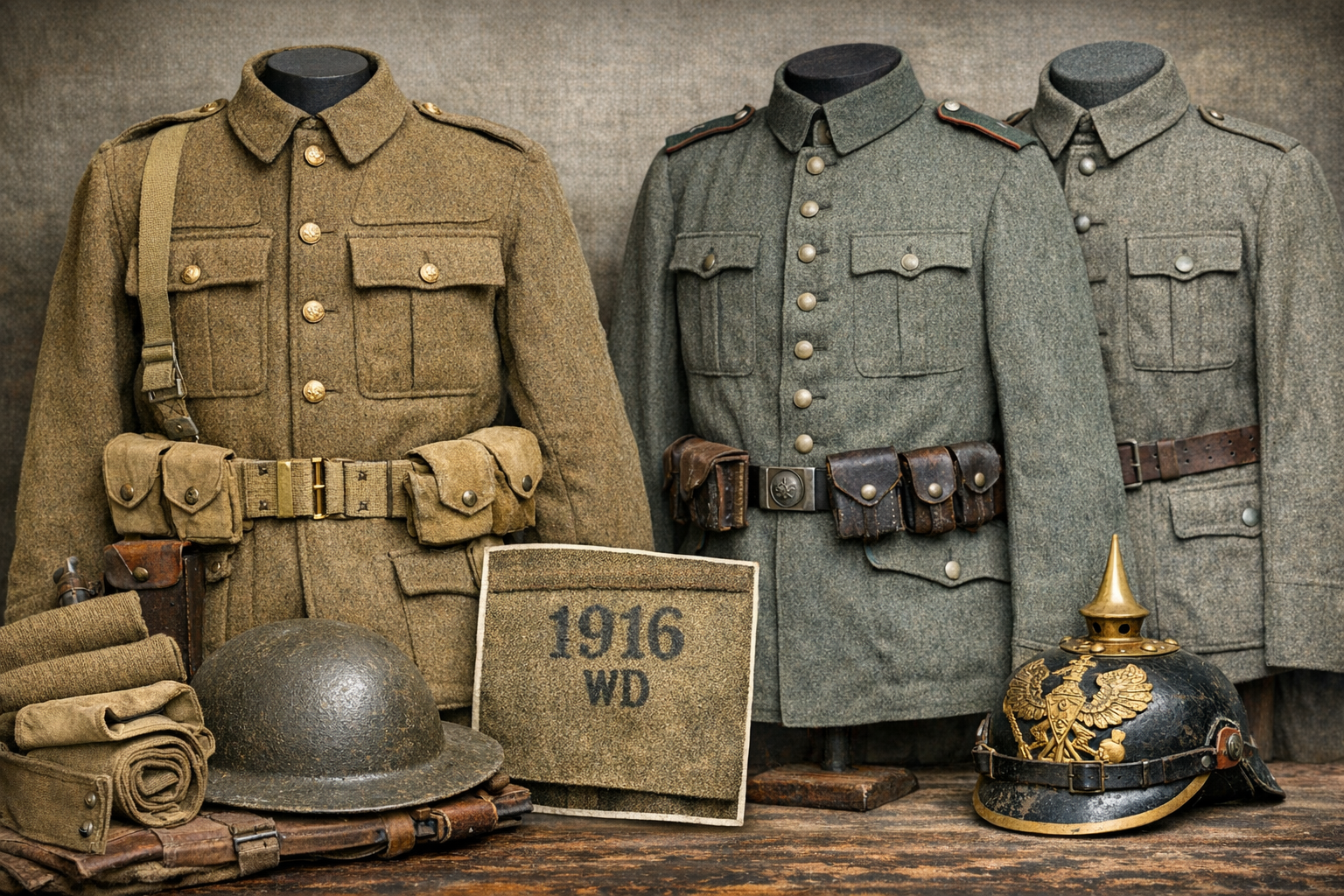
During the war, millions of these uniforms were produced by British textile mills.
In 1915 alone, uniform contracts ran into millions of garments as the army expanded rapidly.
Khaki Drill Cotton – The Hot Weather Version
Wool worked in Europe, but it wasn’t ideal in warmer climates.
That’s where khaki drill cotton came in.
Khaki drill was used for:
-
Tropical uniforms
-
Summer training wear
-
Colonial service
Material specs:
-
Fabric: heavy cotton drill
-
Weave: diagonal drill weave
-
Weight: lighter than wool serge
-
Color: pale khaki
Cotton drill uniforms were common in places like:
-
Egypt
-
India
-
the Middle East
Compared to wool, cotton was:
-
cooler
-
cheaper
-
easier to wash
But it had one drawback.
It didn’t insulate well in cold conditions.
Other Uniform Materials
The British uniform wasn’t just fabric. Several materials completed the outfit.
Leather equipment
The famous 1908 Pattern Web Equipment replaced earlier leather gear. It used woven cotton webbing instead of leather straps.
Advantages:
-
lighter weight
-
easier mass production
-
resistant to rain damage
Brass and steel hardware
Uniform buttons were usually brass, stamped with the General Service button design.
Later in the war, shortages pushed the army to use simpler finishes.
Puttees
Soldiers wrapped their lower legs with wool puttees—long strips of cloth.
Puttees helped:
-
support the ankle
-
keep mud out of boots
-
protect trousers
Pros and Cons of WW1 British Uniform Materials
Every military uniform balances durability, cost, and comfort.
British uniforms were practical—but not perfect.
Pros
Durability
Wool serge held up well to rough trench conditions.
Many surviving uniforms today still show intact fabric after more than 100 years.
Natural insulation
Wool kept soldiers warm even when damp.
That mattered in wet environments like the Western Front.
Camouflage advantage
Before WW1, bright uniforms were common.
The British khaki color provided better camouflage compared with earlier red coats.
Cons
Heavy when soaked
Wool absorbs water.
In trench conditions, a wet tunic could become noticeably heavier.
Slow drying
Unlike modern synthetic fabrics, wool took time to dry.
Moth damage
For collectors today, wool uniforms often suffer from moth holes.
That’s one of the biggest preservation problems.
Case Study: Restoring a 1916 British Tunic
Let’s look at a real collector example.
A military history collector named Mark found a 1916-dated British service dress tunic at a regional antique fair.
The price was reasonable, but the condition raised questions.
Problems included:
-
two moth holes in the sleeve
-
faded shoulder straps
-
replaced buttons
The first step was identifying the fabric.
Under magnification, the cloth showed the distinct diagonal twill pattern of wool serge. The color also matched known WW1 khaki shades.
Inside the tunic, the maker’s stamp read:
“1916 – War Department”
That confirmed wartime production.
Mark then restored the tunic using three careful steps:
-
Cleaning
The tunic was dry-cleaned using a conservation method to avoid shrinking the wool. -
Button replacement
Period-correct General Service brass buttons were sourced from surplus dealers. -
Fabric stabilization
A conservation textile patch was applied behind the moth holes.
The goal wasn’t to make the tunic look new.
It was to preserve the original material.
That’s the key principle collectors follow today.
German Uniform Comparisons
Looking at German uniforms helps put the British design in perspective.
German 1914 Feldgrau Tunic
Germany introduced the feldgrau uniform before WW1.
Material:
-
Wool broadcloth
-
gray-green color
Compared with British khaki:
-
German cloth was slightly heavier
-
the tunic design was more fitted
However, feldgrau wool also absorbed water in trench conditions.
German M1915 Simplified Uniform
By 1915, Germany simplified its uniforms to speed production.
Changes included:
-
fewer decorative elements
-
simplified pocket design
-
cheaper fabric blends
This was similar to British wartime adjustments when production pressure increased.
German Pickelhaube vs British Helmets
Early in the war, German soldiers wore the Pickelhaube leather helmet.
British troops wore the cloth cap until the Brodie steel helmet appeared in 1916.
The Brodie helmet provided better protection from shrapnel—one of the most common battlefield threats.
FAQs About WW1 British Uniform Materials
What fabric lasted best in WW1 uniforms?
Wool serge lasted the longest. Its twill weave made it resistant to tearing and wear.
Why were British uniforms khaki?
Khaki provided better camouflage than bright uniforms. The color had already been used in colonial campaigns before WW1.
Were WW1 uniforms mass produced?
Yes. Britain produced millions of service dress uniforms during the war to equip a rapidly expanding army.
Did soldiers wash their uniforms often?
Not frequently in trench conditions. Mud and wear were common.
How can collectors identify authentic wool serge?
Look for:
-
diagonal twill pattern
-
coarse wool texture
-
period stitching
Are original WW1 uniforms rare?
They exist but are becoming harder to find in good condition due to fabric damage.
What damages old uniforms the most?
The main threats are:
-
moths
-
humidity
-
poor storage
Conclusion: The Solution for Collectors
Once you understand the materials, collecting WW1 uniforms becomes a lot easier.
British soldiers relied mainly on khaki wool serge and khaki drill cotton. These fabrics were chosen because they balanced durability, camouflage, and mass production needs during a massive global war.
For collectors today, the trick is learning to read the details:
-
wool twill patterns
-
wartime stamps
-
correct buttons and stitching
When you find a real piece—like that 1916 tunic Mark restored—you’re not just holding fabric.
You’re holding something that once stood in a trench, crossed a battlefield, and survived more than a century.
And if you store it properly—cool, dry, and moth-protected—it might survive another hundred years.
That’s the real goal of collecting military history.